Imagem gerada pelo nosso modelo.
bike fit
Cycling Shoe Fit: Choose Faster, Safer Shoes With Data
A practical guide to cycling shoe fit, stiffness, cleat position, and testing changes with power, cadence, RPE, and symptoms.
Why Shoe Fit Matters More Than Claimed Stiffness
Cycling shoe fit is one of the easiest places for serious riders to confuse performance marketing with actual performance.
The best road cycling shoes are not simply the stiffest shoes on a product page. They are the shoes that let you apply force repeatedly, hold a stable foot position, avoid nerve irritation, and maintain good mechanics when fatigue starts changing how you pedal.
A shoe that is too narrow, too high in volume, poorly shaped through the heel, or incompatible with your cleat stance can look perfect on paper and still limit the quality of your riding. Not because the sole is obviously wasting energy, but because your body may start protecting itself from pressure, numbness, or instability.
That protection shows up in subtle ways. You stop driving through the pedal smoothly. You wiggle your toes every few minutes. You unclip at lights and shake out the foot. You avoid riding in the drops because the extra hip closure changes pressure under the forefoot. You move your cleat to solve a shoe shape problem, then create a knee tracking problem somewhere else.
The core idea is simple: a cycling shoe is not just a platform. It is an interface between your body and the bike. If that interface creates pain or instability, any theoretical gain from cycling shoe stiffness gets diluted by compensation, higher perceived effort, and less repeatable mechanics.
That is why shoe choice should be treated like a fit decision, not just an equipment upgrade.
Key Fit Signals: Pressure, Numbness, Hot Spots and Stability
Good cycling shoe fit gives you a secure foot without forcing the forefoot to act like it is in a clamp.
The most important signals are not how the shoe feels while standing in a shop. They are how it behaves under repeated load, heat, swelling, and fatigue.
Pressure
Pressure is not automatically bad. You need enough hold to stop the foot sliding forward or twisting under torque. The problem is concentrated pressure.
Watch for pressure across the outside of the forefoot, over the top of the midfoot, around the heel collar, or under the ball of the foot. A small pressure point early in a ride often becomes the main limiter later because soft tissue tolerates compression poorly when combined with heat and repeated loading.
If loosening the shoe slightly improves comfort without creating movement, the shoe may simply need a better closure pattern. If loosening the shoe creates heel lift or forefoot drift, the last shape is likely wrong.
Numbness
Numbness is a stronger warning sign than ordinary discomfort. It usually means the shoe, insole, sock, cleat position, or a combination of those factors is compressing nerves or reducing normal tissue tolerance.
Common triggers include a toe box that narrows too aggressively, straps or dials overtightened across the forefoot, too much pressure under the metatarsal area, or cleats positioned in a way that loads the front of the foot more than the rider can tolerate.
Numbness that appears only during harder efforts still matters. Higher torque can expose fit problems that endurance pace hides.
Hot spots and hot foot
Hot foot is usually not a mystery. It is a pressure management problem.
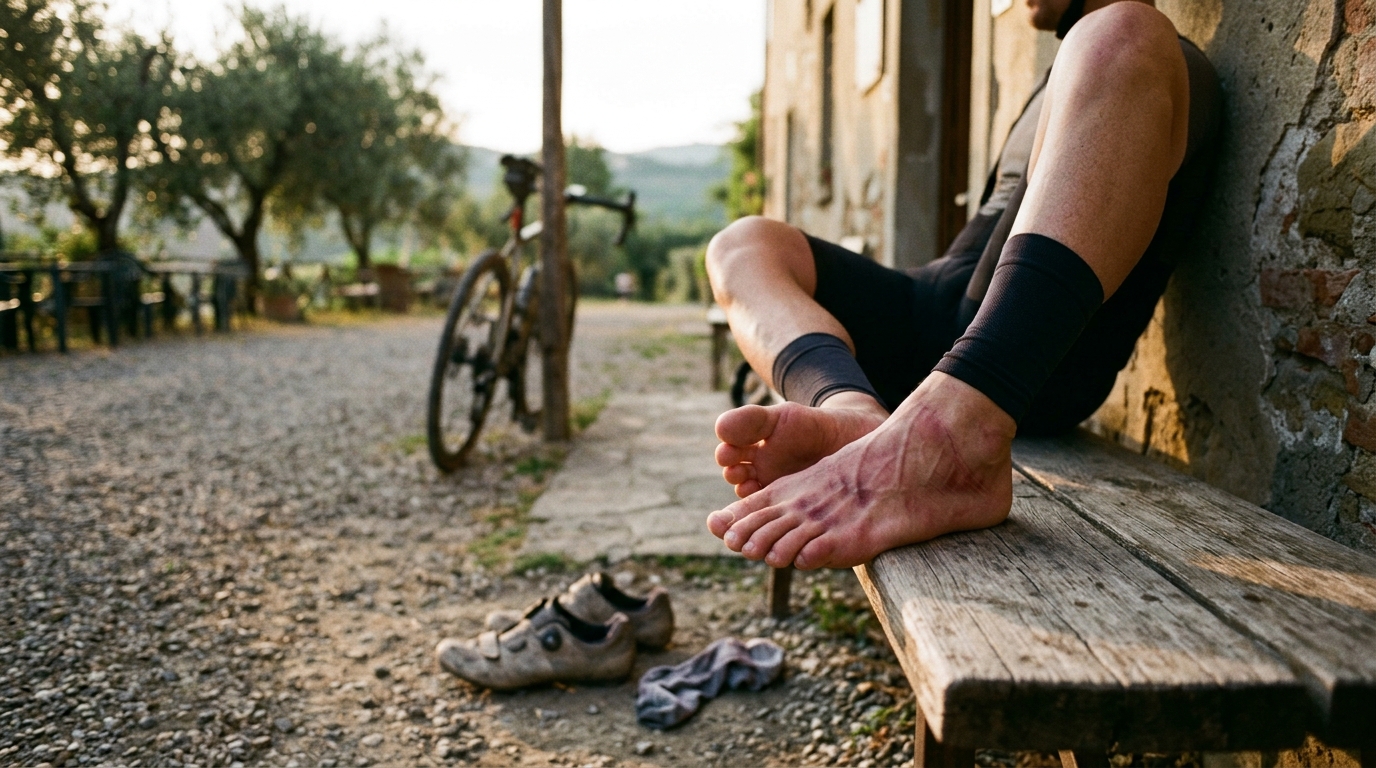
A hot spot under the forefoot can come from a shoe that is too narrow, an insole that does not distribute load, a cleat placed too far forward for the rider, or simply over-tightening as the foot swells. The sensation feels local, but the cause is often systemic. The foot is being asked to stabilize, apply force, and tolerate pressure through too small an area.
The wrong response is to keep tightening the shoe because the foot feels unstable. That can make the pressure worse. The better response is to find out why the foot is moving in the first place.
Stability
A good shoe should let you pedal hard without gripping with your toes. Toe gripping is a sign the foot does not trust the platform.
Look for heel lift, side-to-side movement in the forefoot, a feeling of rolling off the outside edge, or repeated micro-adjustments while riding. These are fit data points, not quirks. A stable foot is quieter. It allows a more repeatable pedal stroke and makes cleat changes easier to evaluate.
Stiff Soles, Sustainable Power and What the Data Actually Shows
Cycling shoe stiffness matters, but it is often oversold as a direct path to speed.
A stiffer sole can improve how force is spread across the shoe and can reduce the sensation of flex under load. This is especially relevant during hard accelerations, climbing out of the saddle, and high-torque efforts. But once a sole is sufficiently stiff for a rider, more stiffness does not automatically mean more speed.
The reason is mechanical and physiological.
Power on the bike is measured at the crank, pedal, or hub depending on your setup. If a shoe meaningfully changes how you produce force, that should eventually show up in repeatable power, cadence, perceived exertion, or fatigue patterns. In practice, what riders often notice first is not a clean power gain from a stiffer sole. It is a change in comfort, stability, and how confidently they can produce force.
That does not make stiffness irrelevant. It means cycling shoe stiffness should be evaluated through the lens of fit.
A very stiff shoe with a poor shape can increase local pressure because the sole does not deform around the foot. A slightly less aggressive shoe that matches your anatomy may let you ride harder for longer because your foot remains calm. That is not a downgrade. That is better system performance.
The right question is not, 'Is this the stiffest shoe available?' The right question is, 'Can I produce my target power and cadence without foot symptoms or compensation?'
If the answer is yes, the shoe is doing its job.
For riders using structured training, this matters because comfort can affect workout quality around FTP, threshold work, and repeated hard efforts. A shoe that feels sharp during a short test but causes hot foot during sustained work is not automatically the right race choice. It is a fit problem waiting to show up when the effort gets long enough.
Cleat Position Basics: Fore-Aft, Rotation and Stance Width
Cleat position decisions should start conservatively. The cleat is not a power switch. It affects foot pressure, ankle behavior, knee tracking, hip comfort, and how stable you feel under load.
Fore-aft
Moving the cleat changes where the pedal axle sits relative to the foot.
A more forward cleat position can increase the sense of leverage through the forefoot, but it can also increase pressure near the ball of the foot and demand more from the calf and small stabilizing structures. A more rearward cleat position often reduces forefoot pressure and can calm hot spots, but it may change how the rider perceives acceleration and ankle movement.
There is no universal fastest position. The right position is the one that supports your target riding. A criterium rider who values repeated accelerations may prefer a different feel than an endurance rider trying to reduce foot symptoms deep into long training rides.
Rotation
Rotation should respect the natural angle of the foot rather than forcing the knee into a visually neat path. If the cleat rotation fights your anatomy, the system will compensate somewhere. That might be at the knee, hip, ankle, or through uneven pressure under the foot.
The practical check is simple: clip in, ride at steady endurance intensity, then ride under moderate load. The knee should track without feeling guided or twisted. The foot should not feel like it is searching for more float at the edge of the pedal system.
If you keep hitting the limit of available float, the cleat rotation is probably wrong.
Stance width
Stance width is the side-to-side relationship between the foot and the bike. It can be changed through cleat placement within the shoe, pedal washers where appropriate, axle options, or different pedal systems.
A stance that is too narrow for the rider can push the knees inward or create pressure along the outside of the foot. A stance that is too wide can make the pedal stroke feel disconnected and may change hip mechanics. Shoe shape also matters here. A wide foot crammed into a narrow shoe may mimic a stance problem because the foot cannot sit naturally over the pedal.
Do not use stance width to hide a shoe fit problem unless there is a clear reason. Fix the interface first, then fine-tune the coordinates.
How to Test Shoes and Cleat Changes Without Fooling Yourself
Cyclists are very good at feeling differences and not always good at identifying which differences matter.
New shoes usually feel better because they are new. A different cleat position can feel faster because it changes muscle recruitment or pressure. A stiffer sole can feel more responsive because it gives clearer feedback. None of that proves performance improved.
A useful test needs control.
Change one thing at a time
Do not change shoes, insoles, cleats, saddle height, and pedal system together unless you are solving a severe fit issue with professional help. If symptoms improve, you will not know why. If symptoms worsen, you will not know what to reverse.
For a clean test, keep the bike setup, route type, tire pressure habits, and training context as stable as possible. If you change shoes, start with cleats placed to approximate the old setup before experimenting.
Use familiar workouts
The best testing environment is a session you know well. Endurance rides reveal comfort issues. Tempo and sweet spot work reveal sustained pressure tolerance. Hard starts or short climbs reveal stability and confidence under torque.
Do not judge a shoe only from an easy spin. Also do not judge it only from a maximal effort when everything hurts anyway. You need enough load to expose the interface without burying the signal under fatigue.
Give the body time, but do not ignore warnings
Some adaptation is normal when changing shoes or cleat coordinates. Different contact points can make familiar sensations feel unfamiliar.
But numbness, sharp pain, knee irritation, or worsening hot foot should not be treated as proof that you are adapting. They are data. If a change creates symptoms quickly and repeatably, reverse it or adjust it before turning a small problem into a training interruption.
Use Neverchill's FTP estimator for training-zone context if you need it, not as a way to prove a shoe is faster from a single ride. Shoe testing is about repeatability and symptom control as much as raw power.
Know when to get help
Normal fit discomfort is usually mild, symmetrical, and responsive to simple changes like closure tension, sock thickness, insole choice, or a conservative cleat adjustment.
Persistent numbness, sharp pain, symptoms that affect only one side, pain that changes your gait off the bike, or knee and hip irritation that returns ride after ride deserve more caution. In those cases, a professional bike fitter, podiatrist, or qualified medical professional can help separate a simple equipment issue from a biomechanical or medical problem.
Metrics to Track: Power, Cadence, RPE and Post-Ride Symptoms
A data-driven shoe test does not require a lab. It requires consistent notes and a willingness to separate sensation from outcome.
Track these signals after each relevant ride:
- Power: Did you produce normal power for the workout without unusual strain?
- Cadence: Did your preferred cadence change without a deliberate reason?
- RPE: Did the same type of effort feel easier, harder, or simply different?
- Foot symptoms: Any numbness, burning, tingling, pressure, or toe gripping?
- Knee and hip symptoms: Any new tracking discomfort or joint irritation?
- Stability: Did the foot feel planted during hard seated and standing efforts?
- Closure changes: Did you need to loosen or tighten the shoe repeatedly?
The most useful pattern is not a single great ride. It is a repeated absence of problems while training quality stays normal or improves.
If power is normal, RPE is normal, cadence is normal, and symptoms decrease, that is a strong positive signal. If power looks fine but RPE rises and foot symptoms appear, the shoe is not passing the test. If the shoe feels calm at endurance pace but creates burning under harder torque, it may be a fit mismatch for racing even if it is fine for easy miles.
Post-ride symptoms matter because some pressure problems fade the moment you unclip. Write them down before they disappear from memory. Where was the pressure? Which foot? Which part of the ride? Did it appear after tightening the shoe? Did standing make it better or worse?
Those notes make the next adjustment logical instead of random.
A Practical Shoe-Buying Checklist for Serious Cyclists
The best road cycling shoes for you are the ones that fit your foot, your cleat needs, and your riding demands. Use the checklist below before paying for stiffness, weight, or brand reputation.
Before trying shoes
- Know your current symptoms: hot foot, numbness, heel lift, pressure, instability, or knee discomfort.
- Bring the socks and insoles you actually ride with.
- Check whether your current cleat position is solving a real need or compensating for poor shoe fit.
- Decide what the shoe must improve, not just what you want it to feel like.
During the fit check
- The heel should feel secure without needing excessive closure tension.
- The forefoot should have room to load and expand without sliding inside the shoe.
- The upper should hold the midfoot evenly, not create a narrow pressure band.
- The toe box should not force the toes into gripping or curling.
- The arch support should feel supportive, not intrusive.
- The cleat mounting range should allow your preferred fore-aft and stance position.
On the bike
- Pedal at endurance intensity and check for quiet feet.
- Add moderate torque and watch for twisting, toe gripping, or forefoot pressure.
- Stand briefly and check whether the heel stays planted.
- Ride in the position you actually use during harder efforts, not just upright on the tops.
- Avoid over-tightening to create a false sense of stability.
After the ride
- Note symptoms immediately.
- Compare the ride with familiar sessions, not ideal expectations.
- Adjust only one variable before the next test.
- Keep the shoe only if comfort, stability, and training quality all make sense together.
The faster shoe is usually not the one with the biggest stiffness claim. It is the one that lets you apply force without distraction, maintain cadence without compensation, and finish rides without a list of foot symptoms.
That is the real standard for cycling shoe fit. The shoe should disappear under you. When it does, the data becomes cleaner, the pedal stroke becomes more repeatable, and the equipment stops getting in the way of the work.