Image generated by our model.
performance
Cycling Performance Prediction: Forecast Race Demands
A practical guide to using power, fatigue, route demands and validation to forecast cycling performance without fooling yourself.
What Cycling Performance Prediction Can and Can't Tell You
Cycling performance prediction is useful because it forces a simple question before the ride starts: what will the effort actually require?
That sounds obvious, but most bad race plans come from vague thinking. A rider says the climb is manageable, the time trial suits them, or the group ride should be fine. Then the road exposes the gap between belief and demand.
A good prediction does not tell you exactly what will happen. It cannot know when a rival attacks, where the crosswind bites, whether the surface is slow, or how well you will handle pressure late in the race. What it can do is narrow the range of likely outcomes. It can show whether the required power is realistic, whether the pacing plan matches the terrain, and whether your current freshness supports the target.
The goal is not certainty. The goal is fewer self-inflicted errors.
For data-driven endurance athletes, the best cycling performance model is not the most complicated one. It is the one that connects your actual physiology to the actual course, then gets tested against completed rides. That feedback loop matters more than any elegant spreadsheet.
The Inputs That Matter: Power, Weight, Fatigue, Route and Weather
Most useful prediction work starts with a small set of inputs.
Power
Power is the anchor because it measures the work you are producing, not the speed you happen to get from it. Speed is shaped by wind, drafting, surface, gradient, position and equipment. Power is still imperfect, but it is the cleanest practical signal available.
The key is using the right power value for the demand. A steady climb asks a different question than a rolling road race. A technical time trial asks a different question than a smooth one. If your model uses a single number for every scenario, it is probably overconfident.
Start with your current sustainable power, not the best file you have ever uploaded. If you need a baseline, use an FTP estimate as a starting point, then cross-check it with recent efforts. Treat the number as a working assumption rather than a permanent identity.
Weight
Weight matters most when gravity is a major part of the demand. On flatter terrain, aerodynamic drag and tactical position often dominate. On climbs, body mass and equipment mass become harder to hide.
The mistake is treating weight as a moral score rather than a performance input. If the route is climb-heavy, power-to-weight deserves attention. If the route is fast and exposed, position, pacing and the ability to stay sheltered may matter more.
A prediction should reflect the course, not a generic obsession with lighter always being better.
Fatigue
Fatigue changes the meaning of the same power number. A target that is realistic when fresh can become fantasy after a hard training block, poor sleep, travel, heat stress or repeated surges.
This is where cycling power data analysis has to look beyond best efforts. The relevant question is not only what you can do in isolation. It is what you can do under the conditions the event will create.
Recent training load, subjective freshness, muscle soreness and the quality of recent hard sessions all matter. None are perfect. Together, they give you a better read than a single heroic effort from a very different phase of training.
Route
The course determines how power must be delivered. A smooth climb rewards steady output. A punchy route rewards repeatability. A technical descent can reduce the benefit of climbing strength if it repeatedly breaks rhythm. A flat road race may reward positioning more than raw threshold power.
Before trying to predict cycling race performance, divide the route into demand types:
- Sustained climbs where pacing discipline matters
- Short climbs or ramps where repeatable high power matters
- Flat or rolling sections where drafting and positioning matter
- Technical areas where acceleration cost and handling matter
- Exposed sections where wind direction may reshape the race
This turns the prediction from a generic average into a tactical map.
Weather
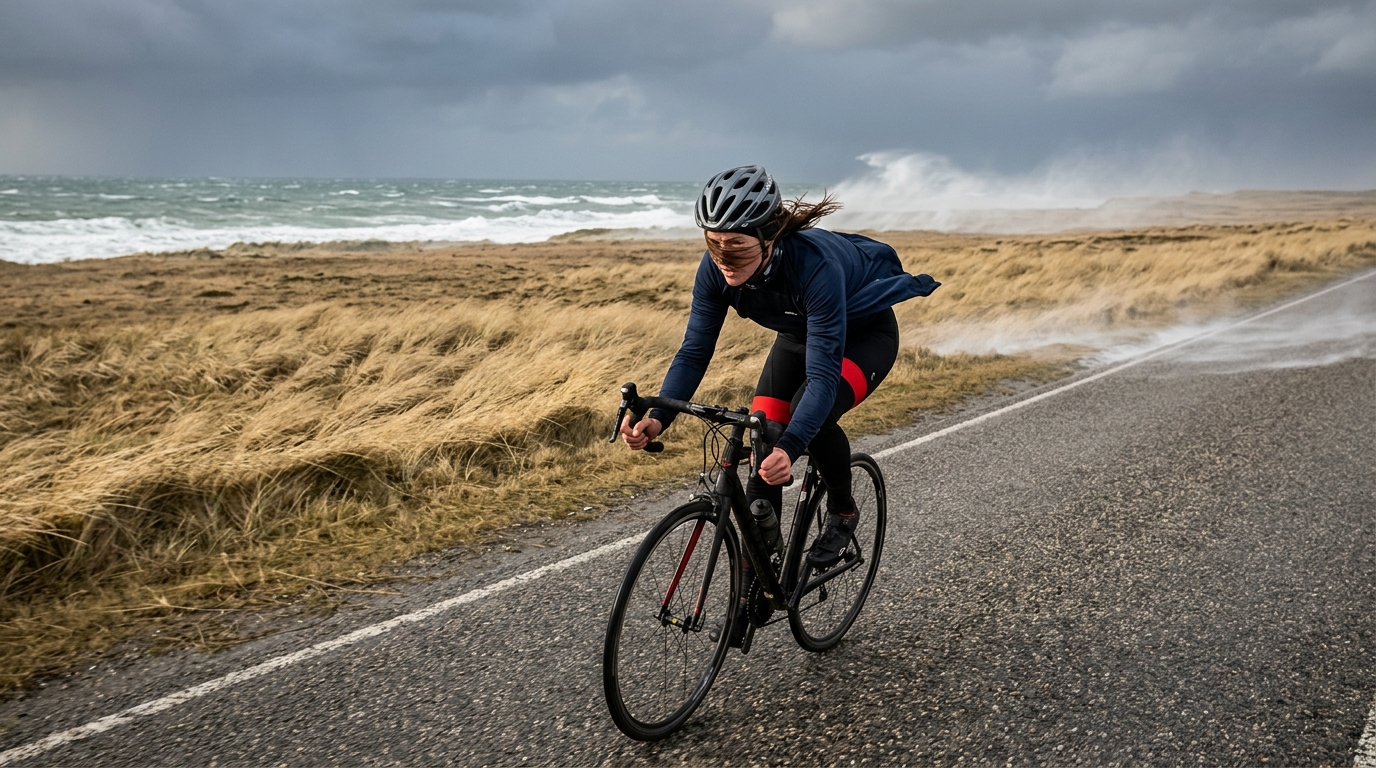
Weather can make a clean model messy very quickly. Wind changes speed more than most riders expect. Heat changes the cost of a given power. Rain can alter cornering, braking and group behavior.
The practical point is not to forecast every detail perfectly. It is to avoid pretending the route exists in a vacuum. If conditions are likely to make the effort more stochastic or more costly, build that into the plan.
What Counts as Recent and Relevant Evidence
The phrase 'use recent form' is only useful if it points to better decisions.
Recent does not mean the last ride by default. It means evidence close enough to your current fitness, fatigue and conditions that it still describes the rider who will start the event. A clean effort from the same training phase is usually more useful than an old peak from a different season, a different body weight, or a different life stress load.
Relevant means the effort matches the demand you are trying to predict. Prioritize files that resemble the event in the ways that change performance:
- Duration of the key effort
- Riding position, especially for time trials
- Terrain type and rhythm
- Heat, wind and surface conditions
- Fatigue state before the effort
- Whether the effort was steady, stochastic, or repeated after earlier work
If the event depends on sustained climbing, a recent steady climb tells you more than a fresh sprint. If the event depends on surviving repeated accelerations, look at how power holds up after prior surges. If the event finishes after accumulated fatigue, late-ride data should carry more weight than fresh efforts at the start of a session.
A prediction based on recent, relevant evidence will usually beat a prediction based on old peak performance because it asks the right question: what can you express now, under the conditions the race is likely to impose?
A Simple Prediction Workflow
Use this before a race, hard training ride, climb target, or time trial. Keep it simple enough that you will actually repeat it.
- Define the event demand. Decide what will likely decide the ride: sustained power, repeatable surges, aerodynamic efficiency, positioning, technical handling, or fatigue resistance.
- Choose the current power assumption. Use recent, relevant efforts rather than lifetime bests. If the evidence is mixed, choose a conservative working range instead of a heroic target.
- Segment the route. Break the course into climbs, exposed roads, technical areas, recovery sections, selection points and places where speed may be misleading.
- Adjust for fatigue and weather. Lower confidence if you are carrying training load, poor sleep, travel stress, heat exposure, or conditions that will make the ride more variable.
- Set pacing ranges. Give each key segment a controlled range, plus a clear rule for when to spend more. This prevents the common mistake of riding every section as if it matters equally.
- Validate after the ride. Compare assumptions with outcomes, identify why the model missed, and update the next forecast.
This workflow matters because it separates the forecast from the wish. You are not asking what you want to hold. You are asking what the event requires, what your current evidence supports, and where the course will try to pull you away from the plan.
A Worked Example: Forecasting a Road Race Selection Point
Imagine a rider targeting a rolling road race where the decisive selection is likely to come on a repeated climb rather than at the finish line.
The weak prediction is: 'I can climb well, so I should be fine.' That is not a plan. It ignores positioning, fatigue before the climb, and the cost of repeated accelerations.
A better prediction starts with the demand. The rider marks the repeated climb as the key segment because the terrain narrows, the bunch stretches, and riders who enter too far back have to surge before the climb even begins. That positioning cost changes the physiology. The selection is not just the climb. It is the effort to arrive near the front, the climb itself, and the acceleration over the top if the group splits.
Next, the rider chooses a current power assumption from recent efforts that look similar: climbing under fatigue, not a fresh solo effort on perfect legs. If recent training shows that sustained power is stable but repeated surges cause a fade, the plan should not rely on closing gaps from the back.
Then the rider segments the decisive portion:
- Before the climb: spend energy on position, not unnecessary moves
- Lower slopes: stay controlled if the group hesitates or surges unevenly
- Hardest part: allow commitment only if the front group is forming
- Over the top: expect another acceleration rather than a clean recovery
- After the split: assess whether contributing protects position or wastes limited matches
Weather and fatigue adjust the confidence. If the day is hot or the rider starts with heavy legs, the model should shift from attacking the selection to surviving it near the front. That is not negative thinking. It is matching the tactic to the available engine.
The output is practical: enter the selection well positioned, avoid closing early gaps from too far back, keep the hardest effort for the part of the course that actually splits the field, and judge success by whether the rider exits the segment with the right group rather than by average power for the whole race.
How to Predict Climb, Time Trial and Road Race Demands
Climb prediction
Climb prediction is the cleanest use case because the demand is often less chaotic. The key inputs are rider mass, bike and kit mass, sustainable climbing power, gradient profile, surface and likely wind exposure.
The most important decision is whether to model the climb as steady or variable. A climb with changing gradients may punish a rider who tries to hold perfectly even power because steep sections force torque and power spikes, while easier sections invite speed-chasing when recovery would be more valuable. The risk is not just going too hard. It is spending above target in places where the extra speed gained is not worth the later fatigue.
For pacing, the model should answer two questions:
- What power is realistic if the effort is evenly paced?
- Where does the route make that even pacing difficult?
That second question is where the useful insight lives. It tells you where to stay calm, where to avoid chasing speed, and where a slight lift in power might be worth the cost. On a steady climb, discipline protects the whole effort. On a broken climb, discipline means controlling the spikes rather than pretending the power line will be perfectly flat.
Time trial prediction
A time trial is not just a power test. It is a power, position and pacing test.
The rider who produces the highest power does not always ride the fastest. A more aerodynamic position can be decisive, but only if it allows the rider to produce enough power and hold the position under fatigue. This is why time trial prediction should be built from actual rides in the target position, not optimistic road bike power.
A good model should include:
- Sustainable power in position
- Whether power fades while staying aero
- Course interruptions that force accelerations
- Wind exposure and likely speed changes
- Pacing risk on early fast sections
The cause-and-effect problem in a time trial is that speed can lie. A tailwind or fast opening section can make an unsustainable effort feel controlled because the feedback from the road is positive. A headwind or slow surface can do the opposite, tempting the rider to overcorrect because the speed looks disappointing. The model should protect against both errors by defining effort and position quality, not chasing early speed.
The best time trial forecast is usually a range tied to execution: power you can hold in position, places where you will accept small changes in output, and points where staying aero matters more than forcing a number.
Road race prediction
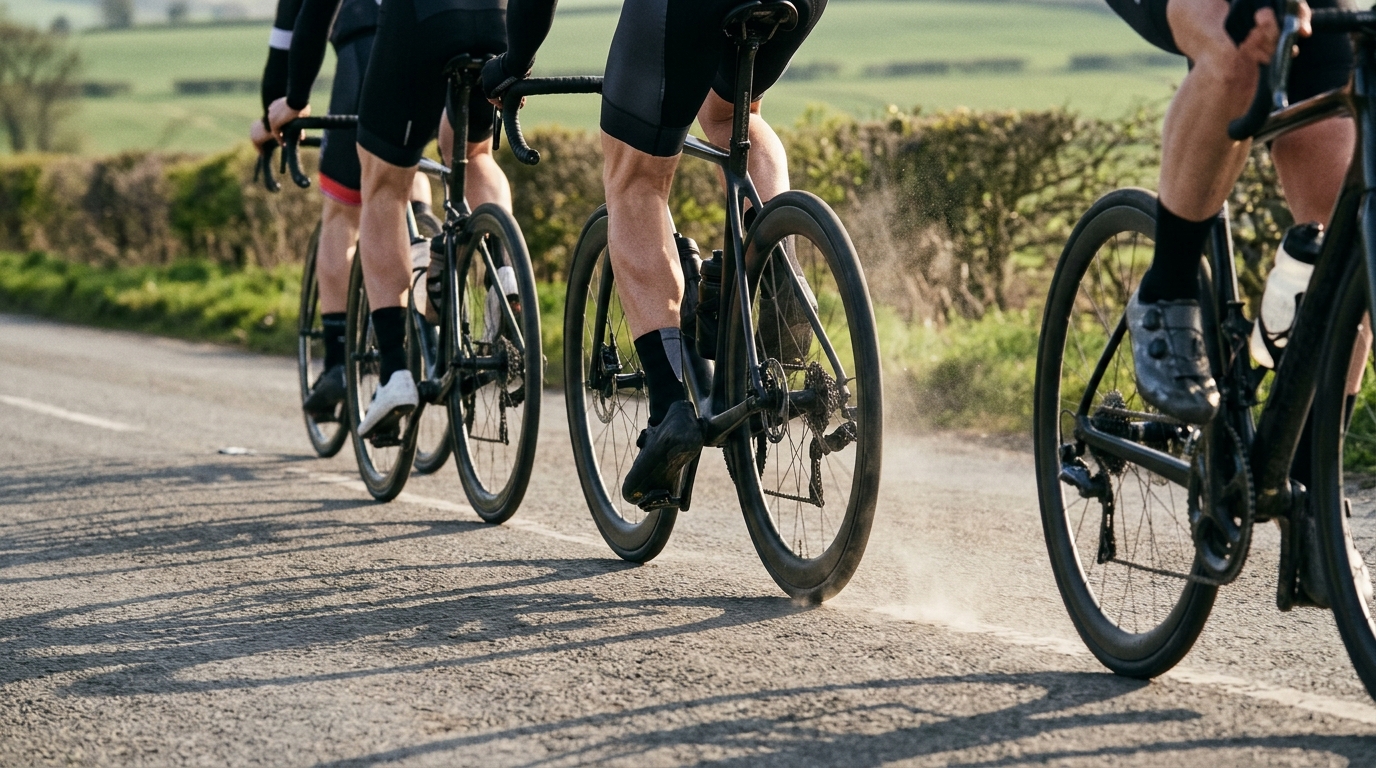
Road races are harder to predict because drafting and tactics dominate. The winning move may be less about average power and more about producing the right power at the right time after many prior costs.
For road racing, prediction should focus on likely selection points rather than full-course precision. Ask where the race is most likely to become hard. Then ask what kind of effort those points demand.
The model should identify:
- Where positioning before the hard section matters
- Whether the decisive effort is sustained or explosive
- How many times similar efforts may repeat
- Whether fatigue before the key point changes the required power
- Whether the course rewards waiting or forcing the race
Terrain changes the decision. A narrow climb makes position before the turn valuable because moving up once the road tilts can cost more than the climb itself. A crosswind section rewards early commitment because the shelter can disappear before the strongest riders have actually attacked. A technical course punishes poor positioning because every corner turns into an acceleration tax. A rolling course may look manageable on average power while quietly draining riders through repeated spikes.
This makes prediction tactical. Instead of saying the race will require a certain average power, you are asking whether you can survive or create the decisive moments.
Common Model Errors: Bad FTP, Dirty Data and Optimistic Assumptions
Most prediction failures are not caused by a lack of complexity. They are caused by bad assumptions.
Bad FTP
If FTP is set too high, every downstream prediction becomes too optimistic. Training zones look easier than they are. Race pacing looks sustainable when it is not. Climb targets become traps.
If FTP is set too low, the opposite happens. The rider may underpace, avoid productive stress, or misread strong form as merely adequate.
The fix is not to worship FTP. It is to keep it current and cross-check it against real efforts. If the number does not match what you can repeatedly do in training, update the assumption.
Dirty data
Power meters drift. Files include dropouts. Smart trainers can disagree with outdoor meters. Heart rate can be affected by fatigue, temperature, caffeine, stress and hydration.
Dirty data is dangerous because it often looks precise. A graph with clean lines can still be built on flawed measurement.
Before trusting a prediction, check whether the source data makes sense. Look for unrealistic spikes, missing sections, sudden sensor changes, or power that does not match perceived effort and speed. If the input is suspect, the model output should be treated as provisional.
Optimistic assumptions
The biggest modeling error is assuming ideal execution.
Real races are not ridden in a lab. You may miss a wheel, brake into corners, surge out of position, eat late, overheat, or follow the wrong move. Even a strong rider needs margin.
A useful prediction should include a conservative race plan and an aggressive option. The conservative plan protects against early overreach. The aggressive option tells you when it is rational to spend more, such as when the decisive selection is forming or the terrain strongly favors commitment.
How to Validate Predictions Against Completed Rides
Prediction only improves if you audit it.
After the ride, compare what the model expected with what actually happened. Do not just ask whether the finishing time or result was right. Ask why the prediction missed or worked.
Use a compact post-ride audit:
| Assumption | Actual outcome | Likely reason for miss | Next adjustment |
|---|---|---|---|
| Power target was sustainable | Held, faded, or exceeded | Freshness, pacing, heat, fueling, or unrealistic baseline | Update target range or confidence level |
| Key segment would decide the ride | It did, or another point mattered more | Course reading, tactics, wind, positioning | Re-mark selection points next time |
| Fatigue was manageable | Legs stayed stable or faded early | Training load, sleep, travel, prior surges | Adjust taper, warm-up, or pacing ambition |
| Weather impact was minor | Conditions changed speed, cooling, or handling | Wind, heat, rain, surface | Add more margin for similar conditions |
| Data source was reliable | File was clean or suspect | Sensor issue, dropout, calibration, device mismatch | Fix equipment check before modeling |
Useful review questions include:
- Was the assumed power realistic?
- Did fatigue show up earlier than expected?
- Did weather change the cost of the effort?
- Did terrain create more variability than modeled?
- Did drafting reduce the demand or hide repeated spikes?
- Did fueling support the target effort?
- Did the power file look clean enough to trust?
This turns each event into a calibration tool. If you repeatedly fade late despite hitting the planned power early, the issue may be durability, fueling, heat management or pacing ambition. If you consistently outperform predictions on certain terrain, the model may be underestimating your strengths or overestimating the course demand.
The point is to make the next forecast less wrong.
Turning Predictions Into Pacing, Training and Race Decisions
Cycling performance prediction is only valuable if it changes decisions.
For pacing, it gives you guardrails. You know which sections require restraint and which justify commitment. You stop treating the entire ride as a single effort and start matching output to terrain and race context.
For training, it clarifies specificity. If the target event demands long steady work, training should develop that ability. If the selection is likely to come from repeated surges, training should include repeatability under fatigue. If the time trial depends on power in position, road bike numbers are not enough.
For race selection, prediction can be blunt in a useful way. Some events reward your current strengths. Others expose a limiter that needs more time. That does not mean avoiding hard races, but it does mean knowing whether the goal is performance, practice or data collection.
For equipment and setup, predictions can reveal where changes matter. On a climb-focused route, mass and pacing may deserve attention. In a time trial, position and sustainable aero power may matter more. In a road race, the best equipment choice may be the one that helps you handle, accelerate and stay positioned without wasting energy.
The best athletes do not use models to remove uncertainty. They use them to prepare for it. They know the target demand, understand the assumptions, validate the outcome, and update the plan.
That is the real value of cycling performance prediction. It turns guesswork into a structured conversation between the data, the course and the rider you actually are right now.