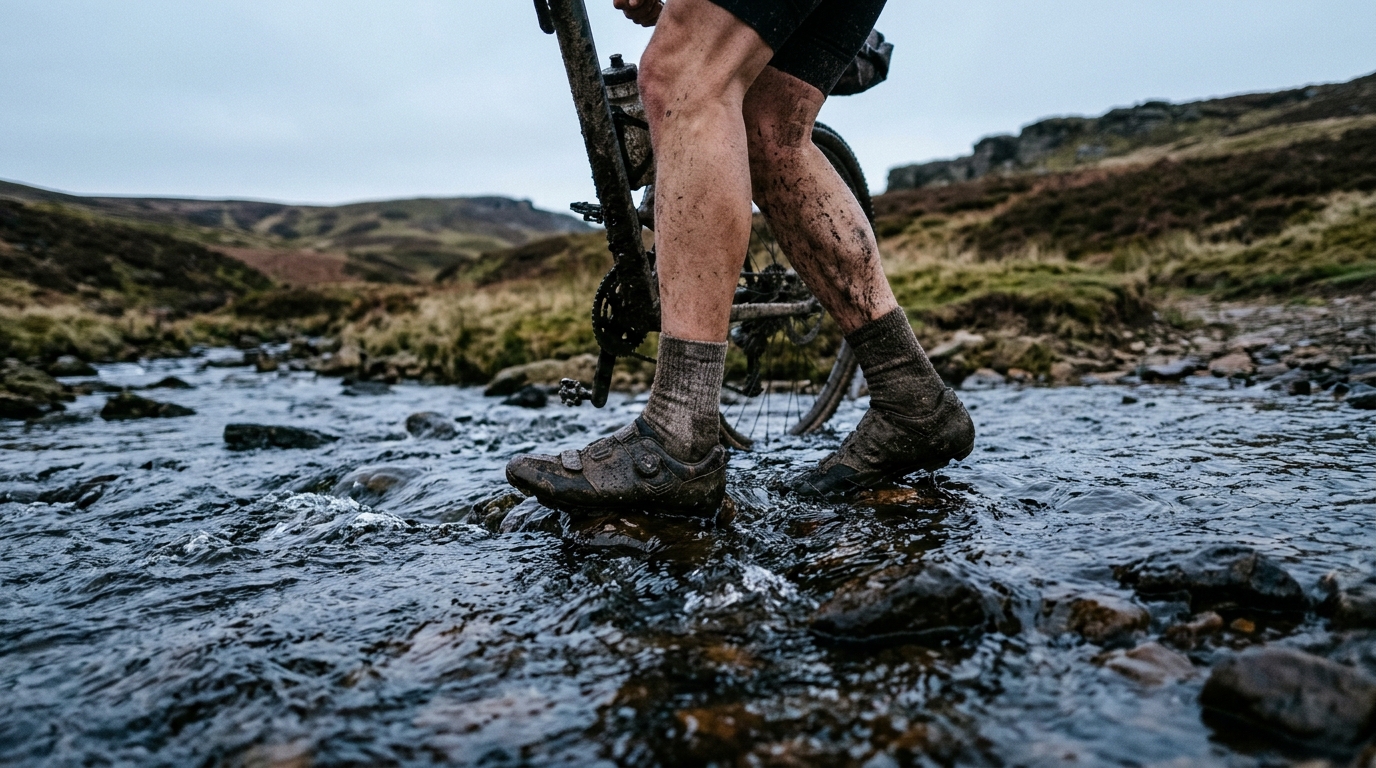
Image generated by our model.
cycling prs
Cycling PRs That Actually Show Progress
Strava segments are useful, but noisy. Learn which cycling PRs reveal real fitness gains and how to review them with context.
Why segment PRs are a noisy measure of fitness
Cycling PRs feel clean because the output is simple: faster than before or not. But the inputs behind a segment time are rarely clean.
A Strava segment does not measure fitness directly. It measures the time it took to cover a piece of road under a specific mix of conditions. That mix can include wind direction, traffic, road surface, temperature, tire choice, pacing, drafting, fatigue, motivation, and whether the segment came after a long ride or from a fresh start.
That does not make Strava segments useless. It means they are context-dependent. A personal record on a tailwind-aided false flat may say more about conditions than your engine. A slower time on the same road after a heavy training block might hide a genuine fitness improvement. The mistake is treating every segment PR as a pure signal.
The better question is not, 'Did I PR?' It is, 'What kind of PR was it, and what does it tell me about the system I am trying to improve?'
The PR hierarchy
Not all cycling PRs deserve the same weight. If the goal is to track real progress, rank them by signal quality:
- Power-duration PRs - the cleanest view of rider output.
- Repeatable climbs - useful when the course is safe, consistent, and paced well.
- Route PRs - good for testing execution, fueling, durability, and decision-making.
- Repeatability markers - proof that useful power is becoming more durable.
- Strava segment PRs - motivating and sometimes revealing, but only with context.
This hierarchy does not mean segment times are worthless. It means they sit downstream of better evidence. A leaderboard result becomes useful when it supports what the power, benchmark ride, and repeatability data are already suggesting.
Power-duration PRs: the cleanest starting point
Power-duration PRs are useful because they are based on work done by the rider rather than speed over ground. They show how much power you can produce across different effort types, from explosive surges to sustained aerobic output.
These PRs help identify whether recent training is moving the intended lever. Sprint work should eventually show up in short-duration power. Threshold development should lift sustained power. Endurance consistency should make repeatable hard work feel less costly and less fragile.
A power curve is not perfect. Power meters can drift, fatigue matters, and pacing errors can distort the shape. But compared with segment time, power is much closer to the physiological truth.
If you need a reference point for how threshold fits into the broader picture, connect your review to functional threshold power rather than treating every maximal effort as the same kind of achievement.
The shape of the curve matters more than a single point. If short power improves while sustained power stagnates, the training stress is probably tilting toward intensity, freshness, or anaerobic work. If longer efforts improve while peak punch fades, you may be building a stronger aerobic base while carrying enough fatigue to blunt top-end expression.
Neither outcome is automatically good or bad. The question is whether the PRs match the phase of training and the demands of the target event.
The FTP estimator can help as a rough interpretive tool, but do not outsource judgment to a calculator. A power PR is meaningful when it aligns with repeatable execution, stable measurement, and the type of fitness you are trying to build.
Repeatable climbs, routes, and durability markers
A good benchmark is boring in the best way. It removes variables so performance changes become easier to see.
A repeatable climb is useful because it reduces some of the noise that makes flat segments messy. Aerodynamics and drafting still matter, but sustained uphill efforts usually reward power-to-weight, pacing, and durability more directly than a rolling group ride segment.
The best benchmark climb is not necessarily famous. It is the one you can repeat under similar conditions, ride safely, and pace consistently. If the climb forces interruptions, has unpredictable traffic, or requires a technical descent before the effort, it is less useful as a performance benchmark.
A benchmark route captures something a power curve cannot: how well you manage the entire ride. It includes pacing discipline, fueling, fatigue resistance, equipment choices, and decision-making.
This is where cycling performance benchmarks become more race-like. A rider can set a great power PR while fresh and still struggle to convert that capacity into a strong ride when the work is embedded inside a longer effort. Route PRs reveal that gap.
Repeatability markers are quieter, but often more predictive. The breakthrough might be producing a familiar power with less strain, repeating hard efforts with cleaner execution, or finishing a demanding ride without the late fade that used to appear.
Fitness is not just peak output. It is the ability to produce useful power at the right time, then recover enough to do it again.
A simple PR review workflow
Build a small benchmark system instead of chasing every segment in your area.
Choose 3 to 5 benchmarks that cover the demands you actually care about. A strong set might include a sustained climb, a rolling route, a flat or sheltered steady effort, and a familiar endurance loop. If you race or target events with repeated surges, include a repeatability marker as well.
Test those benchmarks every 4 to 8 weeks. That rhythm is frequent enough to show whether training is working, but not so frequent that every block turns into a testing block.
Use the same start and finish points. Keep the setup as consistent as possible. Compare solo rides with solo rides, group rides with group rides, fresh efforts with fresh efforts, and fatigued efforts with fatigued efforts. If the context is different, the interpretation should be different too.
After each benchmark attempt, record the result and the conditions in a notes field. The notes matter because they protect you from two common mistakes: taking credit for favorable physics, or writing off good fitness because the day was slow.
A practical review flow looks like this:
- Pick 3 to 5 benchmarks that match your goals.
- Schedule benchmark attempts every 4 to 8 weeks.
- Record the result, conditions, setup, fatigue state, nutrition, and RPE.
- Compare only like-for-like attempts.
- Look for patterns across benchmarks, not one isolated PR.
- Decide whether the result shows better fitness, better execution, better conditions, or excessive cost.
Benchmark log template
Use a simple log. The point is not to create a lab. The point is to preserve the context that makes the number interpretable.
| Date | Benchmark type | Duration | Power | Time | Wind | Solo/group | Fatigue state | Setup | Nutrition | RPE | Interpretation |
|---|---|---|---|---|---|---|---|---|---|---|---|
| Power-duration effort | Solo | Fresh or fatigued | Bike, tires, position | Before and during | Fitness signal, execution signal, or unclear | ||||||
| Repeatable climb | Solo or group | Fresh or fatigued | Bike, tires, wheels | Before and during | Compare only with similar attempts | ||||||
| Benchmark route | Solo or group | Fresh or fatigued | Bike, tires, bags, position | Before and during | Note pacing, stops, traffic, and late-ride control | ||||||
| Repeatability marker | Solo or group | Fresh or fatigued | Bike and setup | Before and during | Look for consistency, not just the best rep |
Keep the interpretation column short but honest. 'Tailwind and group-assisted, not a clean fitness signal' is more useful than pretending the time stands alone. 'Same setup, similar conditions, higher power, controlled RPE' is the kind of note that gives a PR real weight.
How to interpret conflicting PR signals
The hard cases are where PRs disagree. That is also where the review process becomes valuable.
Say your benchmark route time improves, but your power is flat. The ride was done in a group, the wind was favorable, and the pacing was smoother than usual. That is still a good ride, but the most likely conclusion is not new fitness. It is better conditions, better execution, group assistance, or some mix of all three.
That does not make the PR meaningless. Better execution is a real performance skill. If your event rewards positioning, drafting, and timing, that route PR may still matter. But it should not be used as proof that your aerobic ceiling has moved.
Now reverse the situation. Your route time is slower, but power is higher, pacing is controlled, nutrition is solid, and the ride was solo into less favorable conditions. That may be a stronger fitness signal than the faster group-assisted PR. The clock is not always wrong, but it is not always the cleanest witness.
This is the core of good PR analysis: separate capacity from execution and conditions. A useful review does not ask which number is most flattering. It asks which explanation best fits the evidence.
When a PR signals progress and when it signals overreach
A PR is progress when it fits into a pattern.
If power is up, perceived effort is controlled, recovery is normal, and the result appears in a relevant benchmark, that is a strong signal. If the same improvement shows up in different ways - for example, better sustained power and a faster benchmark climb under comparable conditions - the case is stronger.
A PR is less convincing when it appears as an isolated spike. One huge effort can come from freshness, caffeine, competition, favorable conditions, or simply a willingness to dig deeper than usual. That can be useful, but it is not the same as a durable fitness gain.
A PR can also be a warning.
If it comes with unusually high strain, poor sleep afterward, loss of motivation, or a sharp drop in subsequent training quality, the cost may outweigh the signal. The athlete did not just discover new fitness. They may have spent too much of it.
This matters because PR chasing can quietly distort training. The calendar starts revolving around proving form instead of building it. Easy days become segment hunts. Productive workouts become maximal tests. The result is often a rider who has plenty of isolated achievements and not enough consistent adaptation.
The best athletes do not avoid PRs. They place them correctly. Some rides are for testing. Some are for training. Some are for recovery. Confusing those categories is where progress starts to leak away.
How to review PR trends across a season
A season review should not be a highlight reel. It should answer whether your training produced the fitness you needed when it mattered.
Start by grouping your cycling PRs by type: power-duration PRs, benchmark climbs, route PRs, repeatability markers, and segment PRs. Then look for timing and relevance.
Ask these questions:
- Did PRs appear during the phase they were meant to appear?
- Did the improvements match the demands of the target events?
- Were gains repeatable or isolated?
- Did faster segment times also come with better power or better execution?
- Did PR attempts disrupt training consistency?
- Were the best performances solo, sheltered, or group-assisted?
The trend matters more than the trophy. A rider who improves benchmark performance steadily, handles more work without falling apart, and arrives at key events with repeatable power is building usable fitness. A rider who collects scattered Strava segments but cannot reproduce power under fatigue has a noisier story.
Also look for missing PRs. If sprint power never moves, that may be fine for an endurance-focused athlete. If sustained power and benchmark climbs stagnate despite a large training load, the program may need adjustment. If route PRs improve but power does not, better pacing, equipment, or group dynamics may be driving the change. That is still useful, but it is a different kind of improvement.
The goal is not to make every ride measurable in a suffocating way. It is to choose better signals.
Strava segments are motivating, social, and occasionally revealing. But if you want cycling personal records that actually guide training, prioritize power curve PRs, repeatable benchmarks, and context-rich review. Fitness is not proven by one fast line on a leaderboard. It is proven when the same underlying capacity shows up across conditions, efforts, and time.