Bild von unserem Modell generiert.
bike maintenance
Bike Maintenance Tracking: A Practical Log System
Use component mileage, condition tags, inspections, and trend notes to catch bike wear before it turns into a failed ride or expensive repair.
Why maintenance should follow evidence, not memory
Bike maintenance tracking works because components do not wear out according to how recently they feel like they were installed. They wear according to load, contamination, friction, braking, road surface, storage, sweat exposure, and how often the bike is actually ridden.
Most riders still maintain from memory. The chain gets checked when shifting feels rough. Tires get attention when a cut looks severe. Brake pads are noticed when lever feel changes. Cables get ignored until indexing drifts or a shift fails under load.
The problem is timing. By the time the bike feels bad, wear has often moved from isolated to cascading. An over-worn chain can accelerate cassette and chainring wear. A damaged tire can turn a predictable replacement into a ride-ending flat. Contaminated brake pads can reduce braking and damage braking surfaces depending on the system. A frayed or contaminated cable can make a normal shift feel like a derailleur problem.
A useful cycling maintenance schedule is not a fixed ritual copied from another rider. It is a feedback loop: ride, log the conditions, inspect the part, record the result, and adjust the next checkpoint based on what changed.
For a rider already tracking training load, power, or FTP, the logic should feel familiar. One data point matters less than the trend and the response.
The operating system: what to log every time
The log should be simple enough to use consistently and detailed enough to explain wear later. If it becomes a second training diary, it will fail. If it only says 'chain changed sometime recently', it will not help when the drivetrain starts making noise before an event.
Use these fields as the minimum template:
| Field | What to enter |
|---|---|
| Component | Chain, cassette, front tire, rear tire, brake pads, cable, housing, bottom bracket, headset, bar tape, or other part |
| Install date | The date the part went on the bike |
| Install mileage | Bike mileage or component mileage when installed |
| Current mileage | Mileage at the inspection or service point |
| Condition tag | Dry, wet, gritty, salty, muddy, dusty, race-heavy, travel-heavy, indoor sweat-heavy, or mixed |
| Inspection result | Measured wear, visual condition, noise, feel, pressure loss, pad thickness, cable friction, bearing smoothness, or other finding |
| Action taken | Cleaned, lubed, adjusted, replaced, monitored, retorqued, sealant checked, or booked for service |
| Next inspection point | The next mileage, event, training block, or condition-triggered check |
| Notes | Short context that explains why the result might differ from normal |
That template is the difference between a list of parts and a maintenance system. The important fields are not just what was replaced, but why, in what conditions, and what should happen next.
Example log entry
| Field | Example entry |
|---|---|
| Component | Chain |
| Install date | Start of current drivetrain cycle |
| Install mileage | Bike mileage at installation |
| Current mileage | Current bike mileage from ride log |
| Condition tag | Wet, gritty, gravel |
| Inspection result | Wear still acceptable, but dirt buildup heavier than usual |
| Action taken | Degreased, dried, relubed, pulleys inspected |
| Next inspection point | Earlier than the previous checkpoint because conditions were abrasive |
| Notes | Several wet gravel rides since the last clean inspection |
No universal replacement claim is needed. The log is not pretending every chain, pad, or tire dies on the same schedule. It is showing that the conditions changed, so the inspection schedule should change with them.
The key inputs: mileage, time, weather, and terrain
Mileage is the anchor of bike maintenance tracking because it gives each component an odometer. When a part is installed, start its count. When it is inspected, log the current mileage and the condition.
But mileage alone is not enough. Clean endurance miles and dirty, torque-heavy miles may look similar in a ride file, but they do not look similar to a chain, brake pad, or tire casing.
Distance
Distance is the baseline for chains, tires, brake pads, cassettes, chainrings, bottom brackets, bearings, cables, and housing. It prevents the common mistake of treating a component as new because it still feels recent.
Memory compresses training blocks. A part that feels fresh may have already lived through bad weather, travel, rough roads, and race efforts. Mileage makes that visible.
Ride time
Time matters when the bike is exposed to sweat, vibration, and load even if distance is modest. Indoor riding is the obvious case. The drivetrain may avoid road grit, but the bike can see heavy sweat exposure and less airflow.
That changes the inspection priority. Headset areas, bar tape, bolts, cockpit hardware, and drivetrain cleanliness may deserve more attention after indoor-heavy blocks.
Conditions
The log does not need a detailed weather report. It needs tags that change decisions.
Use condition tags such as dry, wet, gritty, salty, muddy, dusty, race-heavy, travel-heavy, indoor sweat-heavy, or mixed. These labels explain why a part wore faster than expected and help decide whether the next inspection should move closer.
Wet grit is especially punishing because it adds abrasive contamination to the drivetrain and brakes. Dust works differently, but it can still enter chains, pulleys, cables, seals, and bearing areas.
Terrain
Terrain shapes load. Long climbs put more torque through the drivetrain. Descents increase braking demand. Rough roads raise tire damage risk and can expose loose bolts or tired bearings. Gravel and mixed surfaces add contamination even when the ride does not feel especially wet.
The aim is not a perfect wear model. It is enough context to make the next maintenance decision less random.
Components worth tracking first
A maintenance log becomes useful fastest when it focuses on the parts most likely to create cost, poor performance, or a failed ride.
| Component | What to track | What accelerates wear | What the log should trigger |
|---|---|---|---|
| Chain | Install mileage, cleaning, lubrication, wear checks, wet or dirty rides | Wet grit, mud, dust, poor cleaning, high-load riding | Earlier inspection, cleaning change, lube review, replacement when wear evidence says so |
| Cassette | Install mileage, chain history, skipping under load, shifting symptoms | Running with an over-worn chain, contamination, poor drivetrain care | Check after chain replacement, inspect if skipping appears with a new chain |
| Tires | Mileage, cuts, plugs, punctures, pressure loss, tread, sidewalls | Rough roads, gravel, debris, casing damage, trainer use where relevant | Closer casing inspection, sealant check for tubeless, replacement if reliability risk rises |
| Brake pads | Install mileage, pad condition, noise, lever feel, contamination, rotor or rim condition | Wet descents, gritty braking, mud, heat, contamination | Pad inspection before similar terrain, surface check, replacement if wear or contamination warrants it |
| Cables and housing | Replacement date, friction, corrosion, fraying, indexing drift | Wet riding, contamination, sweat, storage conditions | Cable and housing inspection before blaming derailleur setup |
| Bearings and headset | Smoothness, play, noise, contamination signs | Wet conditions, washing habits, sweat, rough roads | Service check if play, roughness, or repeated noise appears |
This table should not become a stat dump. Its job is to make the inspection decision obvious: what changed, what part is vulnerable, and what action the log should trigger.
Set checkpoints without inventing replacement intervals
A mileage-based maintenance system does not mean replacing parts blindly at a fixed distance. It means inspecting the right part before the failure window opens.
If a manufacturer gives a wear limit, torque instruction, or inspection recommendation, use that as the first checkpoint. If a trusted shop has a normal practice for your equipment and riding conditions, use it as a starting point. If neither exists, begin with conservative inspection checkpoints and adjust from evidence.
The distinction matters. Inspection points are not replacement intervals. A checkpoint asks, 'What condition is this part in now?' Replacement happens when the inspection result, measured wear, visible damage, repeated symptom, or event risk justifies it.
Use this workflow:
- Add the component when it is installed
- Record install date and install mileage
- Let ride data update current mileage where possible
- Add condition tags only when the ride or block was hard on the bike
- Inspect at the next planned checkpoint
- Record the result and action taken
- Move the next inspection closer if wear accelerated
- Move it farther only after repeated clean inspections in similar conditions
That last step is where the system becomes personal. Your chain wear, tire damage, brake pad use, and cable life are shaped by your roads, power delivery, equipment, cleaning habits, storage, weather, and riding mix. A generic schedule cannot see that. A consistent log can.
Conditions that should trigger extra inspection
Mileage is the baseline. Conditions are the modifier. The log should shorten the inspection window after any block that changes the stress on the bike.
Inspect earlier after:
- Unusually wet rides or road spray
- Gritty or dusty riding
- Salty roads or winter contamination
- Muddy gravel or cyclocross-style conditions
- Travel-heavy blocks where bikes are packed, handled, or transported often
- Race-heavy blocks with more hard braking, high torque, and repeated equipment stress
- Indoor sweat-heavy blocks with limited airflow around the bike
- Rough-road or mixed-surface blocks with higher tire and bearing risk
- Long descending blocks where braking load is higher than normal
This is not about doing more maintenance for its own sake. It is cause and effect. Contamination increases friction. Friction accelerates wear. Sweat and salt increase corrosion risk. Travel creates handling and alignment risk. Racing compresses stress into a short window. The inspection schedule should respond to those inputs.
Pre-event checklist: what to check before it matters
Before a race, training camp, long ride, or key block, use the log to decide what deserves attention. The question is not simply, 'Does the bike feel fine today?' It is, 'Which parts are carrying risk into a ride where failure would be costly?'
Check:
- Chain wear status and last dirty or wet ride
- Cassette behavior under load, especially after a chain change
- Tire cuts, plugs, sealant status, sidewall condition, and repeated pressure loss
- Brake pad condition, braking noise, lever feel, and rotor or rim condition
- Cable friction, indexing drift, fraying, and corrosion signs
- Bearing smoothness and headset play after wet, rough, or sweat-heavy blocks
- Bolts, cockpit hardware, bottle cages, saddle hardware, and anything recently adjusted
The value is prioritization. A bike that has just completed a dry, clean block needs a different inspection than one coming off wet gravel, travel, and indoor sessions.
Worked example: chain wear after wet gravel
Here is the analytical method in action, framed hypothetically.
A rider inspects a chain at a planned checkpoint. The chain checks cleanly, shifting is stable, and the drivetrain has no abnormal noise. The log shows mostly dry road riding, so the next inspection point stays on the normal schedule.
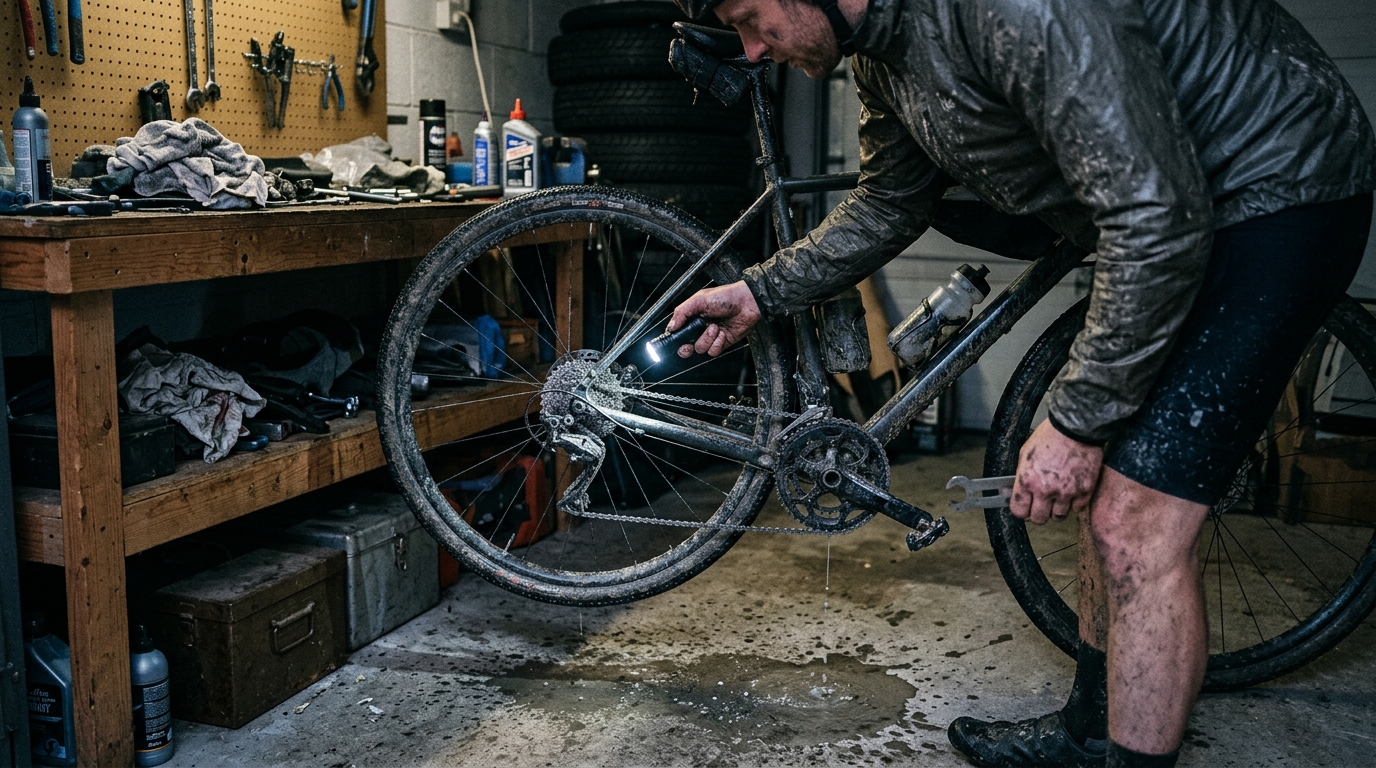
Then the rider completes several wet gravel rides. The next inspection still may not show a failed chain, but the pattern has changed: heavier contamination, rougher pulley feel, faster visible grime buildup, and more cleaning required after each ride.
The wrong conclusion is, 'Chains are unpredictable.' The better conclusion is that the operating conditions changed. Wet gravel added abrasive contamination, so the next inspection point should move closer. The rider should also change the process: clean and dry the drivetrain sooner after those rides, review lubricant choice for the conditions, inspect pulleys, and watch cassette behavior under load after future chain checks.
Nothing dramatic happened. That is the point of the system. The log caught the change while it was still a maintenance adjustment, not a drivetrain failure.
Use trends to separate symptoms from causes
One inspection tells you the condition of a part today. Several inspections tell you the rate of change. That rate is what prevents failures.
If chain wear progresses faster after wet rides, the answer may not be simply replacing chains more often. It may be a cleaning problem, a drying problem, a lubricant mismatch, or a need to inspect sooner after contaminated rides.
If brake pads wear quickly only during descending-heavy or gritty blocks, the schedule should tighten before similar terrain. If rear tires repeatedly develop cuts on the same route type, the cause may be surface choice, casing choice, pressure, or leaving a damaged tire in service too long. If shifting needs frequent adjustment, the issue may be contaminated or fraying cables rather than a derailleur that keeps going out of tune.
The log turns vague symptoms into testable patterns. Ask: is this part wearing faster than expected, and what changed before the wear accelerated?
Why a digital log saves money and protects training
A digital bicycle maintenance log saves money because it stops small wear from becoming system wear.
The drivetrain is the clearest example. Replacing a chain when evidence says it is time is usually cheaper than discovering that the cassette and chainrings have adapted to an old chain. The same logic applies across the bike: brake pads before they damage braking surfaces, tires before repeated punctures cost training time, cables before a shift failure compromises an event.
Reliability also has training value. A preventable mechanical does not just interrupt a ride. It changes the session, adds stress, and can remove the specificity from a key workout or long endurance day.
The format can be a dedicated app, spreadsheet, or notes attached to ride files. Consistency matters more than software. Track component mileage, tag hard conditions, record inspections, and update the next checkpoint based on evidence.
Good bike maintenance tracking does not make the bike immune to bad luck. It removes preventable failures by catching the mechanical risk while the fix is still small.