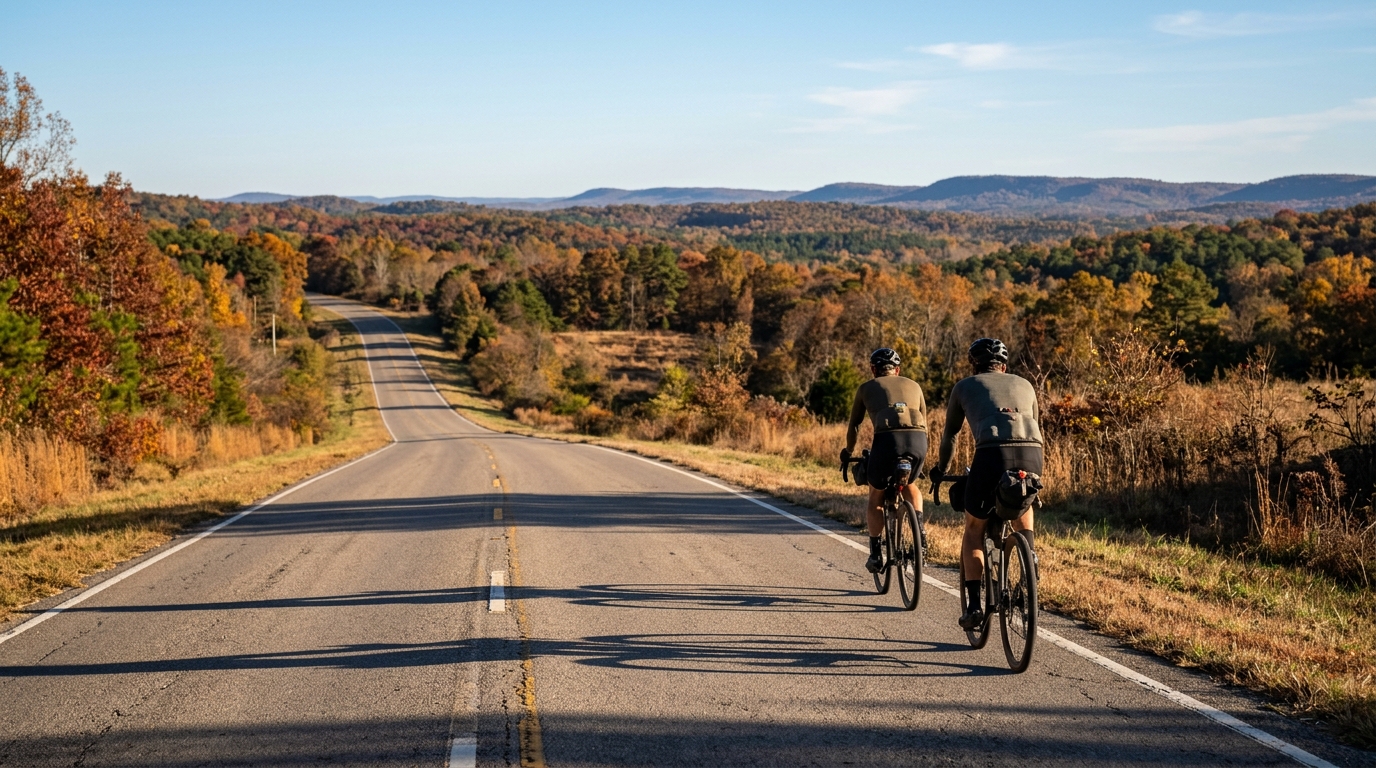
U.S. Bicycle Route 51 in Arkansas
A 159 km asphalt point-to-point route with 767 m of gain, best approached as a steady endurance ride rather than a climb-focused day.
- Distanz
- 159km
- Höhenmeter
- 767m
- Untergrund
- —
- Form
- Punkt-zu-Punkt
Die Route
Höhenprofil
Route character
U.S. Bicycle Route 51 in Arkansas is a 159 km asphalt cycling route with 767 m of elevation gain. On paper, that tells you most of what matters tactically: this is not a route defined by major climbing, but it is long enough that poor pacing will still make the second half expensive.
The elevation profile implied by the numbers points toward an endurance-focused day. With no notable climbs listed, the challenge is less about surviving one decisive ascent and more about managing repeated small rises, changes in rhythm, and the cumulative load of staying on the pedals for a full point-to-point ride.
That makes it a good route for riders who want steady aerobic volume without building the entire day around climbing. It also means the fastest ride will usually come from restraint early, not aggression. If you ride the opening section like a short workout, the modest total gain can still turn into fatigue because the distance gives every small effort time to compound.
Terrain and pacing
The surface is asphalt, so tire choice and setup can stay on the road-oriented side. The bigger question is not traction, but energy management. Over 159 km, the cost of surging repeatedly above sustainable effort is usually higher than the time gained, especially on a route without a listed marquee climb where there is no obvious single place to spend the day’s biggest effort.
A sensible approach is to ride by feel or power and keep the early workload below threshold. If using power, anchor the day around endurance intensity rather than chasing every rise. Riders who track /glossary/ftp should think of this as a durability ride: the key metric is not one peak effort, but how stable the output feels late in the route.
Practical notes
Because the route is not a loop, logistics matter. Plan the start and finish before committing, including transport, pickup, or an out-and-back adaptation if needed. A point-to-point route changes the risk profile because turning around late is not the same as finishing a loop near where you began.
The 767 m of gain is moderate relative to the full distance, but it is still enough to affect fueling and pacing. Treat the ride as a long day on the bike, not a flat cruise. Carry enough food and fluids for the duration you expect, and avoid waiting until fatigue appears before eating.
Who it suits
This route fits riders looking for a long asphalt endurance ride in Arkansas rather than a climb-hunting objective. It should reward steady pacing, efficient fueling, and clean logistics more than explosive climbing strength. If the goal is to build aerobic depth or test late-ride durability, U.S. Bicycle Route 51 in Arkansas cycling route has the right profile: long, paved, point-to-point, and demanding mainly because it asks you to keep producing steady work for the full distance.
Ähnliche Routen
3-Länder-Radweg
A 302.2 km asphalt route in Germany with 1512 m of climbing and point-to-point logistics shaped by the Reußenkreuz climb.
7 Peaks Alpine Challenge
A 110.9 km point-to-point assault through the Victorian Alps, stacking 3404 metres of climbing across relentless, wind-swept high-country ascents.
Aberdare Range
A 46 km asphalt point-to-point through Kenya's Central Highlands that trades big climbs for a relentless 1,700 m of rolling grind.
Abra Málaga
A 45-kilometer point-to-point ribbon of asphalt through Peru's Sacred Valley, climbing 1,699 relentless meters into the high Andes.
Afriski Mahlasela Pass
A 112.8 km asphalt ascent through the Maloti Mountains, climbing 3,384 m to the roof of southern Africa via the storied Mahlasela Pass.
Ahr Cycleway
An 82.9 km asphalt point-to-point route with 541 m of gain, the Ahr Cycleway is a steady endurance ride rather than a climb-focused day.