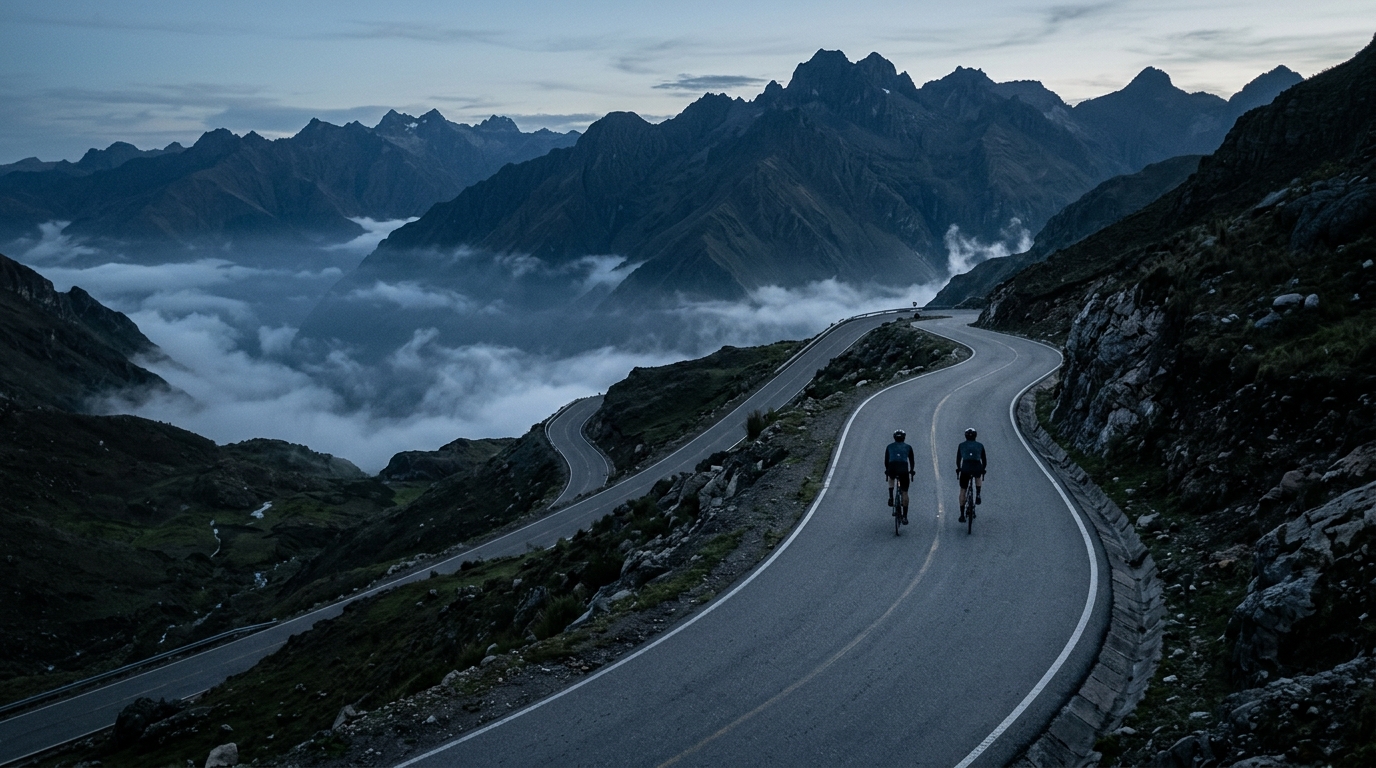
Abra Málaga
A 45-kilometer point-to-point ribbon of asphalt through Peru's Sacred Valley, climbing 1,699 relentless meters into the high Andes.
- Distance
- 45.1km
- Climbing
- 1,699m
- Surface
- Asphalt
- Shape
- Point-to-point
The route
Elevation profile
Overview
Abra Málaga is one of the most storied stretches of tarmac in the Peruvian Andes, a 45.1-kilometer point-to-point route threading through the Sacred Valley. Over its length it gathers 1,699 meters of climbing, a figure that tells you everything about the character of the ride: this is a route defined by sustained altitude gain rather than by punchy, isolated efforts. Riders come here for the raw scale of the landscape and for the satisfaction of grinding upward through terrain that has drawn cyclists and travelers to this corner of Peru for generations. It is a bucket-list objective, the kind of route whose name alone carries weight among those who chase high mountain roads.
The Route
The route runs 45.1 kilometers from start to finish as a point-to-point line, not a loop, so the road you climb is the road that delivers you to the far side. With 1,699 meters of total climbing packed into that distance, the profile trends decisively upward, and the sensation is one of steady, unbroken elevation gain rather than a series of separate summits. The Sacred Valley setting frames the entire effort, its dramatic terrain unfolding as the altitude ticks higher. Because it is point-to-point, planning your logistics around a single direction of travel is essential, and it rewards riders who commit to the full traverse rather than turning back.
Key Climbs
This route carries no individually catalogued climbs, and that absence is itself the defining feature. Rather than a handful of named ascents strung together, Abra Málaga is one long, cumulative pull. The 1,699 meters of climbing arrive as a continuous, rolling gain across the 45.1 kilometers, so the challenge is not about cresting a single marquee summit but about managing effort over sustained high-altitude terrain. Pace yourself to the whole rather than to fragments. The reward is the accumulation itself, the meters banked kilometer after kilometer as the Sacred Valley rises around you and the thin Andean air demands patience and rhythm.
Terrain & Surface
The entire route is paved asphalt, a consistent hard surface from start to finish. That matters here: with 1,699 meters to climb, a smooth, predictable road surface lets you settle into a steady cadence and focus your energy on the gradient rather than on picking a line through loose or broken ground. The asphalt makes this a road-bike route in the truest sense, favoring efficient tires and a rhythm-based climbing style. On the point-to-point traverse, the paved surface also means the descent side can be ridden with confidence, the tarmac giving reliable grip where the road tips back downhill through the Sacred Valley.
When to Ride
High Andean routes like this reward good weather and clear conditions, so aim for a day when the skies are settled and the road is dry. Because the route gains significant altitude, plan for cooler temperatures the higher you climb, and dress in layers you can shed on the way up and pull back on for the descent. Set out early to give yourself margin, both for the sustained climbing effort and for the changeable mountain weather that comes with riding at elevation in the Sacred Valley.
Logistics
As a point-to-point route, Abra Málaga demands a little more planning than a loop. You will need to arrange transport or a shuttle back to your starting point, or build the traverse into a larger one-way journey through the Sacred Valley. Carry enough food and water for the full 45.1 kilometers and the 1,699 meters of climbing, and be self-sufficient for the high-altitude sections. Confirm your return logistics before you roll out, because finishing 45 kilometers away from where you began is part of the route's identity.
Summary
Abra Málaga distills the appeal of high Andean cycling into a single line on the map: 45.1 kilometers of asphalt, 1,699 meters of climbing, and a point-to-point traverse through Peru's Sacred Valley. It offers no catalogued climbs, only one long, honest ascent that asks for patience, rhythm, and respect for altitude. For riders drawn to sustained mountain efforts on smooth tarmac amid unforgettable scenery, it earns its iconic status.