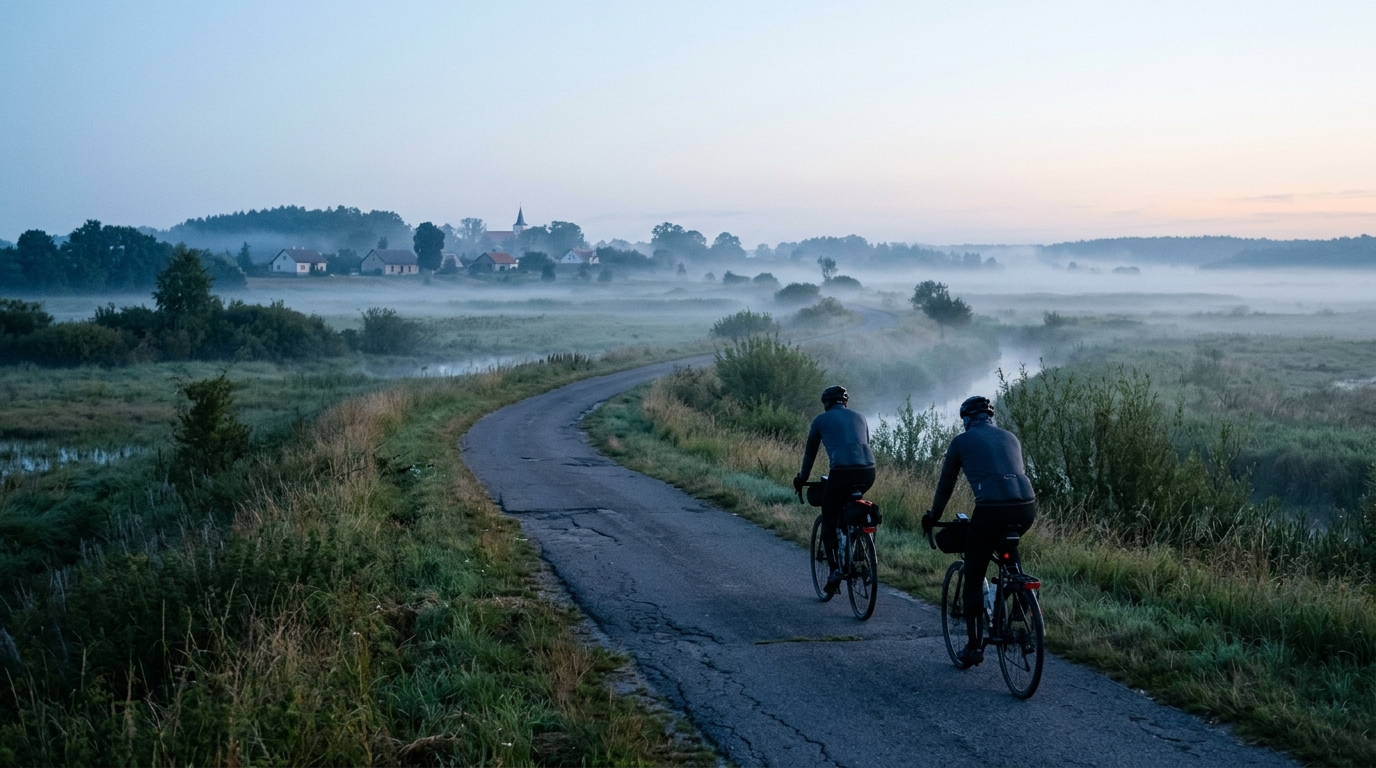
To the Villages of the Narew Valley
A short asphalt route in Poland with modest climbing, suited to steady endurance riding rather than sustained uphill work.
- Distanz
- 23.5km
- Höhenmeter
- 68m
- Untergrund
- —
- Form
- Punkt-zu-Punkt
Die Route
Höhenprofil
Route character
The To the Villages of the Narew Valley cycling route is a short, asphalt ride in Poland that is defined more by rhythm than by difficulty. At 23.5 km with 68 m of elevation gain, it sits firmly in the low-climbing category. There are no notable climbs listed, so the route should be approached as a rolling or gently undulating road effort rather than a climbing objective.
That matters for pacing. With so little total elevation gain across the distance, the ride is unlikely to reward big surges or repeated hard accelerations unless you choose to create them. The better use case is controlled endurance work, an easy aerobic spin, or a short route where consistency matters more than terrain management. If you are using power, this is the kind of course where keeping pressure on the pedals can be more productive than chasing individual rises. For a refresher on how to anchor that effort, see /glossary/ftp.
Terrain and surface
The route surface is asphalt, which keeps the technical demands straightforward. That makes bike choice simple: a road bike is the natural fit, while any efficient endurance setup should also work well. The absence of notable climbs also means gearing is unlikely to be the limiting factor for most riders. Comfort, tire condition, and steady cadence will matter more than a wide climbing range.
Because the route is named for the villages of the Narew Valley, the likely appeal is its point-to-point movement through settled valley terrain rather than a single decisive feature. Do not expect one defining ascent or a summit-style payoff. Expect a ride where the value comes from linking the route cleanly and holding a smooth effort from start to finish.
Practical notes
This is not a loop, so logistics are the main thing to solve before starting. If you want to avoid riding the same roads back, arrange a pickup, transit option, or plan the return as part of a longer day. If you do ride back, the distance effectively becomes a longer out-and-back, so pace the outbound leg accordingly.
For training, this route works best as:
- A short endurance ride
- A low-stress recovery spin if ridden easily
- A controlled tempo session on asphalt
- A straightforward route for riders who want distance without sustained climbing
The key is not to overcomplicate it. With 23.5 km, 68 m of gain, asphalt, and no notable climbs, the route is best treated as a clean, efficient road ride where execution matters more than terrain survival.
Ähnliche Routen
3-Länder-Radweg
A 302.2 km asphalt route in Germany with 1512 m of climbing and point-to-point logistics shaped by the Reußenkreuz climb.
7 Peaks Alpine Challenge
A 110.9 km point-to-point assault through the Victorian Alps, stacking 3404 metres of climbing across relentless, wind-swept high-country ascents.
Aberdare Range
A 46 km asphalt point-to-point through Kenya's Central Highlands that trades big climbs for a relentless 1,700 m of rolling grind.
Abra Málaga
A 45-kilometer point-to-point ribbon of asphalt through Peru's Sacred Valley, climbing 1,699 relentless meters into the high Andes.
Afriski Mahlasela Pass
A 112.8 km asphalt ascent through the Maloti Mountains, climbing 3,384 m to the roof of southern Africa via the storied Mahlasela Pass.
Ahr Cycleway
An 82.9 km asphalt point-to-point route with 541 m of gain, the Ahr Cycleway is a steady endurance ride rather than a climb-focused day.