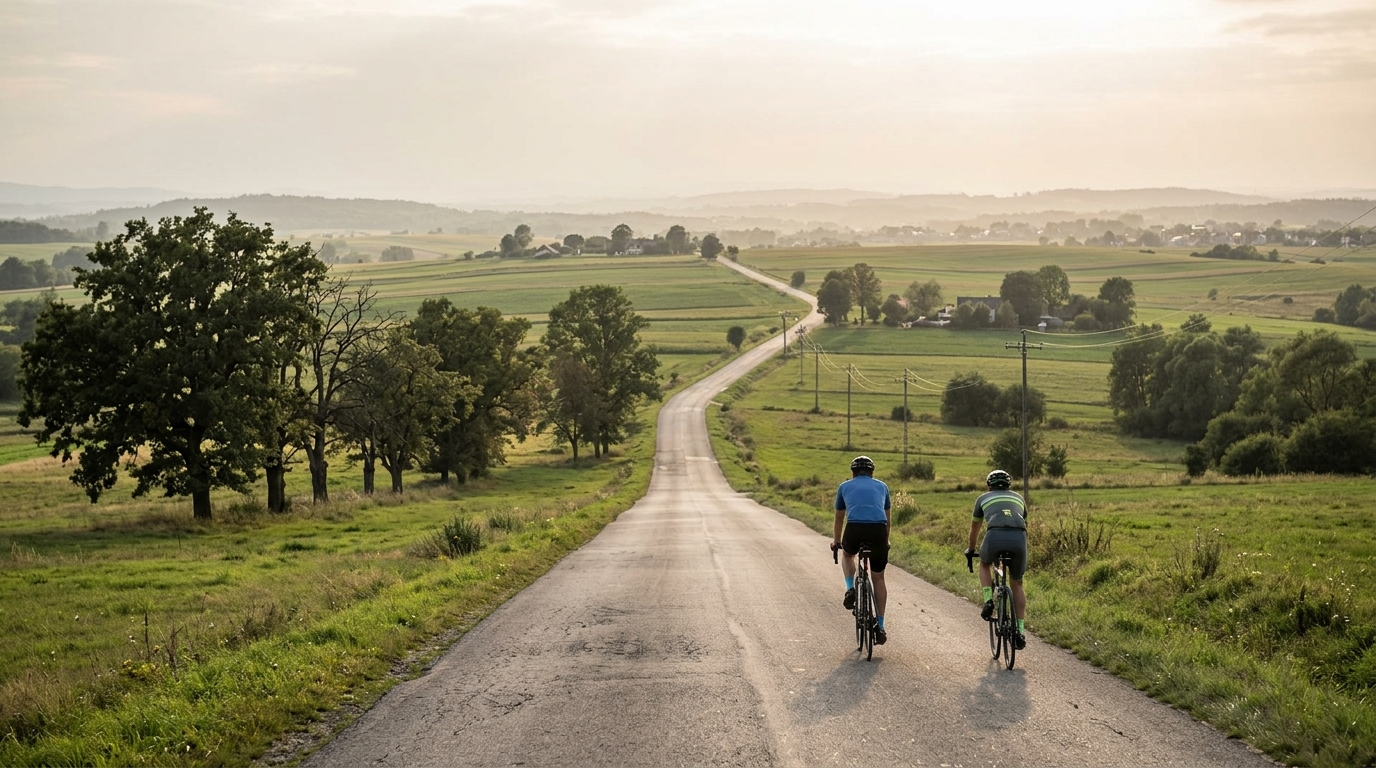
To Castle Hill
A 15.1 km asphalt point-to-point ride in Poland with 76 m of elevation gain and no listed notable climbs.
- Distanz
- 15.1km
- Höhenmeter
- 76m
- Untergrund
- —
- Form
- Punkt-zu-Punkt
Die Route
Höhenprofil
To Castle Hill cycling route overview
The To Castle Hill cycling route is a 15.1 km asphalt ride in Poland with 76 m of elevation gain. On paper, that gives it a clear character: this is not a climbing route disguised as a short ride. It is a controlled point-to-point effort where the terrain should feel more like steady forward movement than repeated climbing pressure.
That matters for how to ride it. With no notable climbs listed, the route is unlikely to be defined by a single decisive ascent. Instead, the main challenge is keeping the effort smooth across the full distance. Riders who over-accelerate early may not lose time to a major climb later, but they can still turn a modest route into a ragged one by riding every small rise or change in road speed too hard.
Terrain and pacing
The combination of asphalt surface, 15.1 km distance, and 76 m of elevation gain points toward a ride that rewards rhythm. This is the kind of route where pacing mistakes are subtle rather than dramatic. There is enough elevation gain to interrupt a completely flat tempo, but not enough listed climbing to justify a climb-specific strategy.
For endurance riders, the cleanest approach is to settle into a sustainable aerobic effort and avoid surges unless the goal is a sharper workout. If using power, this is well suited to controlled riding around endurance or tempo intensity, depending on the session. Riders using /glossary/ftp as a reference should think less about one maximal segment and more about keeping the whole route tidy.
Practical notes
Because the route is not a loop, logistics matter more than they would on a closed circuit. Plan either a return ride, a pickup, or an onward connection before starting. That is especially important if the route is being used as part of a structured session, since a point-to-point finish can make it harder to control total ride load.
The listed surface is asphalt, so a standard road setup is appropriate based on the route data. There are no listed notable climbs, so gear choice does not need to revolve around sustained steep gradients. The smarter preparation is making sure the ride has a clear purpose: an easy spin, a controlled tempo block, or a short point-to-point transfer.
Who it suits
To Castle Hill is best read as a manageable asphalt route rather than a destination climb. Its value is in its simplicity. The distance is long enough to make pacing matter, the elevation gain is light enough to keep the ride accessible, and the point-to-point format gives it a practical edge. Ride it smoothly, and it should serve as a clean, low-complexity route rather than a test of climbing depth.
Ähnliche Routen
3-Länder-Radweg
A 302.2 km asphalt route in Germany with 1512 m of climbing and point-to-point logistics shaped by the Reußenkreuz climb.
7 Peaks Alpine Challenge
A 110.9 km point-to-point assault through the Victorian Alps, stacking 3404 metres of climbing across relentless, wind-swept high-country ascents.
Aberdare Range
A 46 km asphalt point-to-point through Kenya's Central Highlands that trades big climbs for a relentless 1,700 m of rolling grind.
Abra Málaga
A 45-kilometer point-to-point ribbon of asphalt through Peru's Sacred Valley, climbing 1,699 relentless meters into the high Andes.
Afriski Mahlasela Pass
A 112.8 km asphalt ascent through the Maloti Mountains, climbing 3,384 m to the roof of southern Africa via the storied Mahlasela Pass.
Ahr Cycleway
An 82.9 km asphalt point-to-point route with 541 m of gain, the Ahr Cycleway is a steady endurance ride rather than a climb-focused day.