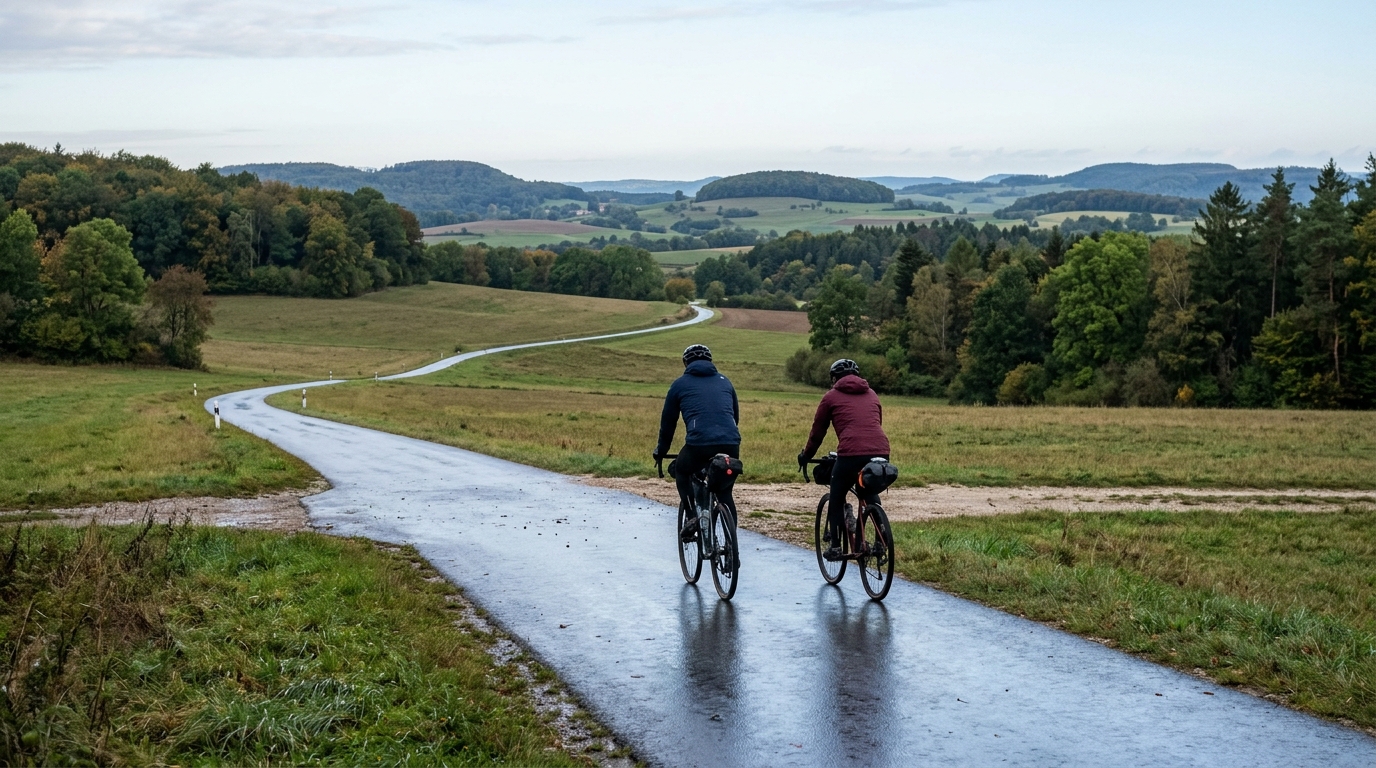
Schwäbische-Alb-Radweg
A point-to-point German asphalt route: 299.4 km, 2185 m of climbing, and a ride shaped by steady accumulation rather than a single decisive climb.
- Distanz
- 299.4km
- Höhenmeter
- 2,185m
- Untergrund
- —
- Form
- Punkt-zu-Punkt
Die Route
Höhenprofil
Schwäbische-Alb-Radweg cycling route overview
The Schwäbische-Alb-Radweg cycling route is a long point-to-point asphalt ride in Germany, covering 299.4 km with 2185 m of elevation gain. That combination tells you a lot about its character before you turn a pedal: this is not a short punchy loop built around one decisive climb, and it is not a flat transport stage either. It is a route where the workload accumulates.
Because there are no listed notable climbs in the route data, the climbing should be treated as distributed rather than concentrated around a single set-piece ascent. That changes the tactical problem. Instead of saving everything for one obvious climb, the better approach is to manage effort across the full distance, especially if riding it in one long push or over consecutive days.
Terrain and ride feel
The all-asphalt surface makes the Schwäbische-Alb-Radweg more predictable than a mixed-surface endurance route. Tyre choice, pacing, and fuelling can be planned around road riding rather than constant changes in grip or rolling resistance. That does not make it easy. Over 299.4 km, 2185 m of gain is still enough to punish repeated surges, poor pacing, or a late start with under-fuelled legs.
The key feature is the relationship between distance and elevation. The climbing is meaningful, but the route profile suggests endurance matters more than pure climbing explosiveness. Riders who settle into a sustainable rhythm will likely get more from the day than riders who treat every rise as an interval. If you use power, anchor the ride around a realistic endurance target relative to your /glossary/ftp rather than chasing speed on every uphill section.
Pacing and practical notes
The route is not a loop, so logistics matter. Start and finish planning should be handled before the ride, not improvised at the end of a long day. Transport, accommodation, or a pickup plan becomes part of the route strategy.
Practical priorities:
- Plan around the full 299.4 km distance, not just the climbing total.
- Expect asphalt throughout, based on the route data.
- Pace the elevation gain as cumulative fatigue rather than a single major climb.
- Avoid early spikes if riding the route in one day.
- If splitting the route, divide stages by total workload, not just kilometres.
Who this route suits
This is a strong fit for riders who want a road-based endurance challenge with enough elevation to keep the ride honest. It rewards steady aerobic power, good fuelling habits, and disciplined pacing more than a single climbing performance.
The Schwäbische-Alb-Radweg cycling route is best understood as a long-form endurance ride: asphalt under the tyres, nearly 300 km to manage, and climbing that matters because it keeps arriving across the route rather than announcing itself in one obvious place.
Ähnliche Routen
3-Länder-Radweg
A 302.2 km asphalt route in Germany with 1512 m of climbing and point-to-point logistics shaped by the Reußenkreuz climb.
7 Peaks Alpine Challenge
A 110.9 km point-to-point assault through the Victorian Alps, stacking 3404 metres of climbing across relentless, wind-swept high-country ascents.
Aberdare Range
A 46 km asphalt point-to-point through Kenya's Central Highlands that trades big climbs for a relentless 1,700 m of rolling grind.
Abra Málaga
A 45-kilometer point-to-point ribbon of asphalt through Peru's Sacred Valley, climbing 1,699 relentless meters into the high Andes.
Afriski Mahlasela Pass
A 112.8 km asphalt ascent through the Maloti Mountains, climbing 3,384 m to the roof of southern Africa via the storied Mahlasela Pass.
Ahr Cycleway
An 82.9 km asphalt point-to-point route with 541 m of gain, the Ahr Cycleway is a steady endurance ride rather than a climb-focused day.