Oder-Spree-Tour
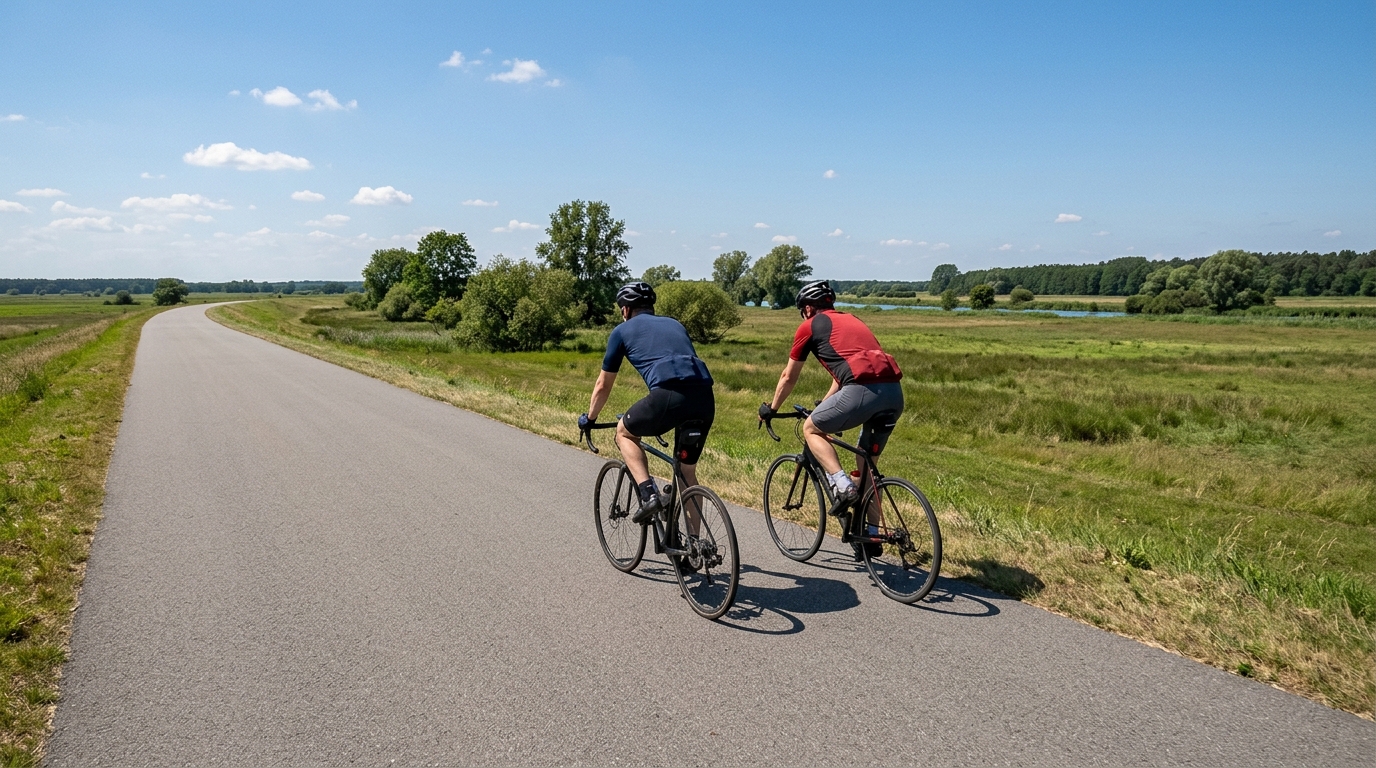
A long asphalt point-to-point ride in Germany with very low climbing for its distance, making pacing, fueling, and position more important than climbing form.
- Distanz
- 324.1km
- Höhenmeter
- 534m
- Untergrund
- —
- Form
- Punkt-zu-Punkt
Die Route
Höhenprofil
Oder-Spree-Tour cycling route overview
The Oder-Spree-Tour is a 324.1 km asphalt cycling route in Germany, and its defining feature is not climbing difficulty but duration. With 534 m of elevation gain across the full distance, this is a route where the terrain profile points toward sustained endurance riding rather than repeated climbing efforts.
That matters for how the ride should be approached. On a route this long, low elevation gain does not make it easy. It changes the limiter. Instead of needing repeated high-torque climbing surges, the challenge shifts toward holding a stable output, managing contact points, eating consistently, and staying mentally switched on as the hours accumulate.
Terrain and ride character
The surface is asphalt, so the route is best understood as a road-focused endurance ride. The lack of listed notable climbs reinforces the same conclusion: the Oder-Spree-Tour is unlikely to be decided by a single decisive ascent. The better approach is to think in terms of efficiency.
Small decisions compound over 324.1 km. Riding too hard early, skipping nutrition because the road feels manageable, or spending too much time above endurance pace can all become expensive later. This is the type of route where a disciplined rider can gain more from restraint than aggression.
For riders using power, this is a good candidate for setting a conservative ceiling relative to /glossary/ftp rather than chasing speed. The profile suggests fewer natural reset points, so pacing has to be self-imposed. If the effort feels too easy early, that is usually a sign the pacing is correct for a route of this length.
Practical notes
Because the Oder-Spree-Tour is not a loop, logistics matter. Start and finish planning should be handled before the ride, especially if riding it as a single long day. A point-to-point route can be rewarding because it gives the ride a clear sense of progression, but it also leaves less room for improvisation at the end.
Key preparation points:
- Use a road bike or endurance setup suited to asphalt.
- Prioritize comfort, especially saddle, hands, and neck position.
- Build a fueling plan around elapsed time, not perceived difficulty.
- Keep early intensity controlled, even if the low climbing total makes the route feel forgiving.
- Plan transport around the non-loop format.
Who it suits
This route suits riders looking for a long, steady endurance challenge more than a climbing test. It is also a strong option for athletes preparing for ultra-distance events, long fondos, or any ride where aerobic durability matters more than peak climbing power.
The headline number is the distance, but the real story is how little elevation gain sits inside it. That combination makes the Oder-Spree-Tour a test of patience, execution, and durability on asphalt.
Ähnliche Routen
3-Länder-Radweg
A 302.2 km asphalt route in Germany with 1512 m of climbing and point-to-point logistics shaped by the Reußenkreuz climb.
7 Peaks Alpine Challenge
A 110.9 km point-to-point assault through the Victorian Alps, stacking 3404 metres of climbing across relentless, wind-swept high-country ascents.
Aberdare Range
A 46 km asphalt point-to-point through Kenya's Central Highlands that trades big climbs for a relentless 1,700 m of rolling grind.
Abra Málaga
A 45-kilometer point-to-point ribbon of asphalt through Peru's Sacred Valley, climbing 1,699 relentless meters into the high Andes.
Afriski Mahlasela Pass
A 112.8 km asphalt ascent through the Maloti Mountains, climbing 3,384 m to the roof of southern Africa via the storied Mahlasela Pass.
Ahr Cycleway
An 82.9 km asphalt point-to-point route with 541 m of gain, the Ahr Cycleway is a steady endurance ride rather than a climb-focused day.