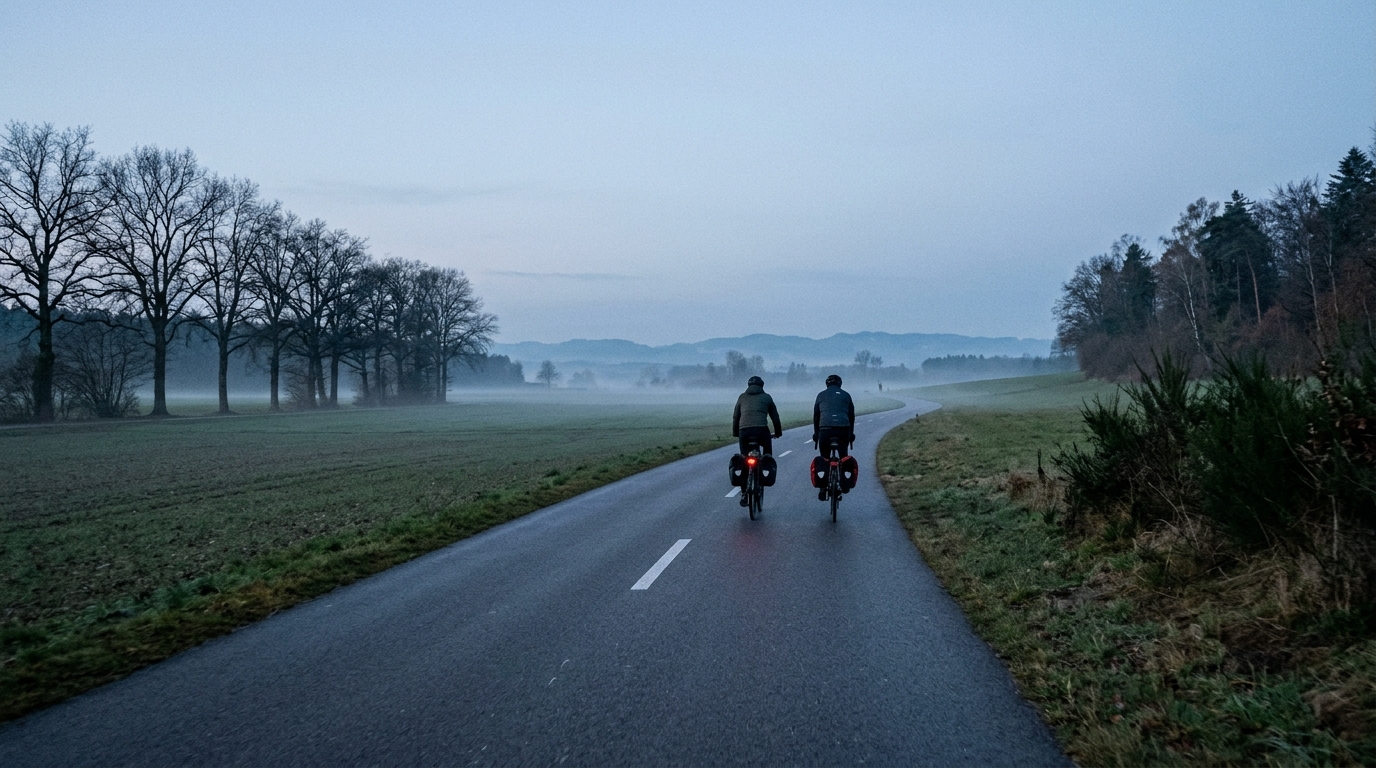
Industrieveloweg Winterthur
A practical 30 km asphalt route in CH with just 75 m of gain, suited to steady riding, commuting-style endurance, and controlled aerobic work.
- Distanz
- 30km
- Höhenmeter
- 75m
- Untergrund
- —
- Form
- Punkt-zu-Punkt
Die Route
Höhenprofil
Industrieveloweg Winterthur cycling route
Industrieveloweg Winterthur is a 30 km asphalt route in CH with 75 m of elevation gain. That combination tells you almost everything about its character: this is not a climbing test, and it is not a route built around one decisive feature. It is a low-gain, road-surface ride where the value comes from rhythm, consistency, and how well you manage effort across the full distance.
Because the route is not a loop, it needs a little more planning than a simple out-and-back circuit. Treat it as a point-to-point ride unless you are deliberately adding a return leg. That matters for pacing and logistics. If the goal is controlled endurance, avoid riding the opening section like a warm-up that can be ignored. On a 30 km route with very little elevation gain, speed and fatigue are shaped less by climbing and more by how evenly you hold pressure on the pedals.
Terrain and ride feel
The surface is asphalt, so the route suits a road bike, endurance bike, or any efficient setup with tyres appropriate for paved riding. With only 75 m of gain, there is no obvious climbing structure to break the route into hard efforts and recoveries. Instead, expect a flatter, more continuous ride where small changes in pace can accumulate quickly.
The absence of notable climbs changes the tactical feel. You are unlikely to need climb-specific gearing or a plan built around saving energy for a major ascent. The smarter approach is to set a sustainable intensity early, then hold it. For endurance work, that means staying comfortably below /glossary/ftp rather than chasing every acceleration.
How to use the route
This route is best suited to:
- Steady aerobic endurance riding
- Low-stress fitness maintenance
- Commuting-style training on asphalt
- Controlled tempo blocks without major climbing interruptions
- Riders who want distance without much elevation load
The main performance trap is assuming that low elevation makes the route automatically easy. A flat 30 km ride still asks for concentration, especially if the goal is smooth power rather than stop-start effort. Without climbs to dictate intensity, the responsibility shifts to the rider. Cadence, position, and pacing become the structure.
Practical notes
Plan the finish before you start, because this is not listed as a loop. If you want a longer session, the simplest extension is to ride back, but that changes the nature of the day from a 30 km route into a longer endurance ride. For the listed route itself, keep the setup simple: paved-surface tyres, normal road gearing, and enough food or drink for a steady ride of this distance.
Industrieveloweg Winterthur is a practical, efficient route rather than a dramatic one. Its strength is exactly that simplicity: asphalt, modest elevation gain, and enough distance to make pacing matter.
Ähnliche Routen
3-Länder-Radweg
A 302.2 km asphalt route in Germany with 1512 m of climbing and point-to-point logistics shaped by the Reußenkreuz climb.
7 Peaks Alpine Challenge
A 110.9 km point-to-point assault through the Victorian Alps, stacking 3404 metres of climbing across relentless, wind-swept high-country ascents.
Aberdare Range
A 46 km asphalt point-to-point through Kenya's Central Highlands that trades big climbs for a relentless 1,700 m of rolling grind.
Abra Málaga
A 45-kilometer point-to-point ribbon of asphalt through Peru's Sacred Valley, climbing 1,699 relentless meters into the high Andes.
Afriski Mahlasela Pass
A 112.8 km asphalt ascent through the Maloti Mountains, climbing 3,384 m to the roof of southern Africa via the storied Mahlasela Pass.
Ahr Cycleway
An 82.9 km asphalt point-to-point route with 541 m of gain, the Ahr Cycleway is a steady endurance ride rather than a climb-focused day.