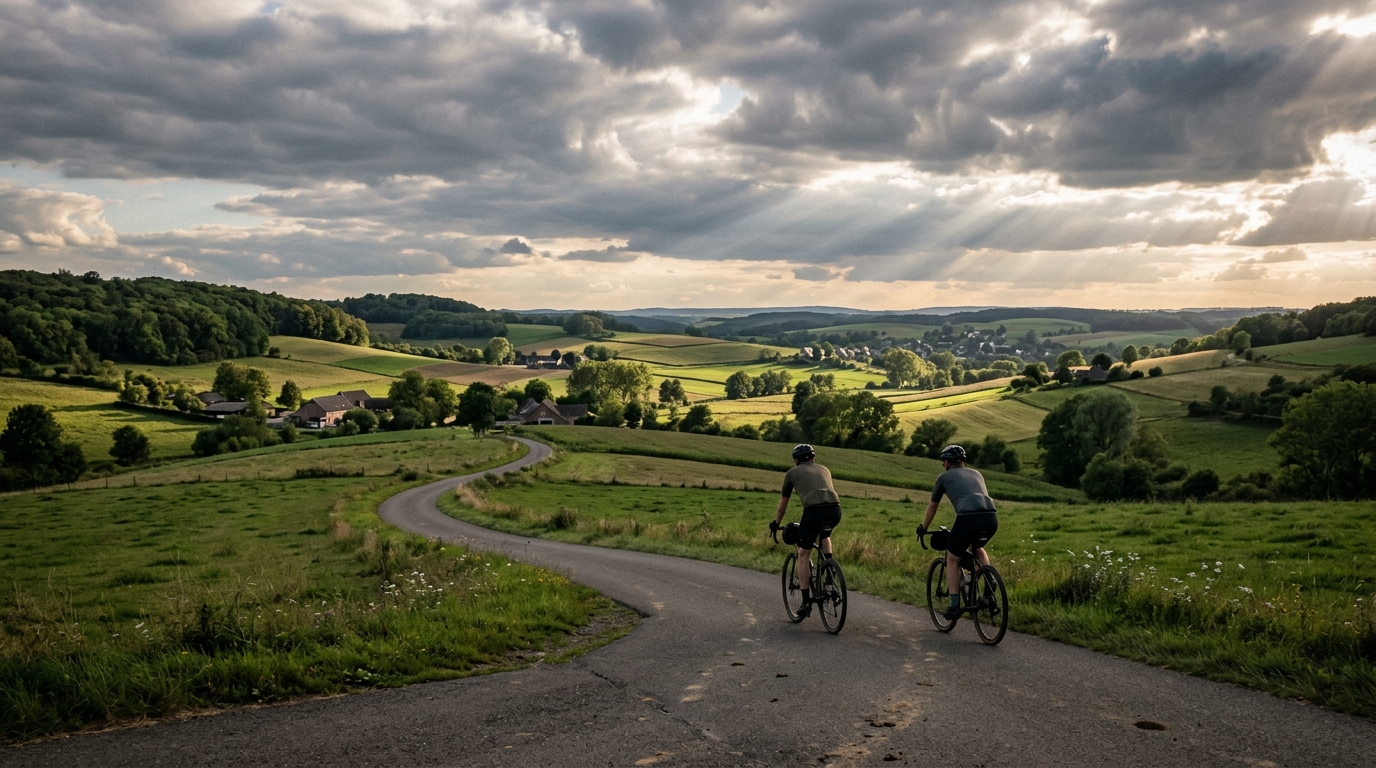
Heuvelland-Fietsroute
A 36.1 km asphalt point-to-point ride with 293 m of climbing, shaped more by repeated elevation changes than by one defining climb.
- Distanz
- 36.1km
- Höhenmeter
- 293m
- Untergrund
- —
- Form
- Punkt-zu-Punkt
Die Route
Höhenprofil
Heuvelland-Fietsroute cycling route overview
The Heuvelland-Fietsroute is a 36.1 km asphalt ride in the Netherlands with 293 m of elevation gain. On paper, that makes it a relatively compact route, but not a flat one. The climbing load is spread across the ride rather than concentrated around a listed marquee climb, so the main challenge is rhythm management rather than surviving one decisive ascent.
That matters tactically. A route like this rewards riders who can keep pressure on the pedals over rolling terrain without repeatedly spiking above threshold. If every rise becomes a short effort, the accumulated cost can arrive late in the ride, especially because the route is not a loop. You are not automatically finishing where you started, so pacing, fuelling, and logistics all need to be treated with a little more intent.
Terrain and ride character
With asphalt as the listed surface, this is best understood as a road-oriented route. A road bike or endurance road setup is the natural fit, and tyre choice can lean toward efficiency rather than mixed-surface security.
The elevation gain of 293 m across 36.1 km gives the ride a rolling profile. There are no notable climbs listed, which usually changes the feel of the day. Instead of saving energy for a named ascent, the smarter approach is to ride the terrain evenly: stay seated where possible, avoid unnecessary accelerations over the tops, and let speed return naturally on descents or flatter sections.
For riders using power, this is the kind of course where discipline around /glossary/ftp matters. The goal is not to prove fitness on every incline. It is to keep the effort controlled enough that the final third still feels productive rather than defensive.
Practical notes
Pacing
Treat the route as short but not effortless. The distance is manageable, but the elevation gain is enough to punish stop-start riding. Keep early climbs conservative and avoid turning every change in gradient into a surge.
Logistics
Because the Heuvelland-Fietsroute is not listed as a loop, plan the finish before you start. That may mean arranging a return ride, linking it with another route, or building your own connection back to the start.
Equipment
The asphalt surface keeps equipment choices simple. A well-maintained road bike, reliable braking, and gearing suited to repeated changes in gradient are the key priorities. There is no listed gravel or mixed-surface component to plan around.
Bottom line
The Heuvelland-Fietsroute is a concise asphalt route with enough climbing to stay interesting. Its difficulty is not defined by one famous ascent, but by how efficiently you manage repeated elevation changes over 36.1 km. Ride it smoothly, solve the point-to-point logistics in advance, and it should deliver a controlled but engaging endurance session.
Ähnliche Routen
3-Länder-Radweg
A 302.2 km asphalt route in Germany with 1512 m of climbing and point-to-point logistics shaped by the Reußenkreuz climb.
7 Peaks Alpine Challenge
A 110.9 km point-to-point assault through the Victorian Alps, stacking 3404 metres of climbing across relentless, wind-swept high-country ascents.
Aberdare Range
A 46 km asphalt point-to-point through Kenya's Central Highlands that trades big climbs for a relentless 1,700 m of rolling grind.
Abra Málaga
A 45-kilometer point-to-point ribbon of asphalt through Peru's Sacred Valley, climbing 1,699 relentless meters into the high Andes.
Afriski Mahlasela Pass
A 112.8 km asphalt ascent through the Maloti Mountains, climbing 3,384 m to the roof of southern Africa via the storied Mahlasela Pass.
Ahr Cycleway
An 82.9 km asphalt point-to-point route with 541 m of gain, the Ahr Cycleway is a steady endurance ride rather than a climb-focused day.