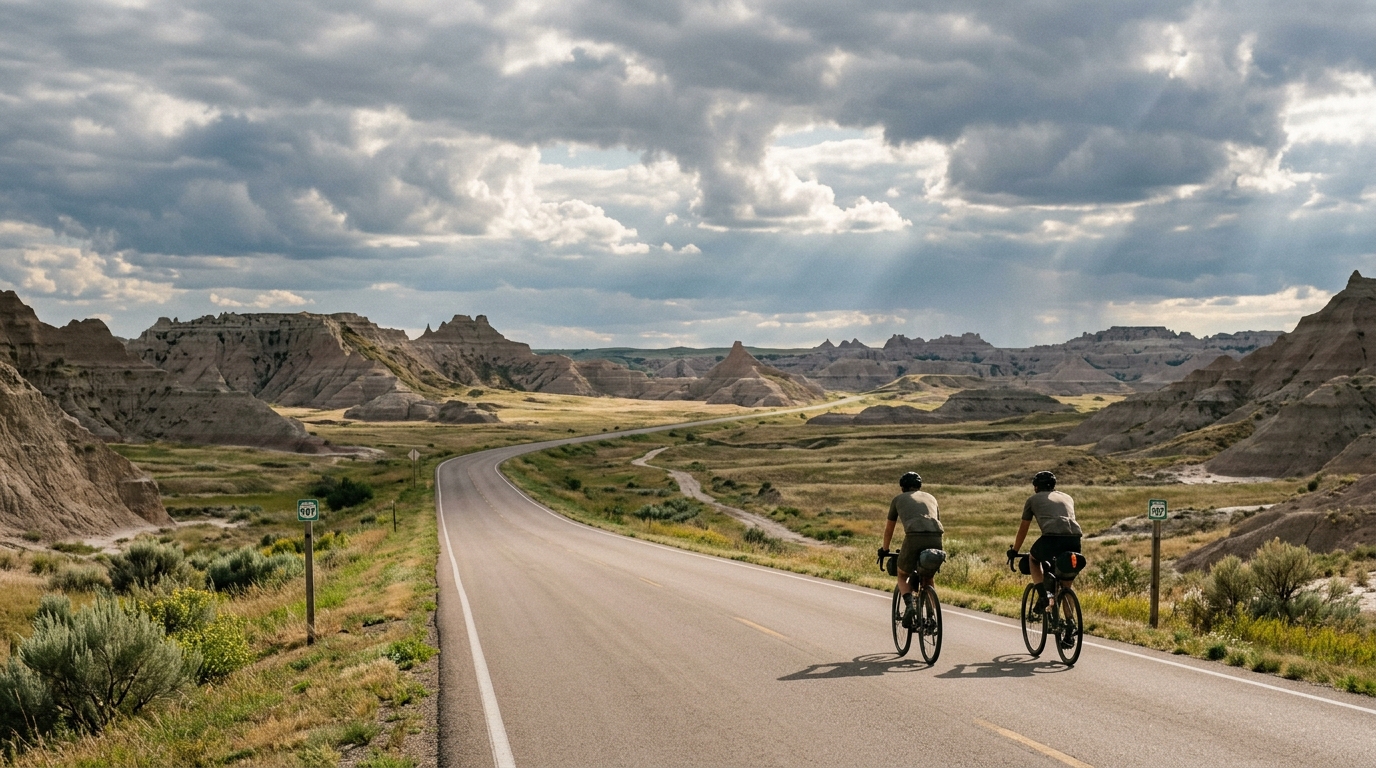
U.S. Bicycle Route 987
A low-climbing asphalt point-to-point route in the US, best read as a steady endurance ride rather than a climbing challenge.
- Distanca
- 63.9km
- Penjanje
- 188m
- Podloga
- —
- Oblik
- Od tačke do tačke
Ruta
Profil visine
U.S. Bicycle Route 987 route character
U.S. Bicycle Route 987 is a 63.9 km asphalt route in the United States with 188 m of elevation gain. The headline is not climbing difficulty. It is continuity, pacing, and logistics. With no notable climbs listed in the route data and a modest total elevation gain for the distance, this is the kind of ride that rewards steady pressure rather than repeated surges.
The route is not a loop, which matters more than the elevation profile. A point-to-point ride changes the day before it changes the legs. You need a return plan, a pickup, a transit option, or the willingness to turn it into an out-and-back. If you ride it one way, the effort can be kept clean and controlled. If you ride back, the total workload becomes a different session entirely.
Terrain and pacing
The asphalt surface makes the route suitable for a road bike setup, assuming normal road conditions. The low overall gain suggests the terrain should feel more like rolling endurance work than a decisive climbing route. That does not mean it is automatically easy. On rides like this, the absence of major climbs often shifts the limiter from gradient to exposure, wind, surface consistency, and how disciplined you are with pacing.
Because there are no listed notable climbs, the best approach is to avoid treating the early kilometres as free speed. A route with modest elevation can still punish repeated accelerations, especially if the return logistics create time pressure. Keep the effort below threshold early, settle into a sustainable rhythm, and let the route's simplicity work for you. If you are using power, this is well suited to an aerobic endurance target tied to your /glossary/ftp rather than a maximal climbing effort.
Practical notes
The key planning point is the non-loop format. Start by deciding whether the ride is a one-way transfer, a point-to-point endurance session, or part of a longer day. That decision determines nutrition, timing, and how much intensity makes sense.
Use the surface and elevation profile to your advantage:
- Road tires are the natural choice for an asphalt route.
- Keep pacing steady, since the route does not appear to offer major climb-based regroup points.
- Plan the finish logistics before you start, because the route does not close back on itself.
- Carry enough food and fluids for the full 63.9 km, rather than assuming a loop will naturally return you to supplies.
Who it suits
U.S. Bicycle Route 987 cycling route looks best for riders who want controlled endurance, a point-to-point road ride, or a low-climbing day where consistency matters more than climbing legs. It is also a useful option for testing equipment, position, or fueling because the profile should make it easier to hold a stable effort without a major climb dictating the ride.
Slične rute
3-Länder-Radweg
A 302.2 km asphalt route in Germany with 1512 m of climbing and point-to-point logistics shaped by the Reußenkreuz climb.
7 Peaks Alpine Challenge
A 110.9 km point-to-point assault through the Victorian Alps, stacking 3404 metres of climbing across relentless, wind-swept high-country ascents.
Aberdare Range
A 46 km asphalt point-to-point through Kenya's Central Highlands that trades big climbs for a relentless 1,700 m of rolling grind.
Abra Málaga
A 45-kilometer point-to-point ribbon of asphalt through Peru's Sacred Valley, climbing 1,699 relentless meters into the high Andes.
Afriski Mahlasela Pass
A 112.8 km asphalt ascent through the Maloti Mountains, climbing 3,384 m to the roof of southern Africa via the storied Mahlasela Pass.
Ahr Cycleway
An 82.9 km asphalt point-to-point route with 541 m of gain, the Ahr Cycleway is a steady endurance ride rather than a climb-focused day.