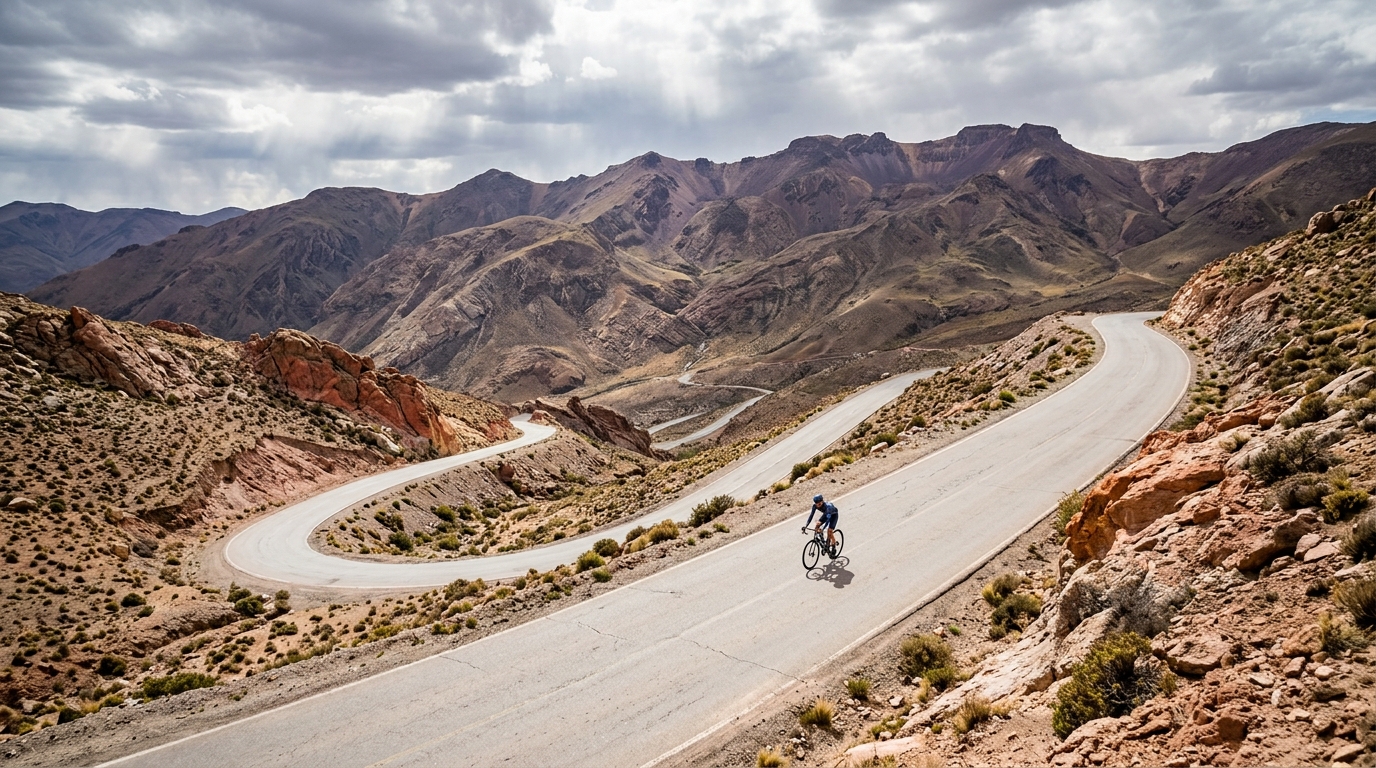
Portezuelo del Cajón
A high-altitude HC climb in Bolivia: 17.6km at 7.37%, rising from 3,184m to 4,482m with pitches up to 11.5%.
- Duž ina
- 17.6km
- Prosek
- 7.4%
- Maks
- 11.5%
- Vrh
- 4,482m
- Visinska razlika
- 1,270m
Uspon
Profil nagiba
Portezuelo del Cajón cycling climb profile
Portezuelo del Cajón is an HC climb in Bolivia that asks for restraint before it asks for strength. On paper, the headline is clear: 17.6km at an average gradient of 7.37%, starting at 3,184m and topping out at 4,482m. That gives the climb 1,298m of net elevation gain, which is the real story here. This is not a short effort with one decisive wall. It is a long, sustained climb at altitude where small pacing errors compound quickly.
What it feels like to ride
The average gradient tells you this climb is consistently serious. A 7.37% average over 17.6km leaves limited room for meaningful recovery, even before considering the altitude. The maximum gradient of 11.5% suggests the climb has sharper ramps, but the difficulty is less about any single pitch and more about having to keep producing climbing power for a long time.
That matters tactically. Riders who treat the lower slopes like a normal threshold climb risk paying for it higher up, where the summit sits at 4,482m. At that elevation, the same power output is harder to sustain, and accelerations become more expensive. The climb rewards a controlled effort that feels almost too conservative early, then holds together when the road continues to rise.
How the gradient unfolds
With the available profile data, the safest read is that Portezuelo del Cajón should be approached as a steady high-mountain grind rather than a climb with obvious recovery steps. The 11.5% maximum is steep enough to break rhythm, so expect moments where cadence drops and torque rises, but the 7.37% average is the number that should govern your pacing.
The key is not to chase speed when the gradient briefly eases or to force the steeper pitches as if they are isolated efforts. Over 17.6km, every surge has a cost. The better strategy is to smooth the power, let cadence fluctuate slightly when the road kicks up, and avoid digging into anaerobic reserves unless the summit is genuinely close.
Pacing and gearing notes
Start below your sustainable climbing effort, especially if using /glossary/ftp as a pacing anchor. The first priority is staying aerobic and keeping breathing under control. If the opening section feels easy, that is a useful sign, not an invitation to lift the pace.
Gearing should be chosen for the 11.5% maximum gradient, not the 7.37% average. You want a low enough climbing gear to keep seated pressure manageable on the steepest ramps, because grinding too hard early can load the legs before the altitude has fully made itself felt.
Practical approach:
- Settle into a controlled rhythm from the base at 3,184m.
- Pace for the full 17.6km, not for the first strong-feeling section.
- Use the easier moments to stabilize breathing and cadence, not to accelerate.
- Keep a gear available for the 11.5% ramps so cadence does not collapse.
- Treat the final elevation gain to 4,482m as the decisive difficulty, even if the gradient never becomes extreme.
Portezuelo del Cajón is hard because it combines length, sustained gradient, and high altitude. The rider who wins the climb is not necessarily the one who starts fastest, but the one who keeps the effort controlled long enough for everyone else’s early mistakes to show.