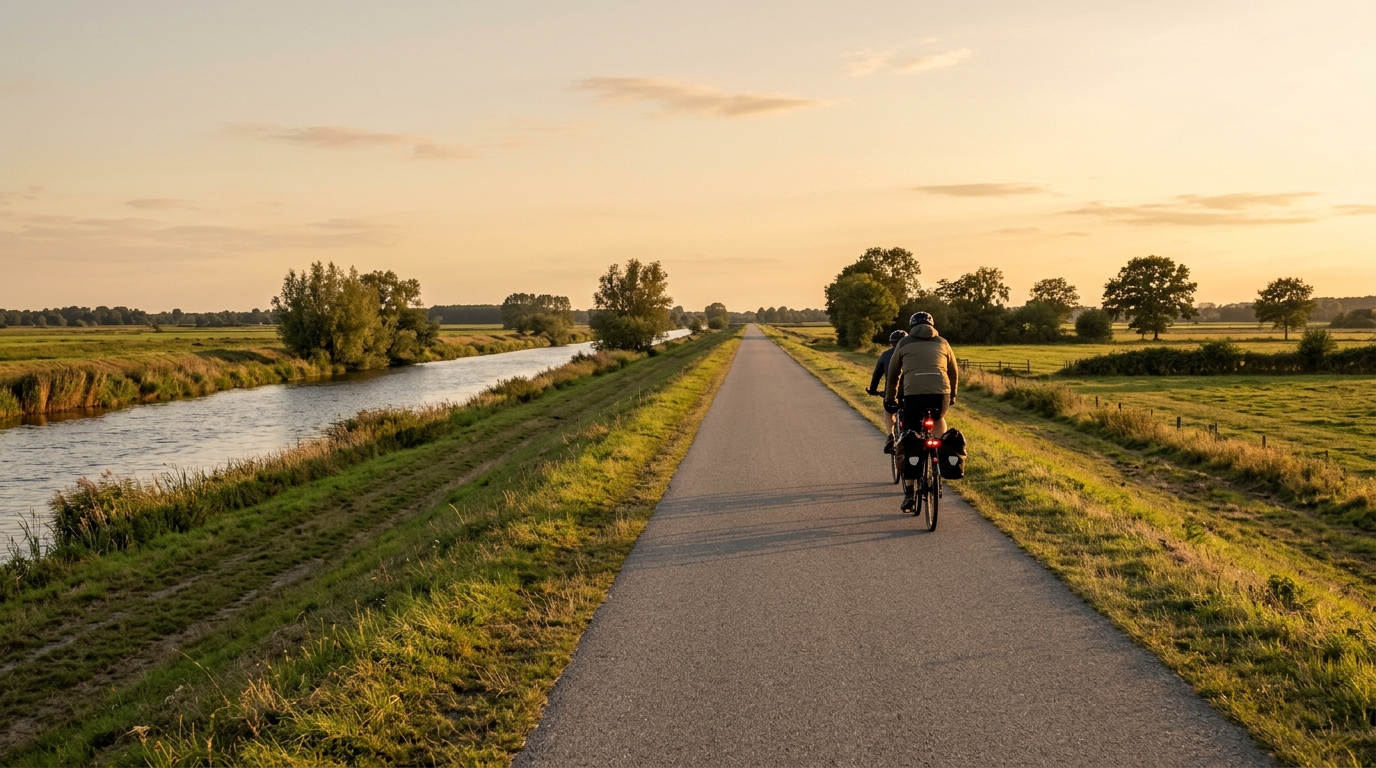
Emsradweg
A flat, asphalt, point-to-point German route where the challenge is pacing 384.2 km with almost no climbing to break the rhythm.
- Distância
- 384.2km
- Subida
- 287m
- Piso
- —
- Formato
- Ponto a ponto
A rota
Perfil de elevação
Emsradweg cycling route overview
The Emsradweg is a long, flat, point-to-point asphalt route in Germany. On paper, the defining number is not the distance alone, but the relationship between distance and elevation: 384.2 km with only 287 m of climbing. That makes this a route where the terrain is unlikely to decide the ride through steep gradients or repeated climbs. The limiter is more likely to be pacing discipline, contact-point comfort, fuelling consistency, and the mental load of holding a steady effort for a very long time.
Because the supplied route data lists no notable climbs, the Emsradweg should be approached less like a climbing challenge and more like an endurance execution test. There are fewer natural terrain breaks, which can sound easy until the ride becomes hours of continuous pedalling without the forced resets that climbs and descents provide.
Terrain and ride character
The asphalt surface points toward a road-bike-friendly setup, assuming normal conditions. With such low total elevation gain, the route should reward smooth power rather than punchy accelerations. Riders who over-ride the early sections because the gradients feel forgiving can still pay for it later, since 384.2 km leaves plenty of time for small pacing errors to compound.
This is the kind of profile where effort can drift upward without obvious warning. On hillier routes, the terrain tells you when to back off. Here, that feedback is weaker. Using a power cap, heart-rate ceiling, or perceived-effort anchor matters more than chasing speed. If riding with power, keep the early effort comfortably below threshold rather than treating the flat profile as permission to sit near FTP.
Practical notes
Pacing
Start easier than the distance makes tempting. The absence of major climbing does not make the ride short, and the main risk is turning a steady endurance route into a slow-burn fatigue trap.
Equipment
The asphalt surface supports a fast, efficient setup. Prioritise comfort over marginal speed gains, especially at the saddle, hands, and neck. On a route this long, a position that is slightly less aggressive but sustainable is usually the better trade.
Logistics
The route is not a loop, so transport planning matters. Decide before the ride how the start and finish will be connected, whether by train, shuttle, or a planned pickup. That detail is not secondary on a point-to-point route of this length.
Bottom line
The Emsradweg is not hard because it climbs. It is hard because it asks for sustained, patient execution across 384.2 km of mostly flat asphalt. Treat it as an endurance route first and a speed route second, and the profile becomes an advantage rather than a trap.
Rotas relacionadas
3-Länder-Radweg
A 302.2 km asphalt route in Germany with 1512 m of climbing and point-to-point logistics shaped by the Reußenkreuz climb.
7 Peaks Alpine Challenge
A 110.9 km point-to-point assault through the Victorian Alps, stacking 3404 metres of climbing across relentless, wind-swept high-country ascents.
Aberdare Range
A 46 km asphalt point-to-point through Kenya's Central Highlands that trades big climbs for a relentless 1,700 m of rolling grind.
Abra Málaga
A 45-kilometer point-to-point ribbon of asphalt through Peru's Sacred Valley, climbing 1,699 relentless meters into the high Andes.
Afriski Mahlasela Pass
A 112.8 km asphalt ascent through the Maloti Mountains, climbing 3,384 m to the roof of southern Africa via the storied Mahlasela Pass.
Ahr Cycleway
An 82.9 km asphalt point-to-point route with 541 m of gain, the Ahr Cycleway is a steady endurance ride rather than a climb-focused day.