Immagine generata dal nostro modello.
bike fit
Cycling Bike Fit: Track Position Changes With Ride Data
Treat bike fit like training: record the baseline, change one thing at a time, and use ride data plus comfort notes to decide what works.
Why bike fit should be tracked, not guessed
A good cycling bike fit is not a fixed object you find once and then protect forever. It is a working position that has to match your body, your bike, your riding goals, and your current durability.
That last part matters. A position that felt perfect during a low-volume period can become a problem when training load rises. A saddle that felt fine indoors can behave differently on rough roads. A bar position that feels fast for a short effort may quietly cost you when fatigue builds.
The mistake many riders make is treating fit changes like vibe checks. The saddle goes up because power feels flat. The cleats move because the knees feel off. The stem changes because someone said the position looks cramped. Sometimes the change helps, but because nothing was recorded, the rider never knows why.
Bike fit data does not replace a skilled fitter, and it does not turn every rider into a biomechanics expert. What it does is create a controlled feedback loop. You make a defined change, ride it in a way that gives useful information, then compare the outcome against your baseline.
That is the same logic that makes structured training useful. Without a baseline, every new sensation feels meaningful. With a baseline, you can separate a real fit signal from normal day-to-day noise.
For endurance athletes, the goal is not just comfort. It is repeatable output. A sustainable position should let you produce power, breathe well, handle the bike, fuel normally, and recover from ride to ride. If a fit change gives you a brief feeling of freshness but creates new pressure, altered cadence, or higher cost at familiar power, the data will usually start telling that story before the injury fully arrives.
Record the baseline before changing the bike
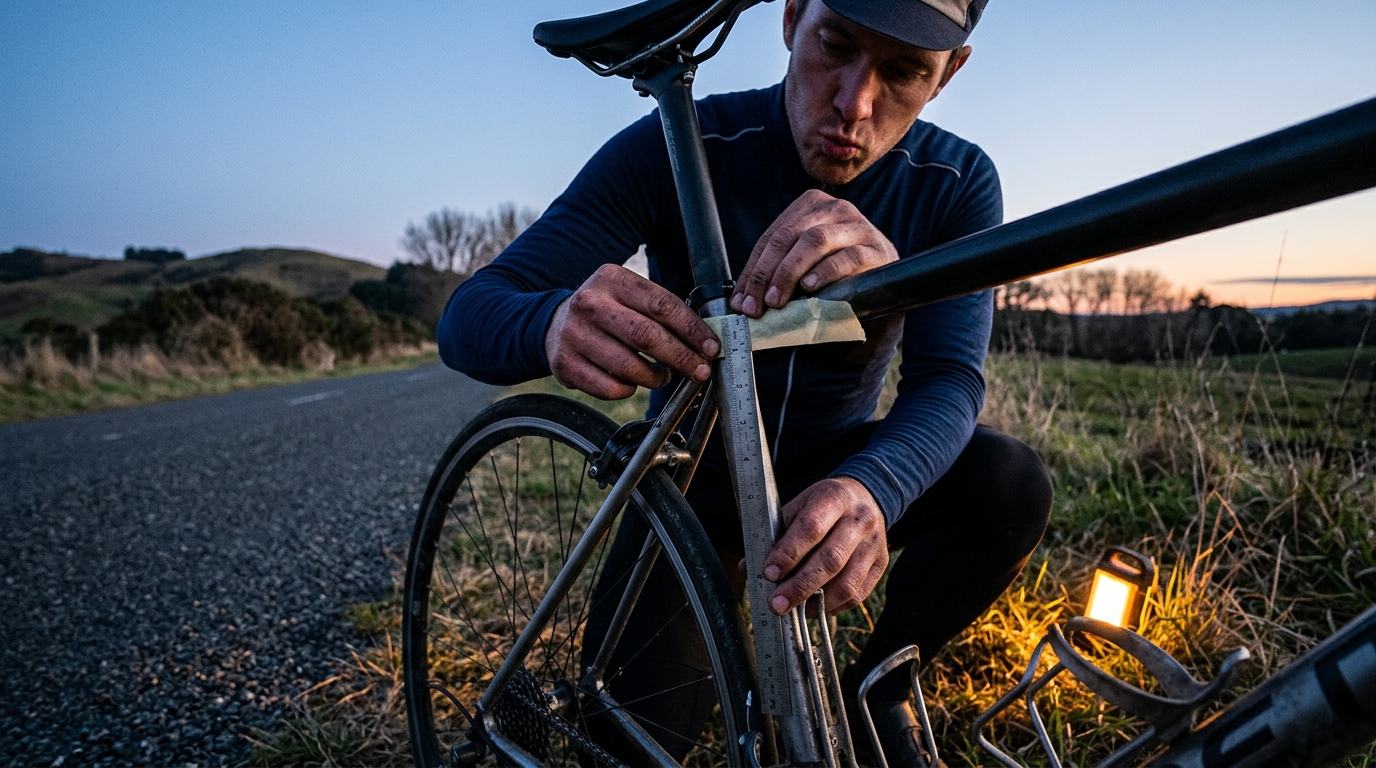
Before changing anything, record the current position. Do this even if the fit feels wrong. A flawed baseline is still useful because it gives you a reference point. Without it, reverting becomes guesswork.
At minimum, log the contact points and controls that shape your posture:
- Saddle height, measured with the same method from the center of the bottom bracket to a consistent point on the saddle
- Saddle setback, measured relative to the bottom bracket using the same reference each time
- Saddle tilt, with the bike level and the device placed in the same location on the saddle
- Saddle model and rail position
- Cleat fore-aft position, lateral position, rotation, and any shims or wedges
- Handlebar reach, including stem length, spacer setup, bar reach, and hood placement
- Bar height relative to the saddle, measured with a repeatable method
- Handlebar rotation and lever angle
- Crank length, pedal model, shoe model, and insole setup
The exact tools matter less than consistency. If you use a tape measure, use the same tape and the same landmarks. If you use a phone level, place it in the same spot each time. Photos help as long as they are taken from repeatable angles with the bike upright and level.
The point is not to create a museum-grade fit document. The point is to give every future decision a known starting point. 'I raised the saddle a little' is not useful fit data. A record of the old setting, the new setting, the reason for the change, and the ride response is.
Test one fit variable at a time
The most important rule in cycling position tracking is simple: change one variable, then ride it enough to understand the effect. If you raise the saddle, move the cleats, rotate the bars, and swap insoles at the same time, you may feel better or worse, but you will not know which input caused the result.
This is where cyclists often get trapped. Fit variables are connected. Saddle height can change how much you reach for the bars. Cleat position can alter how your knee tracks. Bar height can change pelvic rotation and saddle pressure. Because the system is connected, it is tempting to overhaul everything at once. That feels decisive, but it usually destroys the evidence.
A cleaner process looks like this:
- Define the problem in plain language before touching the bike
- Choose the most likely variable linked to that problem
- Make a small, measurable change
- Keep all other equipment and setup unchanged
- Ride familiar routes or repeat familiar efforts
- Record both data and sensations
- Decide whether the signal is clear enough to keep testing, revert, or seek expert input
For example, if the problem is posterior knee tension after harder rides, saddle height is relevant, but it is not the only possible cause. The useful move is not to chase every related variable. It is to adjust the most plausible one, record it, and observe whether the symptom changes without creating a new problem elsewhere.
This process also protects athletes from overreacting to a single bad ride. Power can be suppressed by fatigue. Heart rate can drift because of heat, stress, caffeine, poor sleep, or dehydration. Cadence can change because of terrain or pacing. Fit analysis becomes stronger when the same pattern appears across familiar conditions, not when one ride feels strange.
Ride data signals that suggest a fit problem
Bike fit symptoms usually show up first as sensations: pressure, numbness, tightness, instability, or a loss of fluidity. Ride data helps show whether those sensations are also changing the cost of the work.
Power is the obvious metric, but it should be interpreted carefully. A new position that reduces power during familiar efforts may be a problem, but not always. Some changes require adaptation. The more important question is whether the position allows power to be produced with normal breathing, normal cadence behavior, and normal perceived effort. If power is stable but the ride feels more expensive, the fit may be creating hidden cost.
Cadence is especially useful because it can reveal compensation. If a rider usually pedals smoothly across a range of efforts but suddenly gravitates toward a narrower cadence range after a fit change, the body may be avoiding a part of the pedal stroke. This is not proof of a bad fit, but it is a signal worth logging.
Heart rate adds another layer. If heart rate feels unusually high for familiar endurance power, or if it rises more aggressively than expected during steady riding, the issue may be fatigue, heat, or fueling. But if that change consistently appears only after a position adjustment, the position may be making the same power less economical.
Handling is less formal, but just as important. A position that looks efficient but makes the bike harder to control is not a good endurance position. If you stop eating as often because reaching for food feels awkward, avoid the drops because the front end feels overloaded, or sit more upright whenever the road gets technical, the fit is already shaping performance.
Indoor and outdoor data should also be separated. A position can feel stable on the trainer because the bike is fixed and the environment is controlled. Outside, the same setup has to manage road texture, cornering, braking, and body movement. If a change only works indoors, it may not be a complete solution.
Useful data sources include power, cadence, heart rate, ride file comments, segment comparisons on familiar terrain, and post-ride symptom notes. If you are updating training zones after a larger block of work, keep that separate from fit testing so you do not confuse fitness changes with position changes. For related training context, see FTP and the FTP estimator.
Pair comfort notes with the ride file
The biggest upgrade most riders can make is simple: write better notes. Not emotional notes. Not vague notes. Specific, repeatable notes.
Instead of 'knee felt bad,' record where the sensation appeared, when it started, what intensity made it worse, and whether it changed out of the saddle. Instead of 'saddle uncomfortable,' record whether the issue was soft tissue pressure, sit bone pressure, chafing, sliding forward, or instability. Instead of 'hands numb,' record which hand, which fingers, which bar position, and whether changing posture helped.
Good comfort notes answer these questions:
- Where was the sensation?
- When did it appear during the ride?
- What intensity or terrain made it worse?
- Did it fade, stabilize, or escalate?
- Did standing, changing hand position, or changing cadence alter it?
- Was it still present after the ride?
- Did it affect power production, fueling, handling, or willingness to stay aero?
This is where bike fit symptoms become actionable. A fitter or coach can do far more with 'right foot hot spot during sustained tempo, worse seated, improved briefly after loosening shoe' than with 'feet hurt.' The same is true if you are self-managing a minor adjustment. Specific notes reduce the chance that you solve the wrong problem.
Pair those notes with the ride file. A symptom that appears only during hard seated climbing points toward a different solution than a symptom that appears during easy endurance riding. A pressure issue that appears only after fatigue sets in may be related to posture endurance rather than the static position itself. Data gives the note context. The note gives the data meaning.
When to revert, keep testing, or stop
Not every awkward first ride means the change failed. But not every new sensation deserves patience. The decision comes down to severity, repeatability, and trade-off.
Revert quickly if a change creates sharp pain, numbness that persists, altered pedaling that feels protective, or a handling issue that makes the bike less safe. Those are not adaptation signals. They are stop signs. The same applies if the change solves a small problem by creating a larger one. A slightly better hip angle is not worth persistent hand numbness or unstable descending.
Stop testing and seek professional input if numbness persists, pain is sharp, symptoms worsen from ride to ride, or the issue affects normal movement off the bike. That can mean trouble walking normally, gripping normally, sleeping comfortably, or moving through daily life without symptoms. A qualified bike fitter can help separate a position problem from an equipment problem. A medical professional is the right call when symptoms suggest injury, nerve involvement, or anything that is not resolving after the position is returned to baseline.
Keep testing only when the change produces mild unfamiliarity without escalating symptoms, especially if the original problem improves and performance markers remain normal. Some position changes feel strange because they ask different tissues to share the work. That can be acceptable if the trend is positive and the notes stay clean.
The key is to define the decision before you get emotionally attached to the new setup. Riders often keep a poor change because it was meant to be faster, or because it came from an aesthetic idea of what a race position should look like. That is backwards. The position has to prove itself through output, comfort, and repeatability.
A good test does not ask, 'Does this feel different?' It asks, 'Does this solve the original problem without creating a more costly one?' If the answer is unclear, return to familiar routes, repeat similar efforts, and gather cleaner data. If the answer is still unclear after repeated exposure, the change probably is not strong enough to justify the risk unless a professional fit assessment supports it.
Build a long-term bike fit log
A long-term fit log does not need to be complicated. The best version is the one you will actually update. A spreadsheet, training diary, notes app, or equipment log all work as long as the entries are consistent.
Each entry should include:
- Date of change
- Bike and shoes used
- Previous setting
- New setting
- Reason for the change
- Ride types used for testing
- Key ride data observations
- Comfort notes during and after rides
- Final decision: keep, revert, modify, or ask for fit help
A simple entry can look like this:
| Date | Change | Reason | Test ride | Data signals | Comfort notes | Decision |
|---|---|---|---|---|---|---|
| YYYY-MM-DD | Saddle height changed from baseline to measured test setting | Reduce posterior knee tension | Familiar endurance loop plus normal seated climbing | Power and cadence felt typical for the effort; handling unchanged | Tension appeared later and did not escalate; no numbness or sharp pain | Keep testing on familiar rides |
That is enough. The value is not in the formatting. It is in the connection between the change, the reason, the ride response, and the decision.
Over time, this log becomes more valuable than any single measurement. It shows patterns. You may learn that certain saddle changes repeatedly increase hand pressure, or that a cleat adjustment improves knee comfort but affects calf load. You may notice that symptoms appear only when training load rises, which points less toward a single fit flaw and more toward strength, mobility, recovery, or position durability.
This is especially useful for athletes with multiple bikes. Road, gravel, time trial, and indoor setups do not need to be identical, but they should not be treated as unrelated worlds. If one bike consistently produces better power at lower perceived cost, its position is a clue. If another bike always creates the same symptom, the log will make that pattern hard to ignore.
A fit log also helps when equipment changes. New shoes, pedals, saddles, bars, and shorts can all alter the rider-bike interface. Without records, it is easy to blame fitness when the real change was mechanical. With records, you can see when the symptom started and what changed immediately before it.
The practical standard for a data-driven fit
The standard is not perfection. It is traceability. After any fit adjustment, a data-driven cyclist should be able to answer:
- What changed?
- Why was it changed?
- What happened after the change?
If you cannot answer those, the test was not controlled enough to teach you anything. If you can, then every adjustment makes the next decision better.
Cycling bike fit is often discussed as if there is a single correct position waiting to be discovered. In practice, the useful question is narrower and more performance-focused: can this position support the work you are asking your body to do?
The best fit process is patient, specific, and reversible. Record the baseline. Change one variable. Test it in conditions that matter. Keep the change only if the data and the body agree. That is how bike fit becomes part of the endurance system rather than a reaction to the latest ache.