National Cycle Route 70
A practical guide to National Cycle Route 70, a 315 km asphalt point-to-point route in GB with 2101 m of gain and a pass-heavy profile.
- Distancia
- 315km
- Desnivel
- 2,101m
- Superficie
- —
- Forma
- Punto a punto
La ruta
Perfil de elevación
National Cycle Route 70 cycling route overview
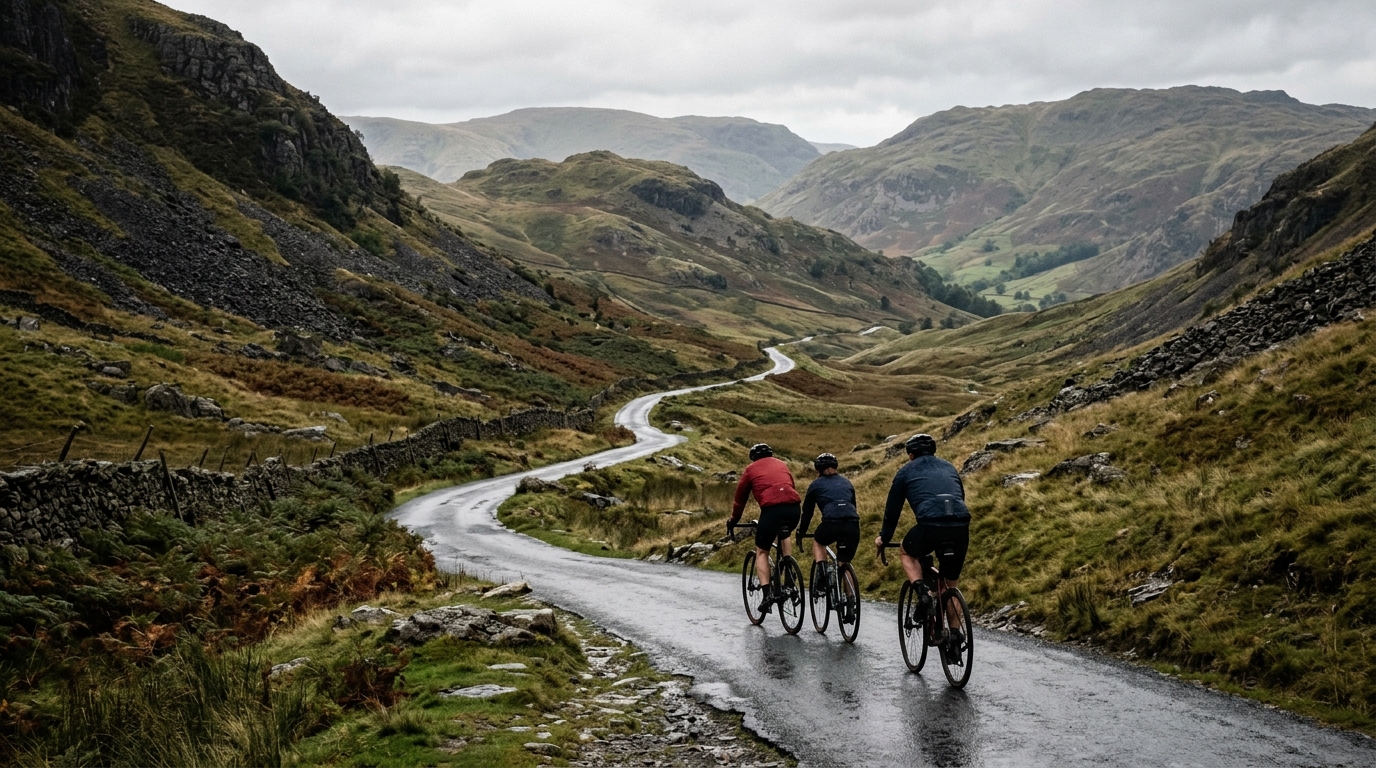
National Cycle Route 70 is a long asphalt point-to-point ride in GB, covering 315 km with 2101 m of elevation gain. On paper, that ratio suggests a route that is not defined by constant climbing from start to finish. The more useful reading is different: the climbing is likely to arrive in decisive blocks, because the route includes a serious list of named passes.
That is the central character of this ride. It is not just a long-distance roll on asphalt. It is an endurance route where pacing and logistics matter, then the terrain asks repeated questions at Wrynose Pass, Kirkstone Pass, Hardknott Pass, Honister Pass, Dunmail Raise, Buttertubs Pass, Killhope Cross, and Whinlatter Pass.
Terrain and ride feel
The surface is asphalt, which makes bike choice relatively straightforward. A road bike or fast all-road setup makes sense, with gearing chosen for control rather than ego. The total /glossary/elevation-gain is 2101 m, but the named climbs are the warning label. A route can have a manageable total climbing number and still feel severe if the harder ramps are concentrated into short, irregular sections.
The practical implication is that the route should not be paced like a flat 315 km endurance ride. The easier sections are where you protect energy, eat consistently, and avoid unnecessary surges. The passes are where the ride can unravel if you arrive over-geared, under-fuelled, or already riding above your sustainable effort.
Key climbs to respect
The notable climbs listed for National Cycle Route 70 are:
- Wrynose Pass
- Kirkstone Pass
- Hardknott Pass
- Honister Pass
- Dunmail Raise
- Buttertubs Pass
- Killhope Cross
- Whinlatter Pass
The important point is not just that these names appear. It is that a route with this many named passes rewards restraint. Treat each climb as part of a sequence, not as a standalone test. If riding with power, keep the early climbs below the effort you would be happy to repeat later. If riding by feel, the correct intensity is one where you can still settle quickly once the road eases.
Logistics and pacing notes
Because National Cycle Route 70 is not a loop, transport planning is part of the ride, not an afterthought. A point-to-point route can be more rewarding, but it removes the simplicity of returning to the start by bike unless you add extra distance outside the route.
For most riders, the 315 km distance makes this a staged ride rather than a casual single outing. The asphalt surface lowers the technical barrier, but the combination of distance, cumulative climbing, and repeated passes means fatigue will build in layers. Plan stops before they become necessary, keep fuel accessible, and assume that weather and exposure on the passes could change the feel of the route quickly.
Who it suits
National Cycle Route 70 suits riders who enjoy long-distance structure with meaningful climbing interruptions. It is not a pure climber's route by total elevation alone, and it is not a simple endurance cruise either. Its difficulty comes from the way a long asphalt route is punctuated by a concentrated list of well-known passes. Ride it patiently, gear it sensibly, and the route becomes a measured endurance challenge rather than a survival exercise.
Puertos en esta ruta
Hardknott Pass
Cat 2England's steepest road - 2.4 km from Eskdale at 13 percent average, with 30 percent ramps on the upper switchbacks.
Wrynose Pass
Cat 3Wrynose Pass is a 10.6 km Lake District climb with a deceptive 3.1% average gradient that hides a savage 18.48% maximum. Here's how the road actually unfolds.
Buttertubs Pass
Cat 3A 6.3 km Category 3 climb through the Yorkshire Dales, Buttertubs Pass averages 4.16% with sharp ramps to 13.11% — deceptively varied and worth understanding before you ride it.
Whinlatter Pass
Cat 4A short category 4 climb in Great Britain where 125m of hidden re-climbing turns a modest 3.92% average into a punchier effort than the numbers suggest.
Killhope Cross
Cat 3A 7.2km Category 3 climb in Great Britain with a modest 3.86% average that hides steep ramps and 113m of hidden climbing from undulation.
Dunmail Raise
Cat 4A compact Lake District climb: 2.8 km at 5.08%, with enough gradient to reward steady pacing over a hard early surge.
Kirkstone Pass
Cat 3Kirkstone Pass is a 6.9 km Lake District climb with 324 m of net elevation gain, an average gradient of 4.67%, and a punishing 17.24% maximum. Here's how to ride it smart.
Honister Pass
Cat 3Honister Pass is a 7.1 km Lake District climb with a deceptive average gradient of 3.97% that masks a brutal 19.67% maximum ramp. Here's how to pace and gear it.
Hardknott Pass
Cat 3A practical pacing guide to Hardknott Pass, a 4.2 km category 3 climb with a 4.94% average gradient and sharper ramps up to 13.36%.
Rutas relacionadas
3-Länder-Radweg
A 302.2 km asphalt route in Germany with 1512 m of climbing and point-to-point logistics shaped by the Reußenkreuz climb.
7 Peaks Alpine Challenge
A 110.9 km point-to-point assault through the Victorian Alps, stacking 3404 metres of climbing across relentless, wind-swept high-country ascents.
Aberdare Range
A 46 km asphalt point-to-point through Kenya's Central Highlands that trades big climbs for a relentless 1,700 m of rolling grind.
Abra Málaga
A 45-kilometer point-to-point ribbon of asphalt through Peru's Sacred Valley, climbing 1,699 relentless meters into the high Andes.
Afriski Mahlasela Pass
A 112.8 km asphalt ascent through the Maloti Mountains, climbing 3,384 m to the roof of southern Africa via the storied Mahlasela Pass.
Ahr Cycleway
An 82.9 km asphalt point-to-point route with 541 m of gain, the Ahr Cycleway is a steady endurance ride rather than a climb-focused day.