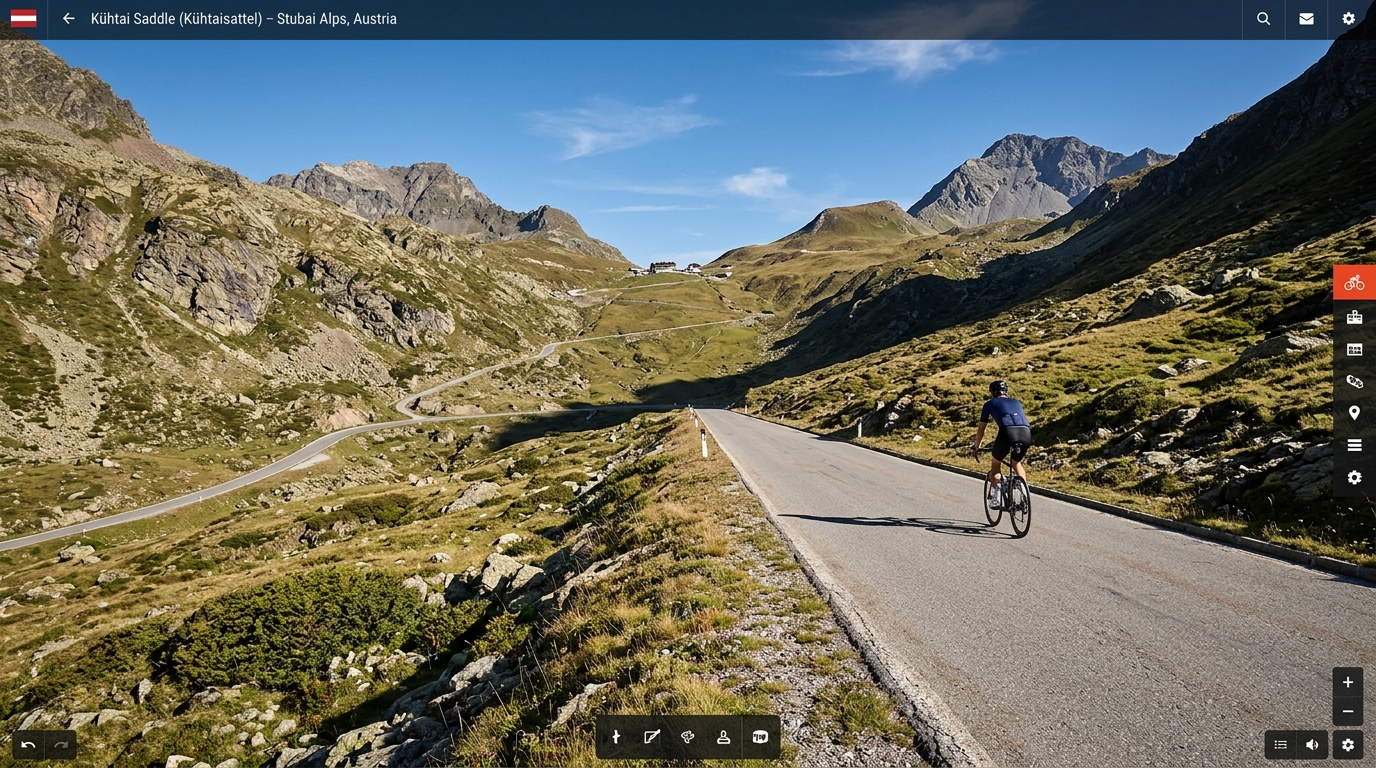
Kühtai Saddle
A practical Kühtai Saddle cycling climb profile, with pacing and gearing notes for a long HC ascent that tops out at 2013m.
- Longitud
- 24.4km
- Media
- 5.8%
- Máx
- 13.1%
- Cima
- 2,013m
- Desnivel
- 1,399m
El puerto
Perfil de desnivel
Kühtai Saddle cycling climb profile
Kühtai Saddle is an HC climb that asks for patience before it asks for power. On paper, 24.4km at 5.78% can look manageable, but that average is the trap. A climb this long, with 1399m of total ascent and a maximum gradient of 13.13%, is not a steady threshold test unless the road happens to be unusually kind. The key takeaway is that the average gradient understates the cost of the harder moments.
The climb begins at 601m and finishes at 2013m, so the ride is defined by sustained elevation gain rather than a short, violent effort. The net elevation gain is 1412m, which tells you the workload is large even before accounting for pacing errors, gearing choices, or the late-climb effect of riding near 2000m.
How the gradient unfolds
With only the headline profile available, the safest way to read Kühtai Saddle is as a long aerobic climb with selective steep sections. The 5.78% average suggests a climb that allows rhythm, but the 13.13% maximum gradient changes the ride completely. Those steeper ramps are where riders who have been sitting slightly above sustainable power start paying for it.
That matters because 24.4km gives mistakes time to compound. A short 13% pitch can be absorbed if the climb is nearly over. On an HC ascent with more than 1400m of net gain, the same ramp can force a surge that lifts lactate, raises breathing rate, and makes the next easier section feel less easy than it should.
The summit at 2013m also changes the final feel of the climb. Even without needing to overstate the altitude effect, the practical point is simple: the top comes after a long accumulation of work, so the final kilometers should be treated as the place to spend remaining capacity, not the place to discover you used it too early.
Pacing and gearing notes
Ride Kühtai Saddle from the bottom as a controlled endurance-to-tempo effort, not as a climb to attack early. If you use /glossary/ftp, the opening goal should be to stay below the power that feels heroic. The length makes consistency more valuable than ambition.
Practical approach:
- Keep the first section deliberately conservative, because the full climb is 24.4km long.
- Expect the 5.78% average to hide harder ramps, since the profile reaches 13.13%.
- Choose gearing that lets you stay seated and keep cadence under control on double-digit gradients.
- Save any sustained increase in effort for the upper part of the climb, when the remaining distance and fatigue are both clearer.
For most riders, the right gear is not the one that works on the average gradient. It is the one that still works when the road pitches toward the maximum. If you are forced into low-cadence grinding too early, Kühtai Saddle becomes less about climbing strength and more about damage limitation.