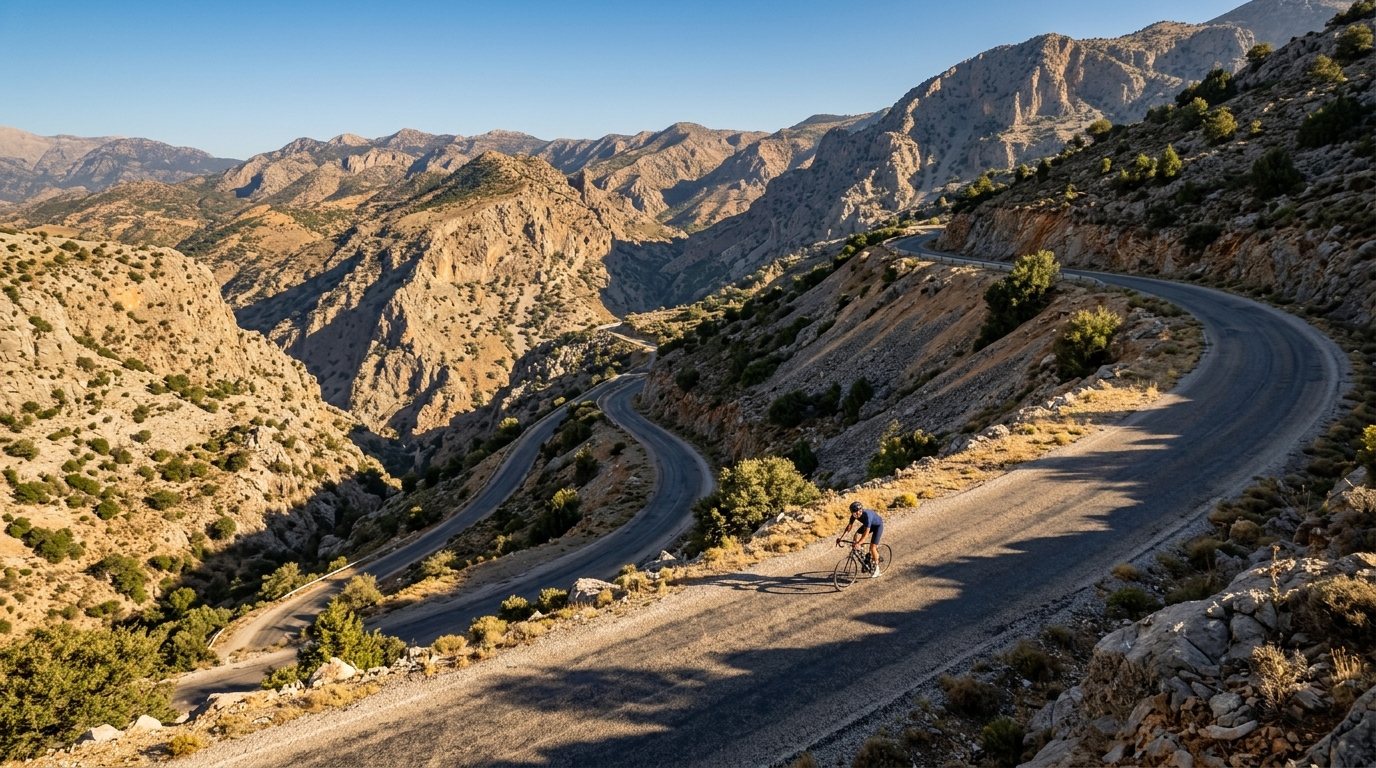
Iberian Gates
A practical profile of Iberian Gates, a long Category 2 climb in TR that rewards steady pacing more than explosive climbing.
- Longitud
- 21.7km
- Media
- 3.2%
- Máx
- 6.8%
- Cima
- 2,126m
- Desnivel
- 689m
El puerto
Perfil de desnivel
Iberian Gates cycling climb profile
Iberian Gates is a long Category 2 climb in TR, measuring 21.7 km from a start elevation of 1439 m to a summit elevation of 2126 m. On paper, the key number is not the maximum gradient of 6.81 percent, but the combination of length and restraint. With an average gradient of 3.17 percent, this is not a climb that forces repeated out-of-saddle surges. It is a climb that asks whether you can keep pressure on the pedals for a long time without gradually drifting above your sustainable effort.
The net elevation gain is 687 m, while the total ascent is 689 m. That tells you a lot about how the road behaves. This is essentially a continuous uphill drag rather than a sawtooth profile packed with meaningful descents. There may be small variations in pitch, but the overall demand is simple: keep moving upward for 21.7 km.
How the gradient unfolds
The average gradient of 3.17 percent means the climb should feel rideable for a broad range of endurance cyclists, especially compared with steeper alpine-style efforts. But that can be misleading. A shallow gradient over this distance often tempts riders into treating the early kilometres like a false flat, especially if they are riding on speed rather than effort.
The maximum gradient of 6.81 percent is important because it caps the severity of the steepest ramps. You should not need to brace for violent changes in gradient or gear-crushing walls. Instead, the harder sections are likely to feel like controlled ramps where the cost comes from already having accumulated time under load.
That makes Iberian Gates more of a diesel climb than a punchy one. The decisive mistake is not being unable to handle the steepest pitch. It is arriving there having ridden the easier gradients too hard.
Pacing and gearing notes
Treat the opening section as a setup, not a chance to bank time. On a climb with this average gradient, speed can feel cheap early, but the 21.7 km length means small over-efforts compound. If riding with power, anchor the effort below your climbing threshold and only allow pressure to rise once the summit is clearly within reach. For riders using perceived effort, the correct early sensation is controlled and slightly restrained, not sharp.
Gearing should prioritize smooth seated climbing. Since the maximum gradient is 6.81 percent, you do not need to gear exclusively for extreme steepness, but you still want enough range to avoid grinding if fatigue, wind, or altitude exposure makes the upper portion feel heavier. A comfortable low gear is still valuable because it protects cadence when the road tips toward its steepest ramps.
The summit sits at 2126 m, so the final part of the climb can feel more demanding than the gradient alone suggests. That is another reason to avoid riding the lower slopes like a tempo time trial. Iberian Gates rewards riders who keep the effort boring for most of the ascent, then use what is left near the top.
For more pacing context, see /glossary/ftp and /glossary/gradient.