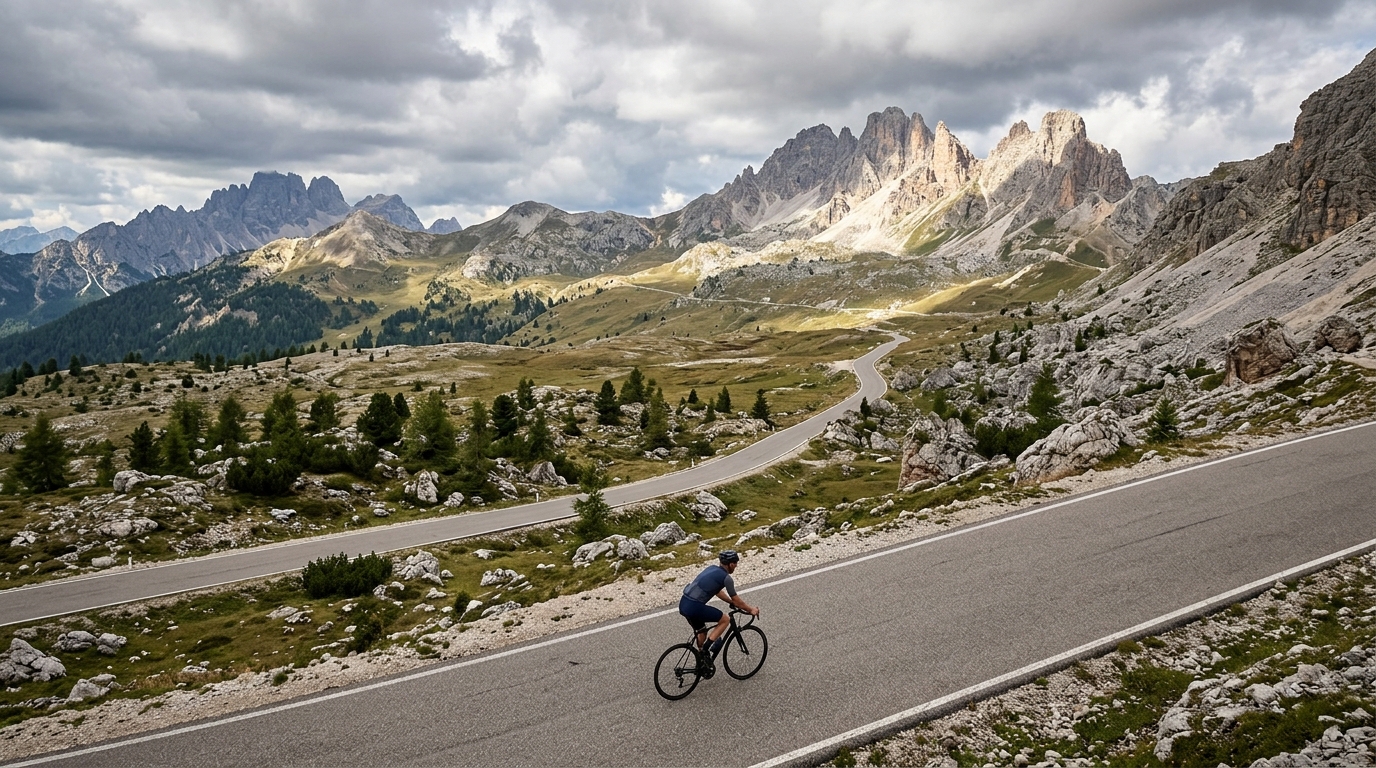
Lavazè Pass
A long HC climb in Italy: 25.6 km at 6.48%, rising from 226 m to 1881 m with very little relief and a brutally steep maximum ramp.
- Länge
- 25.6km
- Ø
- 6.5%
- Max
- 20.1%
- Gipfel
- 1,881m
- Aufstieg
- 1,662m
Der Anstieg
Steigungsprofil
Lavazè Pass cycling climb profile
Lavazè Pass is an HC climb in Italy that asks for patience before it asks for aggression. The headline is simple enough: 25.6 km at an average gradient of 6.48%, starting at 226 m and topping out at 1881 m. The more important detail is the structure implied by the numbers. With 1662 m of total ascent against 1655 m of net elevation gain, this is not a climb full of meaningful descents or recovery shelves. It is, in practical terms, a long upward grind.
That changes how it should be ridden. A climb of this length is not won by matching the steepest pitch early. It is survived, then finished, by keeping the first half boring.
How the gradient unfolds
The available profile data does not give a kilometre-by-kilometre breakdown, so the right interpretation is not that Lavazè Pass sits neatly at 6.48% from bottom to top. An average of 6.48% across 25.6 km tells you the climb is consistently demanding, while the listed maximum gradient of 20.13% tells you the average hides at least one very sharp ramp.
That combination matters. A rider who paces only by the average will be under-geared or over-threshold when the road kicks up. A rider who paces only for the maximum will ride too conservatively for too long. The correct mental model is a sustained HC ascent with enough steepness to punish poor gearing and enough length to punish poor restraint.
The elevation gain also makes the climb feel progressive in cost, even if the road itself is not described segment by segment here. You are gaining 1655 m from start to summit. That means the effort accumulates for a long time, and the final kilometres will be shaped less by raw freshness and more by how much you spent earlier.
Pacing notes
Treat the opening section as a control phase, not a proving ground. On a 25.6 km climb, small over-threshold efforts compound quickly. If riding by power, anchor the effort below your sustainable climbing ceiling early, then reassess only once the rhythm is established. For riders using /glossary/ftp as a reference, this is the kind of climb where discipline relative to FTP matters more than short-term punch.
The 20.13% maximum gradient is the trap. When the road steepens, accept a short rise in torque or power, but do not chase speed. The aim is to keep cadence and breathing from collapsing, then return to your baseline effort as soon as the gradient eases.
Gearing
Bring a low enough gear to ride steep gradients while seated. The average gradient may look manageable, but the maximum gradient is severe, and the length means grinding a too-large gear will have a cost later. Compact or climbing-oriented gearing is the sensible choice for most riders.
Bottom line
Lavazè Pass is not defined by one statistic. It is the interaction of all of them: 25.6 km of climbing, 1655 m of net gain, an HC rating, and a maximum gradient over 20%. Ride it as a long aerobic climb with violent interruptions, not as a steady tempo ascent. The riders who finish strongest will be the ones who respect the duration first and the steep ramps second.