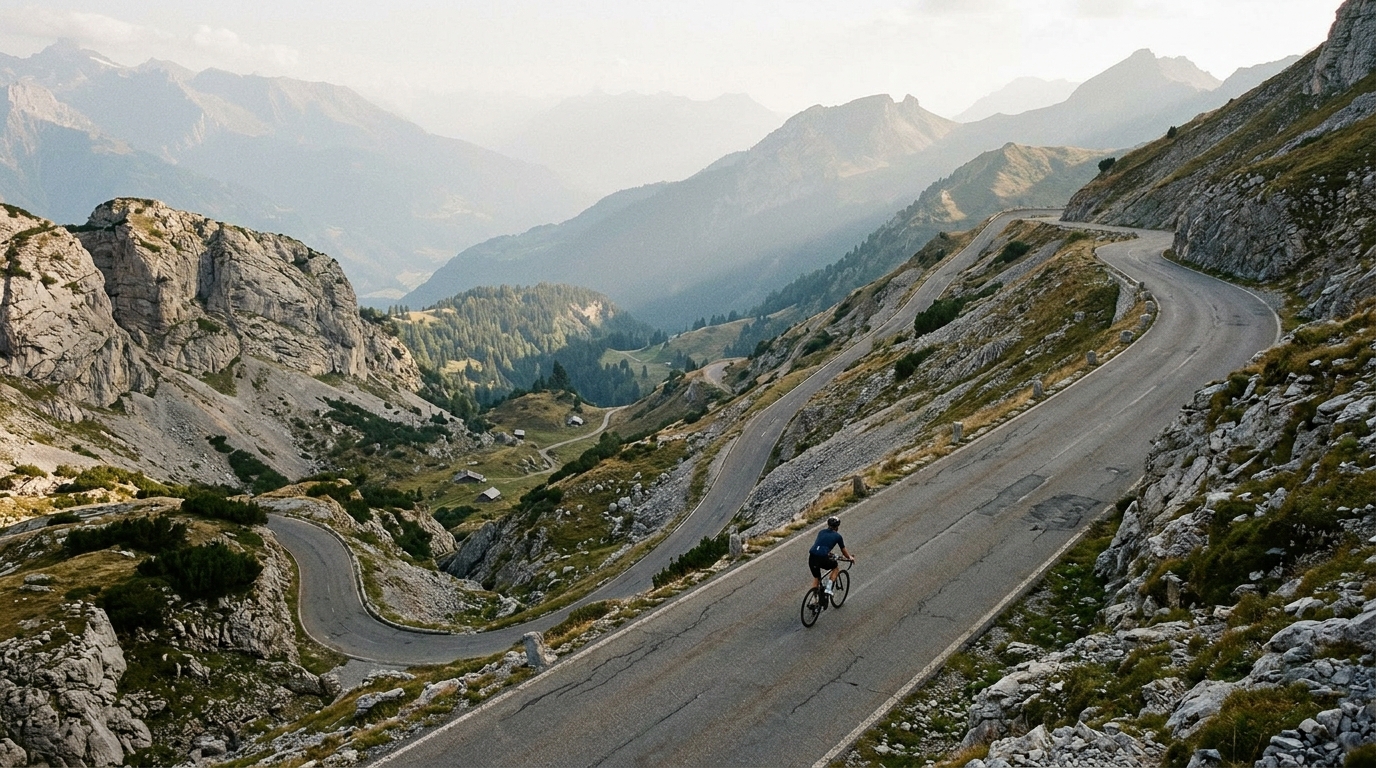
Col de Croix
An HC Swiss climb: 18.1 km at 9.28%, rising from 381 m to 2057 m, with ramps up to 19.8%.
- Länge
- 18.1km
- Ø
- 9.3%
- Max
- 19.8%
- Gipfel
- 2,057m
- Aufstieg
- 1,644m
Der Anstieg
Steigungsprofil
Col de Croix cycling climb profile
The Col de Croix is not a climb you bluff your way over. At 18.1 km with an average gradient of 9.28%, it asks for a long, controlled effort from the first meaningful rise to the summit. The road starts at 381 m and tops out at 2057 m, so the defining feature is not just steepness, but accumulated work. This is an HC climb because the difficulty comes from duration and pitch arriving together.
How the gradient rides
The supplied profile points to a climb with very little margin for recovery. An average of 9.28% over 18.1 km means the baseline sensation is already hard climbing, not a moderate ascent interrupted by harder ramps. When a climb this long averages close to double digits, any easing has to be paid back elsewhere, and the listed maximum gradient of 19.8% confirms that the road contains sections sharp enough to break rhythm.
Without sector data, the honest reading is that Col de Croix should be paced as a sustained high-gradient climb with severe ramps layered on top, rather than as a climb where one clearly defined wall decides everything. The bottom-to-summit problem is therefore simple but unforgiving: keep the early effort below your ceiling so the steepest pitches do not force repeated accelerations above threshold.
Pacing notes
The main mistake is treating the opening kilometres like a normal long climb. On a 9.28% average, riding at the top of your /glossary/ftp range too early leaves almost no buffer for the ramps near 19.8%. Settle into a gear and cadence you can hold while breathing stays controlled, then let speed be the variable.
A practical approach:
- Ride the lower section at a controlled climbing effort, not at chase pace.
- Avoid standing surges unless they are used to reset cadence on the steepest ramps.
- Keep power smooth through gradient changes, because spikes on a climb this steep compound quickly.
- Expect the final portion to feel heavier as the summit sits at 2057 m.
Gearing notes
For most riders, compact or sub-compact gearing with a generous climbing cassette is the sensible choice. The average gradient alone justifies low gears, and the 19.8% maximum makes them more than a comfort option. If your easiest gear only works when you are fresh, it is not low enough for this climb.
The right setup is the one that lets you stay seated for long stretches, keep cadence from collapsing on the steep ramps, and preserve enough control to finish the final kilometres without grinding. If you need to benchmark the effort before attempting it, anchor the pacing to /glossary/ftp rather than speed, because speed will be heavily dictated by the gradient.