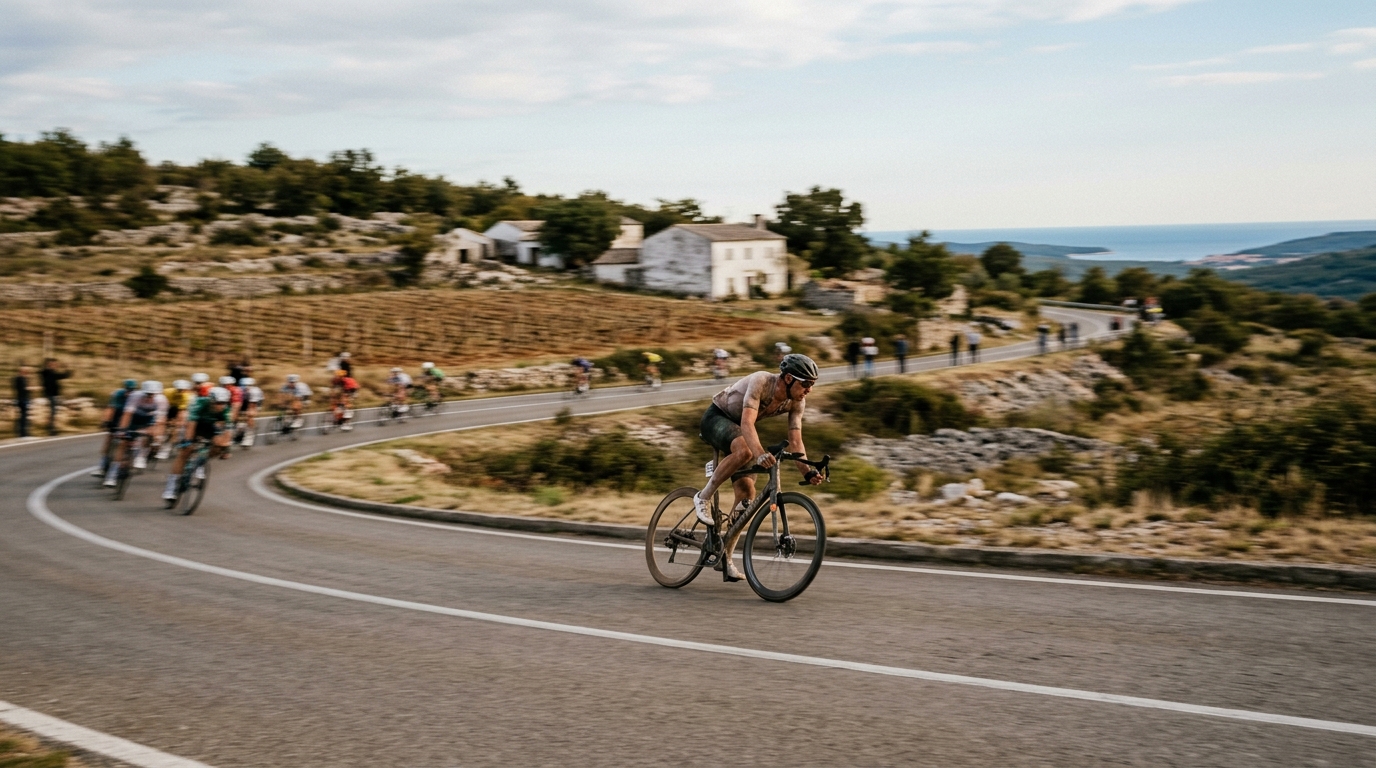
Sliku je generisao naš model.
Pregled trke
Tobias Svarre wins CRO Race 2026 ahead of Tiberi and Wellens
Tobias Svarre sealed the CRO Race overall after a six-stage, 940 km race shaped by hilly stages and the Rijeka summit finish.
Tobias Svarre won the 2026 CRO Race, finishing ahead of Antonio Tiberi and Tim Wellens after six stages and 940 km across Croatia.
The final podium tells the story of a race that was not decided by one simple sprint hierarchy or one isolated climbing day. Svarre also won the youth classification, which underlines the quality of his overall week, while Tiberi paired second overall with the mountains classification. Carl-Frederik Bévort won the points jersey.
How Svarre built the win
The race opened with a hilly 167 km stage from Split to Seget, won by Juan Sebastián Molano, before the first flat stage from Biograd na Moru to Novalja gave Bévort both a stage win and the platform for his points classification campaign.
Svarre made his decisive mark on Stage 3, the 174.5 km hilly stage from Krk to Labin. In a six-day race without a time trial in the provided route profile, winning on a hilly day is often more valuable than the stage result alone. It creates GC separation before the pure mountain test, and it forces the climbers to chase rather than simply control.
That mattered because Stage 4 was the race's only listed summit finish, a 160 km mountain stage from Pula to Rijeka won by [[Daniel Martínez. With Tiberi ultimately finishing second overall and winning the mountains classification, this was the terrain most aligned with his strengths in the final standings. Svarre's ability to come through that summit finish still on course for the overall win was the hinge point of the race.
The closing stages favored control
After Rijeka, the route gave the GC contenders fewer obvious chances to rewrite the race. Stage 5, a 164.5 km hilly stage from Karlovac to Sveta Nedelja, was won by Paul Magnier, while Stage 6, a 159.5 km flat stage from Samobor to Zagreb, was won by [[Davide Donati.
That sequence made Svarre's earlier gains more defensible. Once the summit finish was behind him, the remaining hilly and flat terrain still required attention, positioning, and team control, but the race structure no longer offered a clearly bigger climbing test than Rijeka. The final GC therefore reflects a rider who struck on the right terrain, absorbed the key mountain day, and then carried the advantage through to Zagreb.
Final classifications
Svarre finished first overall, with Tiberi second and Wellens third. Tiberi won the mountains classification, Bévort won the points classification, and Svarre also took the youth classification.
For a 2.Pro race, this was a compact but tactically clear GC win: the hilly stage result gave Svarre leverage, the summit finish tested whether it was real, and the final two days confirmed he had enough across the full route profile to close it out.