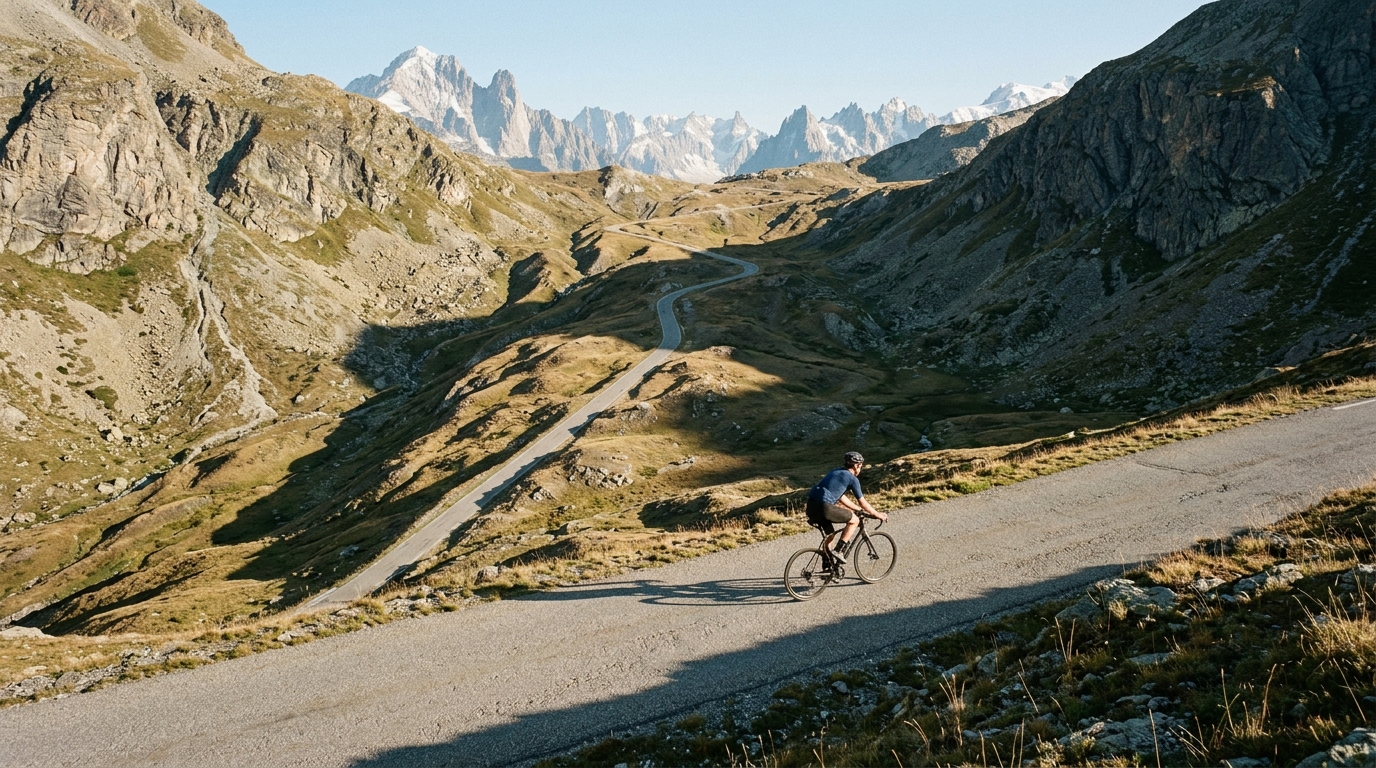
Col de la Seigne
A long HC ascent with major vertical gain, a hard average gradient, and extreme ramps that make pacing and gear choice decisive.
- Duž ina
- 30.5km
- Prosek
- 7.0%
- Maks
- 36.2%
- Vrh
- 2,735m
- Visinska razlika
- 2,410m
Uspon
Profil nagiba
Col de la Seigne cycling climb profile
Col de la Seigne is listed as an HC climb, and the numbers justify that label before the gradient even becomes the main story. The climb runs for 30.5 km, starting at 590 m and topping out at 2735 m. That is 2145 m of net elevation gain, with 2410 m of total ascent across the full route.
That gap between net gain and total ascent matters. This is not just a clean, metronomic rise where every metre points uphill at the same pressure. The route still gains a huge amount overall, but the higher total ascent suggests the effort is likely to be uneven, with sections that ask you to re-accelerate or absorb changes in rhythm rather than simply locking into one steady climbing speed.
How the gradient rides
The average gradient is 7.04%, which is already hard over 30.5 km. On a shorter climb, that figure would be manageable with a firm tempo. Over this distance, it becomes an endurance problem first and a strength problem second. The risk is not one isolated steep pitch. The risk is letting a climb this long pull you above sustainable power too often, then paying for it before the summit.
The maximum gradient of 36.21% changes the way you should approach the climb. Even if that steepest section is brief, it tells you the route contains gradients where momentum can disappear quickly and cadence can collapse if you are over-geared. The practical takeaway is simple: do not pace this like a smooth 7% alpine road. Ride it as a long climb with violent interruptions.
Pacing and gearing notes
The correct pacing strategy is conservative early, controlled through the middle, and flexible near the top. With 2145 m of net gain, the climb rewards riders who can stay below their limit for a long time, not riders who prove their form in the first part of the ascent.
Use /glossary/ftp as the anchor, but do not treat the average gradient as permission to sit at threshold. The climb is too long, and the maximum gradient is too severe. Keep a gear available that lets you stay seated when the road bites, even if that means accepting a slower speed on the steepest ramps.
Practical approach:
- Start easier than the average gradient suggests, because 30.5 km gives mistakes a long time to compound.
- Shift before the steepest ramps, not after cadence has already dropped.
- Avoid standing surges unless you need them for traction or a short reset.
- Treat any easier section as recovery, not as an invitation to chase speed.
- Save mental energy for the upper part, where the altitude gain and accumulated climbing load will make the same gradient feel harder.
Col de la Seigne is the kind of climb where the headline average understates the management task. The profile asks for endurance, low-gear control, and the discipline to keep the effort smooth when the road itself is not.