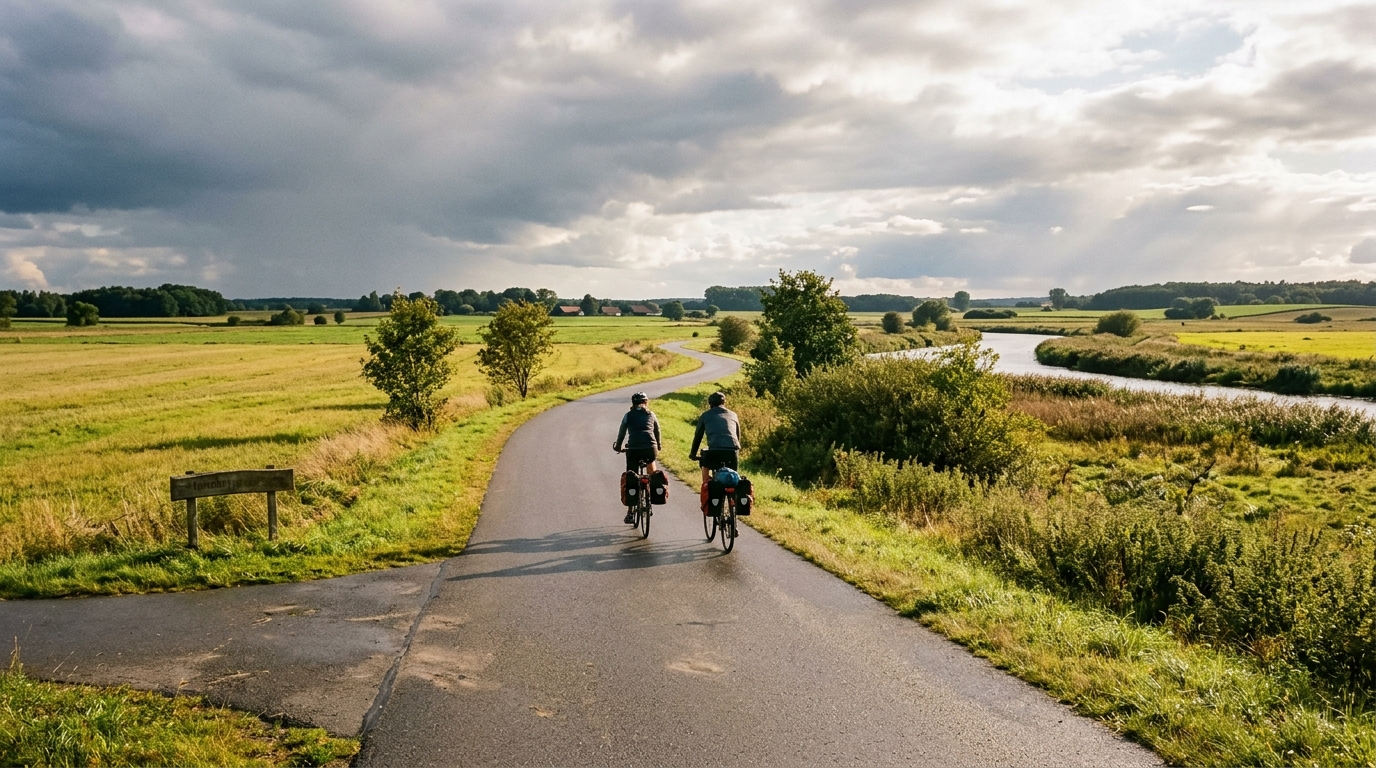
Dahme-Radweg
A practical guide to the Dahme-Radweg cycling route: 136.7 km of asphalt, point-to-point riding, and low climbing load.
- Distância
- 136.7km
- Subida
- 307m
- Piso
- —
- Formato
- Ponto a ponto
A rota
Perfil de elevação
Dahme-Radweg cycling route overview
The Dahme-Radweg is a 136.7 km point-to-point cycling route in Germany, with an asphalt surface and 307 m of elevation gain. On paper, that makes its character fairly clear: this is not a route defined by major climbs or repeated gradient shocks. It is a long, steady endurance ride where the deciding factor is more likely to be pacing, fueling, wind exposure, and how well you manage time on the bike.
That matters because a route with this distance and relatively modest climbing can feel easier than it is early on. Without a major climb to force discipline, riders often drift above sustainable endurance pressure in the first half. The cost usually appears later, when the route length starts to matter. Treat it less like a climbing challenge and more like a controlled aerobic effort.
Terrain and ride feel
With 307 m of elevation gain across 136.7 km, the Dahme-Radweg should ride as a predominantly rolling to flat route rather than a mountainous one. No notable climbs are listed, so the rhythm is likely to come from small changes in terrain, surface continuity, junctions, and day-long fatigue rather than any single decisive ascent.
The asphalt surface is a major practical advantage. It makes the route suitable for road bikes, endurance bikes, and faster all-road setups, assuming normal local conditions. The smoother the bike choice, the easier it becomes to hold a consistent cadence and keep power under control. If riding by effort, stay in the range you would associate with endurance work rather than chasing every small rise. For riders using power, this is the kind of route where discipline around /glossary/ftp matters more than peak output.
How to pace it
The main trap is mistaking low elevation gain for low total load. A 136.7 km ride still accumulates fatigue, even when the climbing number is modest. The best approach is to keep the opening portion deliberately conservative, especially if riding solo or carrying extra kit.
A useful pacing frame:
- Start easier than feels necessary, because the route length will create its own difficulty.
- Avoid hard accelerations out of corners, stops, or small rises.
- Keep fueling regular from early in the ride, not only once fatigue is obvious.
- Save effort for the final portion, where steady pressure is more valuable than short surges.
Practical notes
Because the Dahme-Radweg is not a loop, logistics matter. Plan how you will reach the start and leave the finish before committing to the ride. A point-to-point route rewards preparation: transport, daylight, weather direction, and resupply strategy all have a bigger impact than they would on a shorter loop close to home.
The route’s asphalt surface and low climbing load make it accessible from a terrain perspective, but the distance still places it firmly in endurance-ride territory. It is best approached as a long, efficient day out rather than a route to attack. Ride smoothly, eat early, and let the lack of major climbs work in your favor rather than tempting you into riding too hard too soon.
Rotas relacionadas
3-Länder-Radweg
A 302.2 km asphalt route in Germany with 1512 m of climbing and point-to-point logistics shaped by the Reußenkreuz climb.
7 Peaks Alpine Challenge
A 110.9 km point-to-point assault through the Victorian Alps, stacking 3404 metres of climbing across relentless, wind-swept high-country ascents.
Aberdare Range
A 46 km asphalt point-to-point through Kenya's Central Highlands that trades big climbs for a relentless 1,700 m of rolling grind.
Abra Málaga
A 45-kilometer point-to-point ribbon of asphalt through Peru's Sacred Valley, climbing 1,699 relentless meters into the high Andes.
Afriski Mahlasela Pass
A 112.8 km asphalt ascent through the Maloti Mountains, climbing 3,384 m to the roof of southern Africa via the storied Mahlasela Pass.
Ahr Cycleway
An 82.9 km asphalt point-to-point route with 541 m of gain, the Ahr Cycleway is a steady endurance ride rather than a climb-focused day.