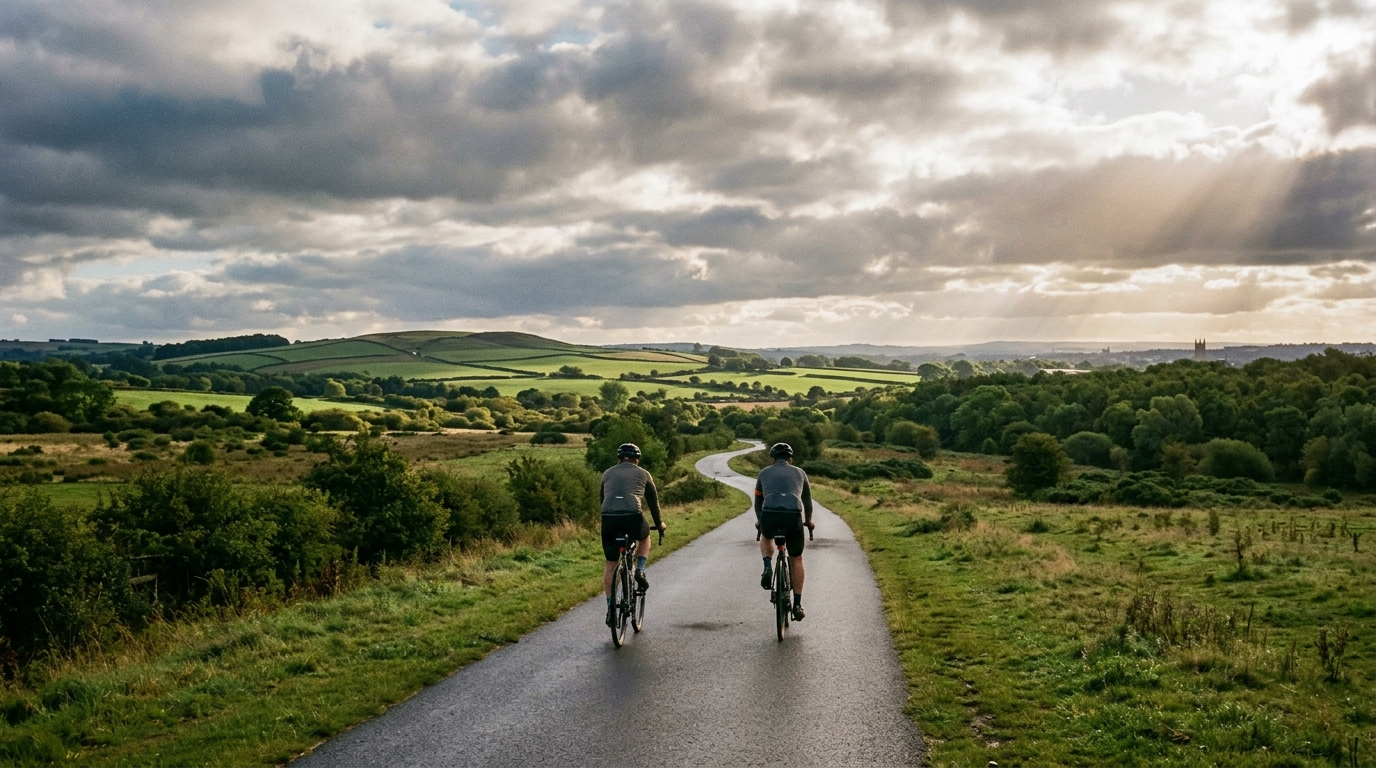
Wonders of Wakefield
A 37.6 km asphalt route in GB with 142 m of elevation gain, best read as a steady, low-climbing point-to-point ride rather than a hill-focused test.
- Distanza
- 37.6km
- Dislivello
- 142m
- Fondo
- —
- Forma
- Punto a punto
Il percorso
Profilo altimetrico
Wonders of Wakefield cycling route overview
The Wonders of Wakefield cycling route is a 37.6 km asphalt ride in GB with 142 m of elevation gain. The key thing to understand is that this is not a climbing route. With no notable climbs listed and a modest amount of total gain for the distance, the ride is shaped more by continuity, surface, and pacing than by any single decisive ascent.
That makes it a route where momentum matters. On a profile like this, the hard parts are less likely to come from long gradients and more likely to come from repeated small changes in speed, turns, junctions, wind exposure, or riding slightly above comfort too often. The physiological cost can still build, but it comes through accumulated effort rather than one obvious climb.
Terrain and ride character
The recorded surface is asphalt, so the route sits firmly in road-ride territory. Tyre choice, pressure, and bike setup should reflect that. A standard road bike or fast all-road setup makes more sense than anything aimed at rough terrain.
The 142 m of elevation gain over 37.6 km points toward a route that should reward steady aerobic riding. There is enough climbing to avoid feeling completely flat, but not enough to define the day. If you ride it aggressively, the main risk is turning every small rise or acceleration into a surge. If you ride it well, the route should feel efficient: settle into rhythm, keep pressure on the pedals, and avoid wasting energy where the terrain does not demand it.
For pacing, think in terms of controlled endurance rather than threshold climbing. Riders using power can keep the effort mostly below /glossary/ftp and save sharper efforts for traffic flow, short rises, or group dynamics. The absence of listed notable climbs means there is no obvious point where the route asks for a single maximal effort.
Practical notes
This route is not recorded as a loop, so planning matters before the ride starts. Treat it as point-to-point unless you have a confirmed way back. That means sorting transport, a return ride, or a pickup in advance.
Because the distance is 37.6 km, the route can fit well as a standalone endurance spin, a steady midweek ride, or part of a longer day if paired with extra riding. The low total elevation gain makes it approachable, but that should not be confused with automatic ease. Speed discipline still matters, especially if conditions or pacing turn it into a sustained effort.
Best suited for
- Riders looking for an asphalt route without a major climbing focus
- Endurance work where smooth pacing is the priority
- A point-to-point ride with simple terrain demands
- Faster road setups rather than gravel-oriented equipment
Bottom line
Wonders of Wakefield is best read as a steady asphalt route, not a hill challenge. Its 37.6 km distance gives it enough substance to be a real ride, while the 142 m of gain keeps the emphasis on rhythm and execution. Plan for the non-loop format, ride it patiently, and let consistency do the work.
Percorsi correlati
3-Länder-Radweg
A 302.2 km asphalt route in Germany with 1512 m of climbing and point-to-point logistics shaped by the Reußenkreuz climb.
7 Peaks Alpine Challenge
A 110.9 km point-to-point assault through the Victorian Alps, stacking 3404 metres of climbing across relentless, wind-swept high-country ascents.
Aberdare Range
A 46 km asphalt point-to-point through Kenya's Central Highlands that trades big climbs for a relentless 1,700 m of rolling grind.
Abra Málaga
A 45-kilometer point-to-point ribbon of asphalt through Peru's Sacred Valley, climbing 1,699 relentless meters into the high Andes.
Afriski Mahlasela Pass
A 112.8 km asphalt ascent through the Maloti Mountains, climbing 3,384 m to the roof of southern Africa via the storied Mahlasela Pass.
Ahr Cycleway
An 82.9 km asphalt point-to-point route with 541 m of gain, the Ahr Cycleway is a steady endurance ride rather than a climb-focused day.