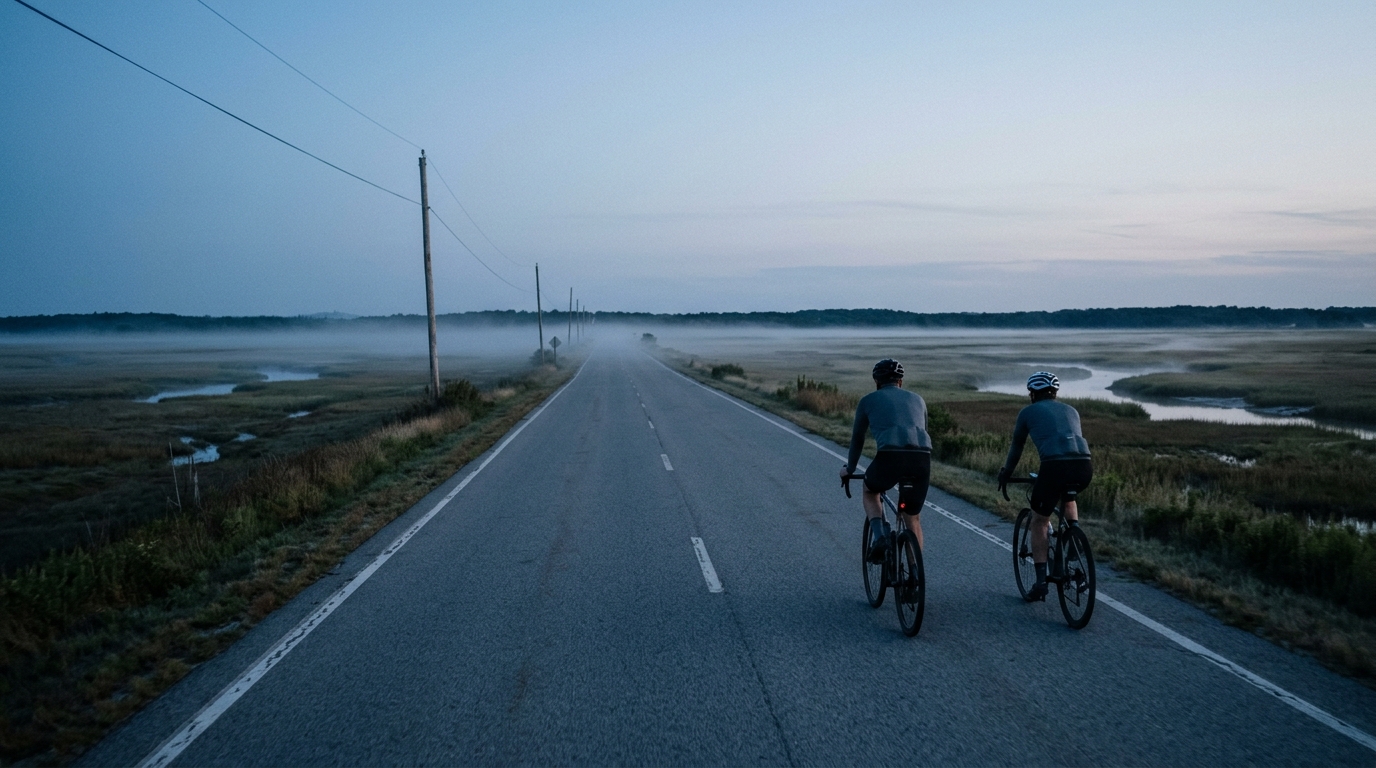
U.S. Bicycle Route 1 in Massachusetts
A practical guide to U.S. Bicycle Route 1 in Massachusetts, a 120.2 km asphalt point-to-point ride with very little elevation gain.
- Distanza
- 120.2km
- Dislivello
- 127m
- Fondo
- —
- Forma
- Punto a punto
Il percorso
Profilo altimetrico
U.S. Bicycle Route 1 in Massachusetts cycling route
U.S. Bicycle Route 1 in Massachusetts is a long, low-elevation asphalt route that is defined less by climbing and more by continuity. At 120.2 km with just 127 m of elevation gain, the demands are not about surviving decisive gradients or managing a sequence of major climbs. The challenge is holding a steady effort, staying fueled, and keeping the ride under control over a point-to-point distance.
That profile changes the way the route should be approached. With no notable climbs listed, there is no obvious place where the ride naturally breaks into clean uphill and downhill blocks. Instead, the effort is likely to feel cumulative. Riders who go too hard early may not get punished by a single steep ascent, but they will still pay for it later because the distance is substantial enough to expose poor pacing.
Terrain and ride feel
The route is on asphalt, which makes it well suited to a road bike or a fast all-road setup. The low total elevation gain suggests a route where speed can stay relatively consistent compared with hillier rides, assuming conditions and local routing allow it.
That does not mean it is effortless. A flat or near-flat route can be deceptively demanding because there are fewer natural recovery points. On a climbing-heavy route, the descents often force some variation in output. Here, the better strategy is to ride below threshold, keep pressure on the pedals, and avoid repeatedly surging just because the terrain allows it.
Pacing and effort
For endurance riders, this is a route where discipline matters more than climbing strength. The total distance is long enough that nutrition, hydration, and position comfort become performance variables, not afterthoughts. If riding by power, the smart move is to keep the early effort controlled rather than chasing speed from the start. If riding by feel, aim for a pace that seems almost too manageable in the opening section.
Because there are no notable climbs in the route data, there is no need to save a specific reserve for a summit. Instead, save it for the final portion of the ride, where accumulated fatigue will be the main limiter.
Practical notes
This is not a loop, so logistics matter. Plan the start and finish before committing to the ride, especially if transport, pickup, or a return ride is involved. The point-to-point format is one of the defining practical features of U.S. Bicycle Route 1 in Massachusetts.
Equipment choice can be straightforward: asphalt surface, long distance, low elevation. Prioritize efficient tires, a comfortable position, and enough storage for food and fluids. Riders using the route as training can treat it as an aerobic endurance day rather than a climbing workout, with the main objective being smooth pacing over the full 120.2 km.
Percorsi correlati
3-Länder-Radweg
A 302.2 km asphalt route in Germany with 1512 m of climbing and point-to-point logistics shaped by the Reußenkreuz climb.
7 Peaks Alpine Challenge
A 110.9 km point-to-point assault through the Victorian Alps, stacking 3404 metres of climbing across relentless, wind-swept high-country ascents.
Aberdare Range
A 46 km asphalt point-to-point through Kenya's Central Highlands that trades big climbs for a relentless 1,700 m of rolling grind.
Abra Málaga
A 45-kilometer point-to-point ribbon of asphalt through Peru's Sacred Valley, climbing 1,699 relentless meters into the high Andes.
Afriski Mahlasela Pass
A 112.8 km asphalt ascent through the Maloti Mountains, climbing 3,384 m to the roof of southern Africa via the storied Mahlasela Pass.
Ahr Cycleway
An 82.9 km asphalt point-to-point route with 541 m of gain, the Ahr Cycleway is a steady endurance ride rather than a climb-focused day.