Saar-Radweg
A practical guide to the Saar-Radweg cycling route: 214.9 km of asphalt, point-to-point riding, and a low-climbing endurance profile.
- Distanza
- 214.9km
- Dislivello
- 364m
- Fondo
- —
- Forma
- Punto a punto
Il percorso
Profilo altimetrico
Saar-Radweg cycling route overview
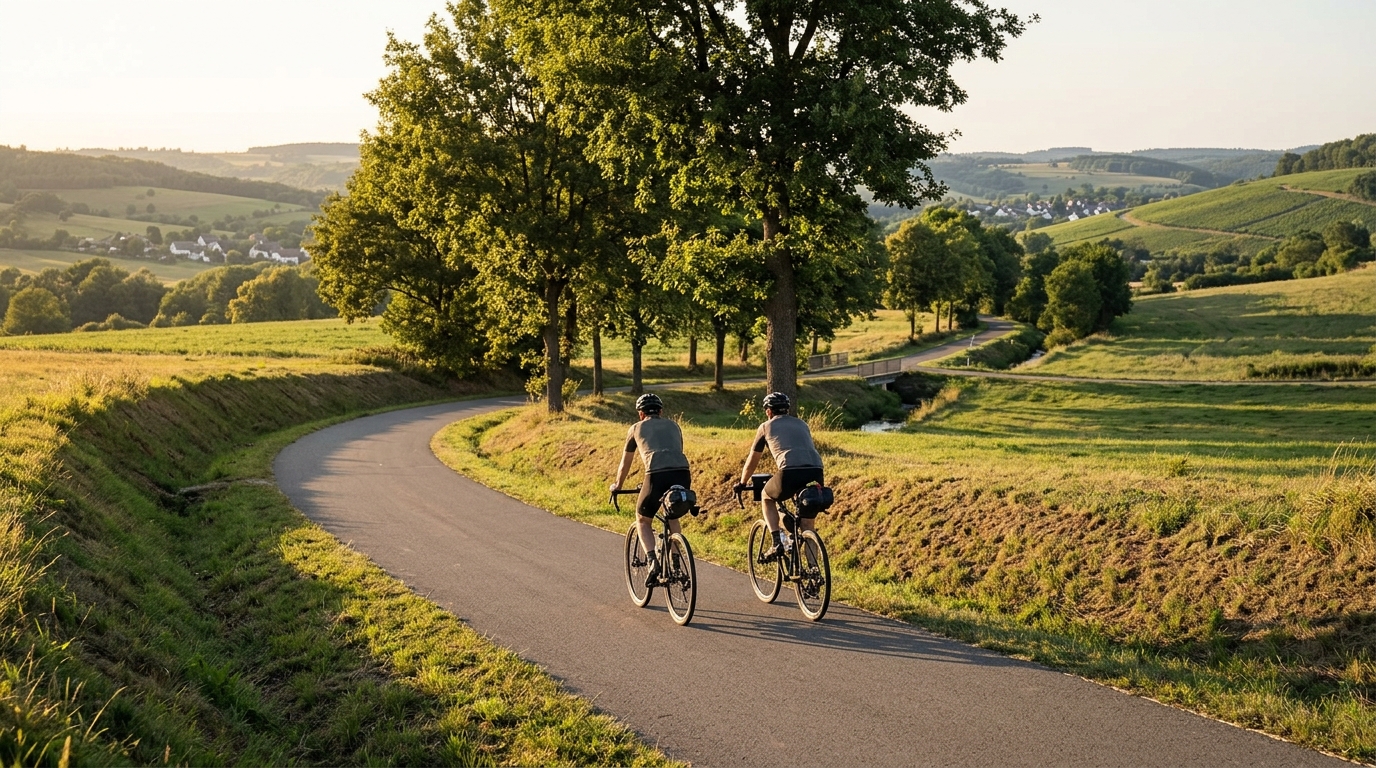
The Saar-Radweg cycling route is a 214.9 km point-to-point ride in Germany, run entirely on asphalt with 364 m of elevation gain. On paper, that tells you the most important thing about the route: this is not a climbing test. It is an endurance ride shaped by distance, consistency, and the ability to keep moving efficiently over a long day or multiple controlled stages.
With no notable climbs listed, the difficulty is unlikely to come from any single decisive ascent. Instead, the challenge is cumulative. A route of this length rewards riders who can settle into a sustainable rhythm, fuel before they feel empty, and avoid turning the early kilometres into a quiet overreach.
Terrain and ride character
The combination of asphalt surface and modest total elevation gain points toward a route that should feel steady rather than explosive. That does not make it easy. Long, lower-gradient rides often hide their cost because there are fewer obvious moments that force a reset. Without major climbs to break the effort into distinct sections, pacing discipline matters more.
For stronger endurance riders, the Saar-Radweg can be ridden as a long aerobic test. The smart approach is to keep the effort below threshold, especially early, and let the distance do the work. If using power, this is the kind of route where riding by feel alone can be deceptive, because smooth asphalt and limited climbing can invite a slightly too-hard tempo for too long. A controlled effort around endurance to steady tempo makes more sense than repeated surges. For reference, see /glossary/ftp if anchoring the ride to threshold-based pacing.
Practical notes
Because the route is not a loop, logistics matter. Start and finish planning should be treated as part of the ride, not an afterthought. Transport, return options, and overnight plans become more important than they would be on a shorter circular route.
The asphalt surface makes road bikes, endurance bikes, and fast all-road setups natural choices. Tyre choice should prioritise efficiency and comfort rather than rough-surface protection, while still allowing enough resilience for a full-day ride.
Key priorities:
- Pace the opening section conservatively, because the distance is the main limiter.
- Fuel on a schedule rather than waiting for hunger, since there are no listed major climbs to act as natural checkpoints.
- Stay aware of contact-point comfort. On a long, relatively steady route, hands, saddle, and neck can become the limiting factors before the legs do.
- Plan the point-to-point logistics before committing to the full distance.
Who it suits
The Saar-Radweg is best suited to riders looking for a long, steady asphalt route rather than a mountainous challenge. Its profile favours aerobic durability, efficient pacing, and clean execution. If the goal is to build endurance without the tactical disruption of major climbs, the route’s 214.9 km distance and low total elevation gain make it a strong candidate.
Percorsi correlati
3-Länder-Radweg
A 302.2 km asphalt route in Germany with 1512 m of climbing and point-to-point logistics shaped by the Reußenkreuz climb.
7 Peaks Alpine Challenge
A 110.9 km point-to-point assault through the Victorian Alps, stacking 3404 metres of climbing across relentless, wind-swept high-country ascents.
Aberdare Range
A 46 km asphalt point-to-point through Kenya's Central Highlands that trades big climbs for a relentless 1,700 m of rolling grind.
Abra Málaga
A 45-kilometer point-to-point ribbon of asphalt through Peru's Sacred Valley, climbing 1,699 relentless meters into the high Andes.
Afriski Mahlasela Pass
A 112.8 km asphalt ascent through the Maloti Mountains, climbing 3,384 m to the roof of southern Africa via the storied Mahlasela Pass.
Ahr Cycleway
An 82.9 km asphalt point-to-point route with 541 m of gain, the Ahr Cycleway is a steady endurance ride rather than a climb-focused day.