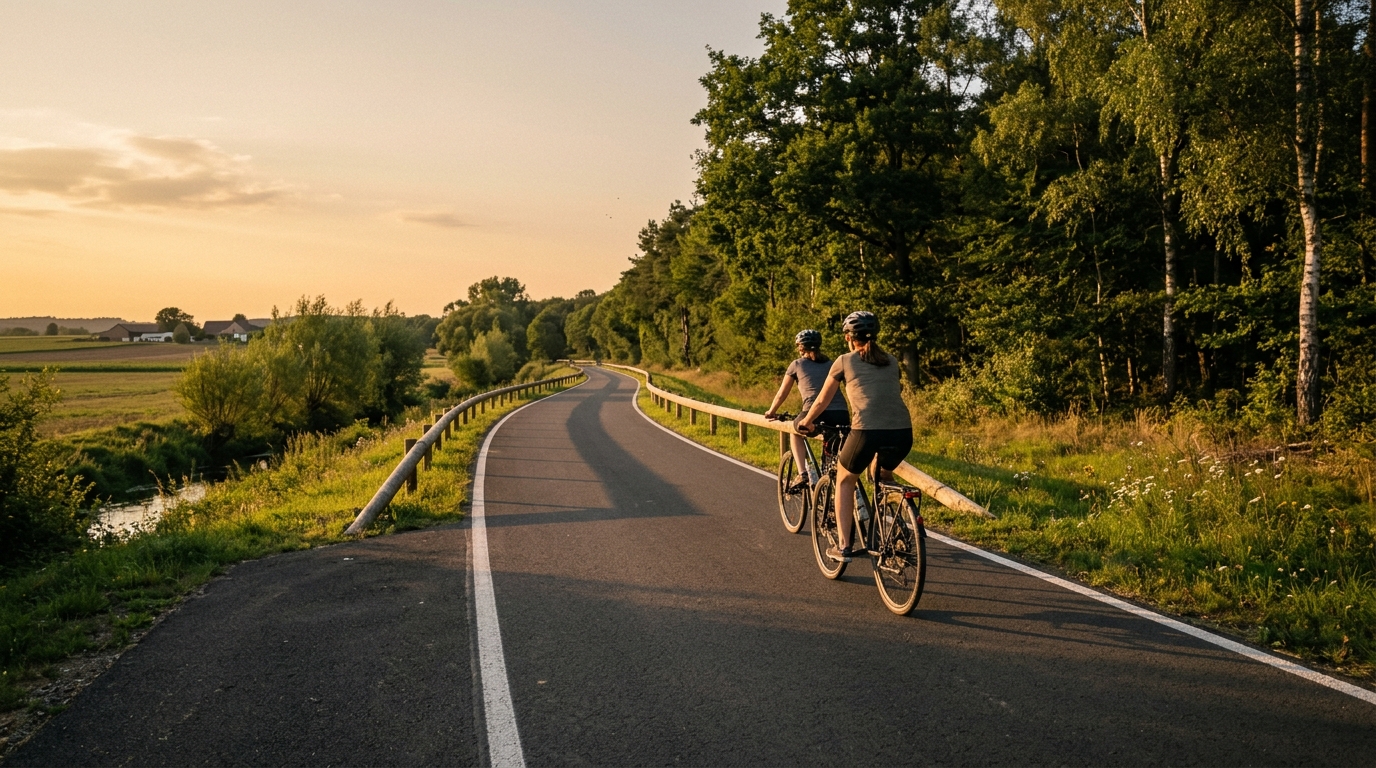
PC15 Cycle Route
A practical guide to the PC15 Cycle Route cycling route in LU: 48.5 km of asphalt with minimal elevation gain and no notable climbs.
- Distanza
- 48.5km
- Dislivello
- 88m
- Fondo
- —
- Forma
- Punto a punto
Il percorso
Profilo altimetrico
Route character
The PC15 Cycle Route cycling route is defined by restraint rather than drama. At 48.5 km with just 88 m of elevation gain, this is not a ride built around climbing, selection, or repeated accelerations over steep terrain. Its main feature is continuity: an asphalt, point-to-point route where the effort is likely to come from pace management, wind exposure, surface rhythm, and how efficiently you keep momentum.
That matters because a route with this little climbing rarely forces natural resets. On a hillier course, gradients break the ride into obvious blocks. Here, the challenge is more subtle. If you ride too hard early, there may not be a climb or descent pattern to help you recover and regroup. The best approach is to settle into a sustainable tempo and let the smooth profile work for you rather than against you.
Terrain and pacing
With no notable climbs listed, the PC15 is a strong option for riders who want steady aerobic work instead of punchy climbing efforts. It suits endurance pacing, efficient group riding, or a controlled solo ride where the goal is to hold consistent pressure without repeated spikes above threshold.
The low elevation gain also makes gearing less of a concern than on mountainous routes. A standard road setup should be more than enough for most riders, and the asphalt surface points toward road tyres rather than gravel-focused equipment. The main limiter is unlikely to be gradient. It is more likely to be how well you manage the sustained nature of the ride.
For training, this is the kind of route that can reward discipline. If the aim is aerobic development, keep the effort even and avoid turning every small rise or exposed section into an unplanned surge. If the aim is a harder session, the profile is better suited to sustained blocks than climb-specific work. For riders calibrating effort, anchoring the ride around /glossary/ftp can help keep the session honest.
Practical notes
The route is not a loop, so logistics matter. Plan the start and finish before committing, especially if riding solo. A point-to-point course can be clean and efficient, but only if the return is sorted in advance.
The asphalt surface makes the PC15 accessible for most road cyclists, but it also encourages carrying speed. That means the usual flat-route discipline applies: stay alert, hold a predictable line, and avoid letting the apparent ease of the profile create sloppy riding.
Who it suits
Choose the PC15 Cycle Route if you want a mostly steady ride in LU with minimal climbing and a straightforward surface. It is not the route for riders chasing notable climbs or elevation-heavy training. It is better as an endurance ride, a smooth point-to-point transfer, or a controlled pacing session where the value comes from consistency rather than terrain difficulty.
Percorsi correlati
3-Länder-Radweg
A 302.2 km asphalt route in Germany with 1512 m of climbing and point-to-point logistics shaped by the Reußenkreuz climb.
7 Peaks Alpine Challenge
A 110.9 km point-to-point assault through the Victorian Alps, stacking 3404 metres of climbing across relentless, wind-swept high-country ascents.
Aberdare Range
A 46 km asphalt point-to-point through Kenya's Central Highlands that trades big climbs for a relentless 1,700 m of rolling grind.
Abra Málaga
A 45-kilometer point-to-point ribbon of asphalt through Peru's Sacred Valley, climbing 1,699 relentless meters into the high Andes.
Afriski Mahlasela Pass
A 112.8 km asphalt ascent through the Maloti Mountains, climbing 3,384 m to the roof of southern Africa via the storied Mahlasela Pass.
Ahr Cycleway
An 82.9 km asphalt point-to-point route with 541 m of gain, the Ahr Cycleway is a steady endurance ride rather than a climb-focused day.