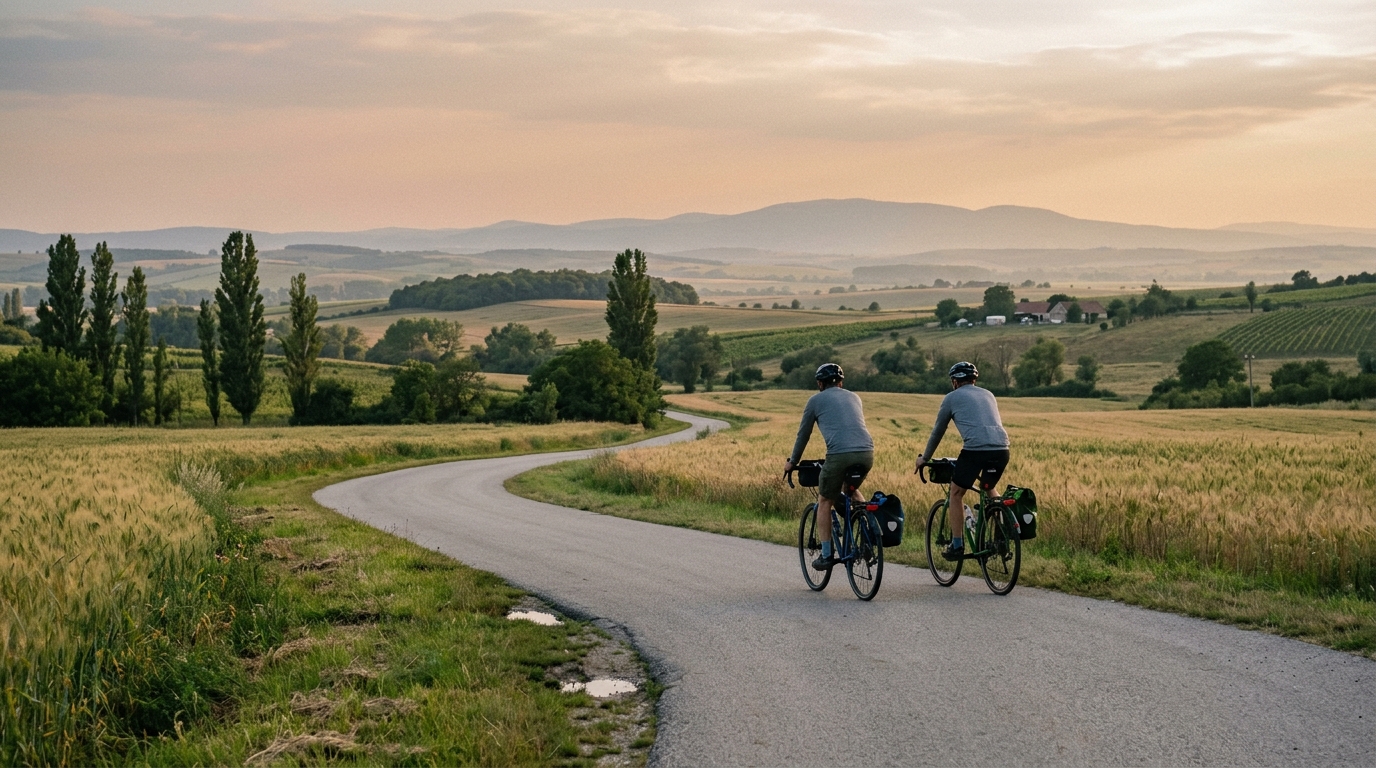
Budapest-Balaton cycle route
A practical route description for the Budapest-Balaton cycle route, a 108.5 km point-to-point asphalt ride with 589 m of elevation gain.
- Distanza
- 108.5km
- Dislivello
- 589m
- Fondo
- —
- Forma
- Punto a punto
Il percorso
Profilo altimetrico
Budapest-Balaton cycle route cycling route overview
The Budapest-Balaton cycle route is a 108.5 km asphalt ride in Hungary with 589 m of elevation gain. Its defining feature is not a single climb or technical surface, but the way its distance and modest climbing load combine into a sustained point-to-point endurance effort.
That matters tactically. At 108.5 km, this is long enough that pacing, fueling, and restraint early on will shape the second half of the ride. But with 589 m of total elevation gain and no notable climbs listed, it should not ride like a mountain route. The climbing is more likely to accumulate through smaller rises and terrain changes rather than one decisive ascent. The practical consequence is simple: avoid treating the lack of major climbs as permission to ride above your sustainable pace. Small surges add up over this distance.
Terrain and ride character
The route is on asphalt, which makes it best approached as a steady road or endurance bike ride rather than a mixed-surface adventure. Tire choice can stay biased toward efficiency and comfort on paved roads. The surface note also means your main limiter is more likely to be duration and pacing than bike handling or traction.
The elevation profile, based on the total gain, points toward a rolling route rather than a climbing day. That usually rewards riders who keep pressure smooth over the rises and resist chasing every change in gradient. If riding with a group, this is the kind of route where the strongest riders can unintentionally make the day harder by accelerating over every small uphill. A steadier approach will preserve more energy for the final third.
For pacing, think in terms of an endurance ride with controlled efforts. Riders using power should anchor the day around sustainable output rather than repeated spikes above /glossary/ftp. Riders pacing by feel should be wary of the early kilometers feeling too easy. On a point-to-point ride of this length, the cost of early enthusiasm tends to appear late.
Practical notes
Because this is not a loop, logistics matter more than they would on a circular local ride. Plan the start and finish as separate points, and decide in advance how you will handle return travel, pickup, or onward riding. That point-to-point format is part of the appeal, but it also removes the simplicity of finishing where you began.
The key preparation priorities are straightforward:
- Bring enough food for a 108.5 km ride, not just a short spin.
- Pace the rolling elevation gain instead of attacking every rise.
- Use a bike and tires suited to asphalt.
- Treat it as an endurance route first, not a climbing route.
- Plan finish-line logistics before you start.
Bottom line
The Budapest-Balaton cycle route is a clean, paved point-to-point ride where the challenge comes from carrying momentum and discipline across 108.5 km. With 589 m of elevation gain and no listed notable climbs, it should suit riders who want distance without a major climbing objective. The route will reward efficient pacing, smooth fueling, and practical planning more than raw climbing strength.
Percorsi correlati
3-Länder-Radweg
A 302.2 km asphalt route in Germany with 1512 m of climbing and point-to-point logistics shaped by the Reußenkreuz climb.
7 Peaks Alpine Challenge
A 110.9 km point-to-point assault through the Victorian Alps, stacking 3404 metres of climbing across relentless, wind-swept high-country ascents.
Aberdare Range
A 46 km asphalt point-to-point through Kenya's Central Highlands that trades big climbs for a relentless 1,700 m of rolling grind.
Abra Málaga
A 45-kilometer point-to-point ribbon of asphalt through Peru's Sacred Valley, climbing 1,699 relentless meters into the high Andes.
Afriski Mahlasela Pass
A 112.8 km asphalt ascent through the Maloti Mountains, climbing 3,384 m to the roof of southern Africa via the storied Mahlasela Pass.
Ahr Cycleway
An 82.9 km asphalt point-to-point route with 541 m of gain, the Ahr Cycleway is a steady endurance ride rather than a climb-focused day.