Immagine generata dal nostro modello.
training camp
Cycling Training Camp: Build Fitness Without Overreaching
How to plan a cycling training camp that builds fitness without tipping into fatigue, illness, or a failed recovery week.
Why a cycling training camp works - and why it can fail
A cycling training camp is useful because it concentrates the thing endurance athletes rarely get enough of in normal life: time on the bike. With fewer work, family, and logistics constraints, you can stack endurance rides, repeat climbs, practice skills, and absorb a higher training load than a typical week allows.
That concentration is also the risk. A camp does not make you fitter during the riding itself. It creates the training stimulus. The fitness comes later, if the body can absorb it. That is why how to plan a cycling training camp matters as much as the routes you choose.
The goal is not to finish the week destroyed. The goal is to leave with a clear aerobic stimulus, intact motivation, and enough freshness to recover into better form. A good camp is not the biggest week you can survive. It is the biggest week you can adapt from.
Who benefits from a cycling training camp
A training camp makes the most sense for riders who already have consistency. If you have been riding regularly, sleeping reasonably well, and can complete normal endurance rides without needing several easy days afterward, a camp can be a productive overload.
It is especially useful for riders preparing for:
- Long gran fondos or endurance events
- Stage races or multi-day challenges
- Hilly sportives where climbing durability matters
- A return to race-specific work after a base phase
- A block of skills work, such as descending, group riding, or pacing climbs
The riders who benefit least are usually the ones trying to use camp as a shortcut. If normal training has been inconsistent, a sudden high-volume block is less a fitness reset than a stress test. You may still do a camp, but the goal should shift toward controlled volume, technique, and routine-building rather than a hero week.
The other group that needs caution is athletes carrying fatigue into camp. If your resting mood is low, legs feel flat, sleep is poor, or easy endurance power feels harder than normal, camp should begin with a conservative plan. Arriving tired and then adding volume is how a productive block becomes a hole.
Pre-camp readiness checklist
Before committing to a large overload, run a simple readiness check. The point is not to talk yourself out of camp. It is to decide what kind of camp your body is actually prepared to absorb.
You are likely ready for a bigger camp if:
- Recent training has been consistent rather than patchy
- Normal endurance rides feel routine, not disruptive
- Back to back riding days do not leave you unusually flat
- Sleep, mood, and appetite are stable
- You are not managing a worsening niggle
- The camp terrain is not dramatically harder than what you usually ride
Scale the camp down if:
- You are arriving after illness, poor sleep, or work stress
- Your recent training has been irregular
- Easy power or pace already feels expensive
- You are relying on camp to make up for missed work
- The routes involve much more climbing, heat, wind, or group intensity than normal
If several items are uncertain, build the first half of camp conservatively. You can add controlled endurance when you are responding well. You cannot easily undo a hard opening ride that pushes fatigue ahead of recovery.
Set the goal: volume, climbing, skills, or race simulation
A good cycling training camp starts with one primary goal. Trying to maximize everything at once is the fastest route to muddled training and poor recovery.
Volume camp
A volume-focused camp is built around low to moderate intensity and repeatable days. The purpose is aerobic durability. Most riding should feel controlled, with climbs paced below the point where you are fighting the bike. If power is available, anchor the week to your current FTP, not the number you hope is still true from a stronger phase.
The key mistake is turning every scenic climb or group ride into a threshold test. One hard climb can change the cost of the next day, and camp value usually comes from accumulated work, not isolated efforts.
Climbing camp
A climbing camp should be about pacing, torque control, descending skill, and repeatability. The aim is not simply to gain elevation. It is to learn what power, cadence, fueling, and mental rhythm you can sustain across repeated climbs.
If you are training for a mountainous event, include days where you climb under control after already carrying fatigue. That is more specific than chasing a best effort when fresh.
Skills camp
Skills work is underrated because it is hard to quantify. A camp is a good time to improve descending lines, cornering confidence, group positioning, eating on the bike, and pacing through rolling terrain.
These sessions should not be buried under maximal fatigue. Technical learning is better when the brain is still engaged. Put skills earlier in rides or on days that are not designed as the heaviest physical load.
Race simulation camp
Race simulation is the sharpest tool and the easiest to overuse. Use it when the athlete already has a base and needs event-specific rehearsal: surges over climbs, rotating pacelines, attacks after long endurance, or practicing nutrition at race intensity.
The danger is confusing simulation with racing every day. A race simulation camp still needs easy riding around the hard sessions. Otherwise, the later work becomes survival rather than quality.
Use training load to size the week safely
Training load is useful because it adds a reality check to ambition. Hours alone can be misleading. A long easy ride and a shorter hard ride can land very differently. If you track TSS, chronic load, acute load, or similar metrics, use them to frame the camp before you arrive.
The basic relationship is clear: the higher and more consistent your normal training load, the more room you have for a camp overload. The lower or more inconsistent your normal load, the smaller the jump should be.
Training load ramp matters because the body adapts to stress it recognizes. When the jump is too abrupt, the limiter often becomes connective tissue, immune resilience, sleep quality, or motivation rather than aerobic capacity. That is why a rider can feel aerobically capable during camp but still come home with deep fatigue or niggles.
A practical camp-sizing framework
Use this framework before you build the route plan.
Green light: normal-plus camp
Choose this if recent training has been steady, your normal weekly volume is well established, the camp terrain resembles what you usually ride, and you generally recover well from back to back endurance days.
Plan a meaningful overload, but keep it controlled. The main risk for this rider is not lack of capacity. It is letting confidence turn every ride into a key session.
Amber light: conservative overload camp
Choose this if recent training has been decent but not perfect, your normal volume has fluctuated, the terrain is hillier or more demanding than usual, or you sometimes need extra recovery after long rides.
Plan the week around fewer key stress points and more absorption. Keep the opening ride deliberately easier than your ego wants. Add volume only after you see stable sleep, mood, appetite, and endurance feel.
Red light: routine-building camp
Choose this if training has been inconsistent, you are arriving tired, you are coming back from illness or injury, or the camp terrain is a large jump from normal.
Do not build the week around overload. Build it around controlled endurance, skills, fueling practice, and good daily rhythm. The win is leaving healthier and more consistent than you arrived.
Questions to ask before finalizing the plan
- What does a normal week look like when life is stable?
- How much intensity have I actually been completing, not just planning?
- Do I usually recover well from back to back long rides?
- Are there recurring aches that appear when volume rises?
- Is the camp terrain harder than my normal terrain?
- Will travel, heat, group dynamics, or poor sleep add extra stress?
If the answer to several of these is uncertain, size the camp conservatively. You can always extend an easy ride when you are thriving. It is much harder to rescue a week once fatigue gets ahead of recovery.
Build the daily ride structure
The best camp structure alternates stress and absorption. That does not always mean a full rest day, but it does mean not stacking the hardest possible version of every day.
A practical structure looks like this in principle:
- Opening ride: controlled endurance, route familiarization, no chasing numbers
- Build ride: longer duration or more climbing, still mostly controlled
- Key stress ride: the main endurance, climbing, or race-specific session
- Absorption ride: short, easy, high-cadence, or skills-focused
- Second key ride: only if recovery markers are stable
- Closing ride: finish with quality, not desperation
The exact layout depends on travel, terrain, group dynamics, and weather. The logic matters more than the template. Put the biggest ride where you are rested enough to execute it. Place easier days before fatigue turns into a problem, not only after it has already arrived.
Sample five-day camp structure
This is a template, not a prescription. Adjust the load to your normal training history and the terrain in front of you.
- Day one - controlled endurance: Keep the ride comfortable and use it to learn the roads, check equipment, and settle pacing. Recovery focus: eat a full meal after the ride, hydrate steadily, and protect the first night of sleep.
- Day two - aerobic build: Add more total work through duration or climbing, but avoid turning climbs into threshold tests. Recovery focus: fuel during the ride before hunger appears and keep the evening low stress.
- Day three - key stress ride: Make this the main endurance, climbing, or race-specific session of the camp. Recovery focus: use familiar products, eat early, and prioritize a real post-ride meal rather than grazing.
- Day four - absorption ride: Ride short and easy, or use the day for skills when concentration is still good. Recovery focus: mobility, easy walking if useful, and an early night.
- Day five - controlled quality or endurance finish: If recovery signs are good, include a final focused endurance or climbing ride. If not, keep it easy and leave with the work absorbed rather than forcing one more hard route. Recovery focus: begin cycling training camp recovery immediately, not after travel day.
The key is that the camp has a center of gravity. There is one main stress day, supporting endurance around it, and a planned absorption point. That structure produces a cleaner stimulus than riding hard until the body chooses the rest day for you.
Group rides: where hidden intensity changes the camp
Group rides require extra discipline. A strong group can make volume feel easier through drafting, but it can also create hidden intensity. Short pulls, town-line sprints, and ego-driven climbs add cost that does not always feel obvious in the moment.
Repeated moderate surges are especially expensive during a camp. Each acceleration draws on glycogen, raises the muscular cost of what was supposed to be endurance riding, and increases the recovery demand after the ride. Do that day after day and the next endurance session is no longer a clean aerobic ride. It becomes recovery debt with scenery.
That is why the best group-ride decision is made before the ride starts. Decide which sections are open for effort and which sections are non-negotiably easy. If the ride is meant to be endurance, let others sprint. If the day is a key session, spend energy where it supports the purpose of the camp.
If you use power, cap the easy work. If you use heart rate, watch for drift and poor recovery between efforts. If you ride by feel, use the talk test and breathing rhythm. Whatever the metric, the purpose is to prevent moderate intensity from leaking into every ride.
Fueling and recovery for high-volume blocks
Under-fueling is one of the most common reasons a cycling training camp goes sideways in coaching practice. Riders often blame lack of fitness when the actual problem is that glycogen, hydration, and sleep are being outpaced by the workload.
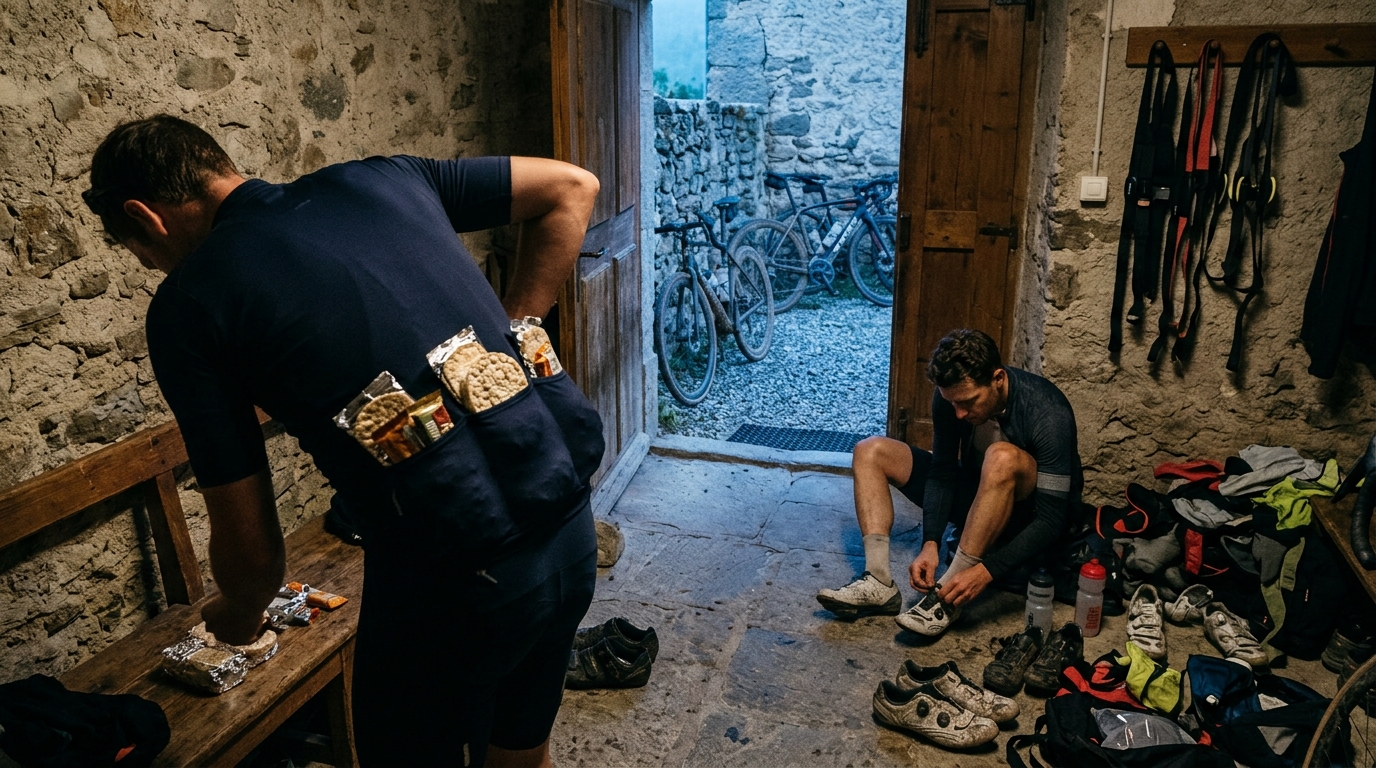
During camp, fuel before you feel empty. Eat early in long rides and keep eating consistently. This is not the time to train low unless that is a deliberate, limited, and already practiced strategy. Most athletes at camp need the opposite: enough carbohydrate to support repeatable work and protect recovery.
Recovery starts before the ride ends. If the final part of every ride becomes a crawl because you did not eat enough, the cost of the session increases while the training quality drops. That fatigue carries into dinner, sleep, and the next morning.
Practical fueling habits that hold a camp together
- Start each ride fed, not just caffeinated
- Eat early, before hunger becomes the reminder
- Set bottle and food reminders on your head unit or watch if you tend to forget
- Carry more food than the route appears to require
- Test products before key rides rather than discovering a gut issue during the hardest day
- Use familiar sports drink, gels, bars, or real food when the session matters
- Separate easy endurance fueling from key-session fueling: easy rides still need steady intake, while hard or long days need a more deliberate plan
- Eat real meals after training, not only snacks
- Prioritize carbohydrate and protein after harder days
- Hydrate steadily instead of trying to fix dehydration at night
- Keep alcohol minimal if adaptation is the goal
- Protect sleep as seriously as the ride plan
The separation between easy endurance fueling and key-session fueling matters. On easier days, the goal is to support aerobic work without turning the ride into a digestive experiment. On key days, the goal is performance and repeatability, so products, timing, and breakfast should already be tested.
The recovery basics are not glamorous, but they decide whether the camp becomes a fitness block or just accumulated stress.
How to adjust when fatigue arrives early
Fatigue arriving early is not failure. The problem is continuing as if the original plan still reflects the body in front of you.
The signs are usually clear: endurance pace feels sticky, cadence naturally drops, mood worsens, appetite becomes odd, sleep quality declines, or power is low for the same perceived effort. A single bad patch is normal. A trend means the plan needs to change.
The correct adjustment depends on the type of fatigue.
If the legs are heavy but mood and motivation are good, reduce intensity and keep the ride aerobic. You may still be able to accumulate useful low-stress volume.
If motivation is low, sleep is poor, and easy riding feels wrong, cut the ride short or replace it with recovery. That is not weakness. That is protecting the adaptation window.
If a niggle appears, do not bargain with it on a climb. Reduce force, avoid hard accelerations, and choose flatter terrain if possible. A small mechanical issue in the body can become a post-camp injury when layered with fatigue.
When adjusting the plan, change the next ride first, not the entire week. Make the next session easier, eat well, sleep, then reassess. If you rebound, continue with a modified version. If you do not, the camp goal becomes recovery and safe completion.
The decision point is whether today’s route improves the next training phase or steals from it. If finishing the planned ride makes the following week worse, the route is no longer the right session.
What to do in the week after camp
The week after camp is where many athletes waste the work. They either panic because the legs feel flat, or they chase the high of the camp and keep training hard. Both responses miss the point.
Cycling training camp recovery should create space for adaptation. Expect some heaviness. Expect power to feel muted for a bit. That does not mean the camp failed. It usually means the stimulus was large enough to require absorption.
The post-camp week should emphasize easy riding, mobility, sleep, and normal life rhythm. Keep intensity limited until the body starts giving positive signals: better mood, stable appetite, normal sleep, and endurance pace feeling natural again.
Do not test fitness immediately because a test performed under residual fatigue measures fatigue as much as form. If you need to reassess training zones, wait until freshness returns, then use a controlled protocol or a tool like the FTP estimator.
Post-camp return-to-training checklist
Before restarting structured work, look for these signals:
- Easy endurance feels normal rather than forced
- Sleep has returned to its usual pattern
- Mood and motivation are stable
- Appetite is normal
- Any soreness is fading rather than moving into joints or tendons
- Power, heart rate, or perceived exertion are lining up again
- You want to train because you feel ready, not because you are anxious about losing fitness
If those signs are not present, extend the recovery emphasis. Easy riding is still training when it helps you absorb the camp. Forcing intensity while residual fatigue is high usually delays the moment when the camp’s benefit becomes usable.
The next productive build should start only when recovery is visible. That is how the camp turns into better fitness rather than a short-term spike followed by a slump.
The camp mindset that produces adaptation
A cycling training camp is a planned overload with a recovery bill attached. The riding creates the stimulus, but the response depends on whether the load was sized correctly, fueled properly, and followed by enough recovery.
Set a clear goal. Size the week against your normal training load. Keep the easy riding easy. Fuel like repeatability matters. Adjust early when fatigue changes the equation. Then respect the recovery week afterward.
Do that, and camp becomes what it should be: a concentrated block that moves your fitness forward without forcing you to spend the next phase digging out of unnecessary fatigue.