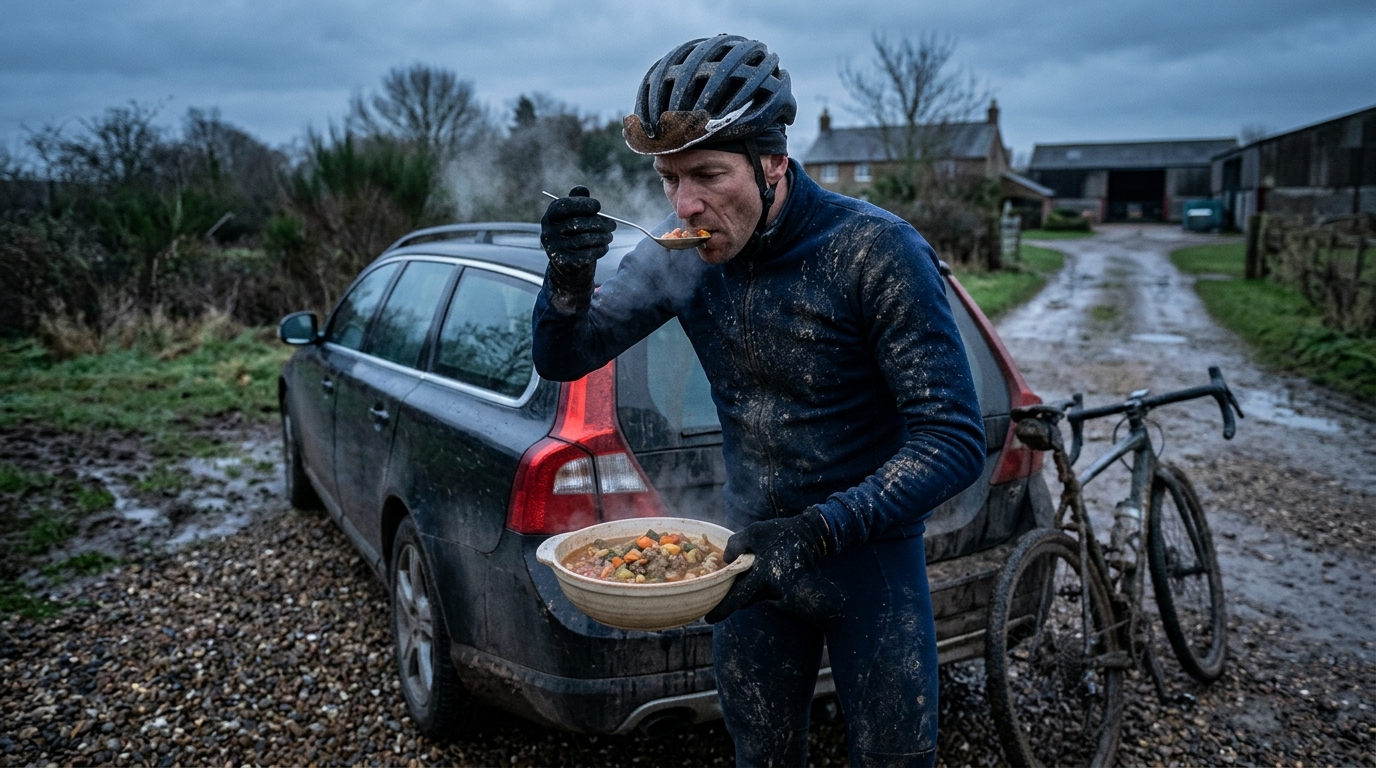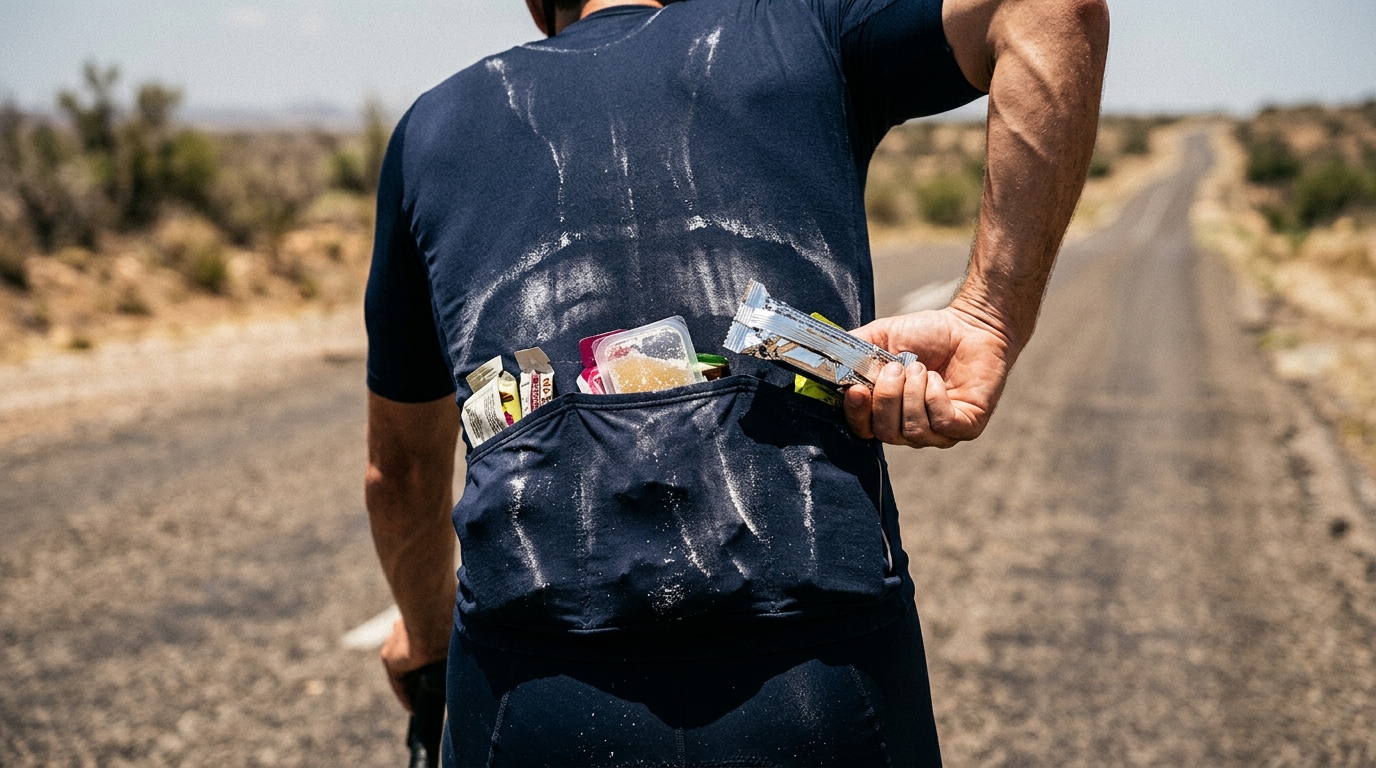
Image générée par notre modèle.
alimentation
Stratégie d'alimentation à vélo : utilise les données pour éviter la fringale
Élabore une stratégie d'alimentation pratique à vélo avec des fourchettes d'apport, un exemple de sortie détaillé et un processus de révision simple utilisant la puissance, la fréquence cardiaque, la RPE et des notes.
Le ravitaillement est un facteur limitant de la performance, pas une réflexion après coup
Un moteur aérobie puissant ne te protège pas d'un mauvais ravitaillement. Souvent, c'est même le contraire. Lorsque la sortie devient exigeante, un cycliste plus en forme peut brûler rapidement les glucides disponibles car il est capable de maintenir l'effort.
C'est pourquoi le ravitaillement doit être traité comme le rythme, la pression des pneus ou les braquets. Ce n'est pas quelque chose à ajouter à l'arrêt au café ou à se rappeler une fois que les jambes commencent à se sentir vides. Il détermine la puissance que tu peux maintenir en fin de sortie, la fréquence à laquelle tu peux répondre aux accélérations, et si la dernière ascension ressemble au plan ou à une gestion des dégâts.
Le coup de fringale est généralement présenté comme un effondrement dramatique, mais la version la plus utile à étudier est plus subtile. La puissance commence à chuter pour le même effort perçu. La fréquence cardiaque peut sembler étrange par rapport à la production. Tu évites les efforts intenses. Tu arrêtes de manger parce que l'estomac ne va pas, ce qui aggrave le problème. Au moment où la fringale complète arrive, le point de décision utile est déjà passé.
La solution n'est pas simplement de manger plus. La solution est de construire un plan de nutrition cycliste qui correspond à la demande de la sortie, utilise des produits que ton intestin tolère, et est examiné avec la même discipline que ton fichier de puissance.
Commence avec une fourchette réaliste de glucides
La demande en glucides est déterminée par l'intensité de ta sortie et la durée pendant laquelle tu demandes à ton corps de la maintenir. Une courte sortie facile n'a pas besoin de la même approche de ravitaillement qu'une longue sortie d'endurance avec des ascensions, une séance de tempo structurée, ou une sortie de groupe rapide avec des accélérations répétées.
Un cadre de départ prudent ressemble à ceci :
| Type de sortie | Durée et intensité | Apport initial suggéré | Meilleur format de carburant | Métrique d'examen |
|---|---|---|---|---|
| Facile ou récupération | Courte, faible pression | 0 à 30 g par heure | Eau, mélange léger, petite collation si nécessaire | Énergie stable, pas de charge intestinale inutile |
| Endurance | Longue sortie régulière | 30 à 60 g par heure | Mélange pour boisson plus barres ou aliments familiers | Stabilité de la puissance et de la RPE en fin de sortie |
| Tempo, sweet spot, sortie de groupe difficile, course | Pression soutenue ou accélérations répétées | 60 à 90 g par heure, seulement si pratiqué | Mélange pour boisson, gels, gommes, aliments faciles à digérer | Capacité à répéter les efforts et à éviter le déclin tardif |
Ce sont des points de départ, pas des prescriptions universelles. Les cyclistes plus petits, les jours d'intensité plus faible, les conditions plus fraîches ou les sorties courtes peuvent se situer plus bas. Les événements longs, les séances de haute intensité et les sorties de groupe de type course peuvent pousser plus haut, mais seulement si le cycliste a entraîné son intestin à le gérer.
Le mélange de produits est important. Certains cyclistes tolèrent mieux un apport plus élevé lorsque les glucides proviennent d'un mélange pour boisson et de gels conçus à cet effet plutôt que d'aliments solides denses seuls. D'autres se débrouillent mieux avec plus de nourriture réelle pendant les sorties d'endurance régulières et gardent les gels pour les sections plus difficiles. Le bon chiffre n'est utile que si le format te permet de l'absorber et de le tolérer réellement pendant la sortie.
Construis le plan avant la sortie
L'objectif d'un plan de ravitaillement est d'éliminer la prise de décision lorsque la sortie devient difficile. L'appétit, la motivation et le jugement sont tous moins fiables une fois que la fatigue commence à s'installer.
Construis le plan dans cet ordre :
Définis la demande de la sortie
Note le caractère attendu de la sortie : récupération, endurance, journée d'escalade, séance structurée, sortie de groupe rapide, simulation d'événement ou course. Plus la sortie contient d'intensité et de durée, plus le ravitaillement doit être délibéré.
Choisis l'objectif horaire
Choisis un objectif de glucides en fonction de ce que la sortie exige et de ce que tu as déjà toléré. Ne choisis pas un apport ambitieux pour un événement important si tu ne l'as pas pratiqué. La tolérance intestinale est entraînable, mais le jour de la course est un mauvais laboratoire de test.
Convertis l'objectif en nourriture réelle
Utilise les étiquettes et des calculs simples. Si ton mélange pour boisson fournit une partie de l'objectif horaire, décide ce qui comble l'écart : gels, gommes, barres, gâteaux de riz, bananes ou autres aliments familiers. Le plan doit te dire quoi consommer et quand, pas seulement te rappeler de manger plus.
Adapte le type de carburant à l'intensité
Les aliments solides fonctionnent souvent mieux lorsque le rythme est régulier et que la respiration est contrôlée. Les gels, les gommes et les mélanges pour boisson sont généralement plus faciles lorsque l'intensité augmente, que la route monte ou que le groupe ne te laisse pas le temps de déballer et de mâcher.
Le meilleur plan place le carburant le plus facile à digérer aux moments où la digestion et la manipulation sont les plus contraintes.
Crée des déclencheurs simples
N'attends pas la faim. La faim est un indicateur tardif à vélo. Utilise les alertes de ton compteur, les repères d'itinéraire, les marqueurs de tour ou les habitudes répétables. Ravitaille-toi avant les ascensions majeures, avant les longues sections exposées et avant que le groupe ne commence à sprinter au sommet, pas après que les dégâts soient déjà faits.
Exemple concret : sortie d'endurance de 3 heures ou sortie de groupe rapide
Supposons que l'objectif soit de 60 g de glucides par heure pour une sortie de 3 heures. C'est un objectif modéré pour de nombreuses sorties d'endurance plus longues et un objectif d'entraînement sensé pour une sortie de groupe rapide si le cycliste sait déjà que son estomac le supporte.
Le plan total est de 180 g de glucides.
Une version simple :
- Boisson énergétique : 30 g par bidon.
- Plan de bidons : un bidon par heure, soit 30 g par heure.
- Complément alimentaire : 30 g supplémentaires par heure sous forme de gels, de pâtes de fruits ou d'une barre.
- Exécution pratique : un gel vers le milieu de chaque heure, ou la moitié d'une barre coupée en deux petites bouchées si le rythme le permet.
Cela donne un rythme clair : bois régulièrement, puis ajoute un aliment énergétique planifié chaque heure pour combler le manque.
Si la première heure se passe mal et que le cycliste ne prend que le mélange en bidon, le plan doit changer sans panique. Tu as 30 g de retard, mais essayer de remplacer tout le déficit d'un coup peut créer des problèmes intestinaux. Une meilleure réponse est d'augmenter légèrement l'objectif des deux heures suivantes si la tolérance le permet, par exemple en ajoutant quelques pâtes de fruits ou un demi-gel supplémentaire par heure, tout en maintenant un apport hydrique constant.
Si le rythme est élevé et que mâcher devient difficile, oriente les glucides restants vers les gels et les boissons énergétiques. Si l'estomac est lourd, arrête de forcer les aliments solides denses, continue de siroter et utilise des doses plus petites et plus fréquentes. L'objectif n'est pas de gagner la feuille de calcul. L'objectif est de maintenir un apport en glucides à un rythme que l'intestin peut gérer.
Ce que les données de sortie révèlent sur le sous-ravitaillement
Le sous-ravitaillement se manifeste rarement par une étiquette claire dans le fichier. Il apparaît comme un schéma.
Le signal le plus utile est un décalage entre la puissance, la fréquence cardiaque et la RPE. Si la puissance diminue alors que l'effort perçu augmente, et que la sortie a été suffisamment longue ou difficile pour épuiser la disponibilité en glucides, le ravitaillement doit être sur la liste des suspects. Si la fréquence cardiaque reste élevée par rapport à une puissance en baisse en fin de sortie, cela peut indiquer un stress thermique, une déshydratation, une fatigue, un mauvais rythme, un mauvais ravitaillement, ou une combinaison de ces facteurs.
Les indicateurs probables de sous-ravitaillement incluent :
- La puissance diminue en fin de sortie même si le terrain et le rythme n'expliquent pas la baisse.
- Les efforts qui étaient gérables plus tôt deviennent difficiles à répéter.
- La RPE augmente fortement à la même puissance d'endurance.
- Le temps de roue libre augmente avant les montées ou après les accélérations.
- La concentration, le choix de la trajectoire ou la motivation se détériorent de manière notable.
- Des chiffres élevés au début se transforment en une chute abrupte plutôt qu'une baisse progressive.
Les facteurs de confusion sont importants. La chaleur, la déshydratation, la fatigue accumulée, un mauvais sommeil, un mauvais rythme et une intensité précoce trop ambitieuse peuvent tous produire un fichier similaire. L'étape pratique consiste à comparer des sorties similaires avec des schémas de ravitaillement différents. Si deux sorties d'endurance ont un terrain et une intensité similaires, mais que la sortie mieux ravitaillée maintient la puissance et la RPE plus proprement en fin de sortie, c'est une preuve utile. Cherche également si la baisse commence après une fenêtre de ravitaillement manquée. Une baisse qui apparaît peu après un apport manqué est plus suspecte qu'une baisse qui suit une erreur de rythme évidente.
C'est là que les cyclistes tirent souvent la mauvaise conclusion. Ils voient une baisse tardive et décident qu'ils manquent d'endurance. Parfois, c'est vrai. Mais si la sortie a été sous-ravitaillée, le signal d'entraînement est contaminé. Tu ne mesures pas proprement la durabilité aérobie. Tu mesures la durabilité aérobie plus un échec nutritionnel.
Teste les gels, les boissons énergétiques et les aliments solides à l'entraînement
L'entraînement est l'endroit où tu sépares les produits qui semblent bons sur le papier de ceux qui fonctionnent réellement pendant ta sortie.
Teste une variable à la fois lorsque c'est possible. Si tu changes la boisson énergétique, la marque de gel, les aliments solides, la caféine et le petit-déjeuner en même temps, tu ne sauras pas ce qui a causé le bon ou le mauvais résultat. Prends des notes de sortie qui incluent ce que tu as mangé, quand tu l'as mangé, le confort intestinal, la stabilité énergétique et toute baisse en fin de sortie.
Une progression de test pratique ressemble à ceci :
- Utilise un carburant familier lors de sorties d'endurance de routine jusqu'à ce que l'apport devienne automatique.
- Ajoute plus de glucides lors de sorties plus longues une fois que la tolérance de base est stable.
- Entraîne-toi à un apport plus élevé lors de séances qui incluent une pression soutenue.
- Teste les produits spécifiques à l'événement lors de séances de type événement.
- Répète le transport, l'ouverture et la consommation de carburant tout en roulant à une intensité réaliste.
La boisson énergétique est utile car elle rend l'apport plus passif, mais elle lie également les glucides aux fluides. Dans des conditions plus fraîches ou lors de sorties à faible transpiration, tu pourrais ne pas vouloir suffisamment de liquide pour répondre à tes besoins en glucides uniquement par les bidons. Par temps chaud, tu pourrais avoir besoin de liquide au-delà de ce que ton plan de glucides prévoit. Se fier à un seul format de carburant peut créer des problèmes.
Les gels et les pâtes de fruits sont efficaces, mais certains cyclistes ont des difficultés s'ils sont pris sans suffisamment de liquide ou empilés trop agressivement. Les aliments solides peuvent être satisfaisants et stables, mais ils deviennent plus difficiles à mâcher et à digérer à mesure que l'intensité augmente. Le meilleur plan utilise généralement chaque outil là où il convient.
Adapte-toi à la chaleur, aux montées et aux efforts intenses répétés
Une même durée de sortie peut exiger un plan de ravitaillement différent selon les conditions et le terrain.
Chaleur
La chaleur modifie le coût de la sortie. Plus de flux sanguin est nécessaire pour le refroidissement, les pertes de sueur augmentent et l'appétit peut diminuer. Cette combinaison peut réduire discrètement l'apport juste au moment où le corps est soumis à plus de stress.
Dans des conditions chaudes, rends le plan plus facile à exécuter. Utilise un carburant qui passe bien. Garde l'accès aux boissons simple. Ne suppose pas que la soif guidera l'apport en glucides. La soif et le ravitaillement sont liés, mais ce ne sont pas les mêmes objectifs.
Montées
Les montées compressent le problème. La puissance augmente, la respiration devient plus lourde et la manipulation de la nourriture devient moins pratique. Si tu commences une montée déjà en retard sur le ravitaillement, tu forces le corps à résoudre un effort à forte demande avec une offre décroissante.
Ravitaille-toi avant la montée quand la route le permet encore. Pour les montées longues ou répétées, utilise des formats faciles à consommer sous pression. Garde les aliments solides compliqués pour les sections plus calmes, à moins que tu ne saches que tu les tolères bien en montée.
Efforts intenses répétés
Les accélérations, les attaques, les courtes montées et les efforts au seuil augmentent la dépendance aux glucides. C'est pourquoi une sortie de groupe rapide peut créer plus de pression de ravitaillement qu'une sortie solo régulière de durée similaire.
Le danger est que la conduite intense rend également l'alimentation plus difficile. Utilise les sections plus faciles, les descentes sûres, les moments de regroupement et les tronçons plus calmes pour rester en avance. Si tu ne manges qu'après chaque bloc intense, tu réponds à une dette plutôt que de la prévenir.
Examine la sortie comme des données d'entraînement
Un plan de nutrition cycliste s'améliore lorsque tu l'examines comme des données d'entraînement. La question n'est pas seulement : « Ai-je eu une fringale ? » C'est : « Le ravitaillement a-t-il soutenu le travail que j'ai demandé à mon corps de faire ? »
Après les sorties importantes, note :
- L'apport en glucides prévu.
- L'apport réel.
- Les types de carburant utilisés.
- Les problèmes de timing.
- Le confort intestinal.
- La stabilité de la puissance en fin de sortie.
- Le comportement de la fréquence cardiaque par rapport à la puissance.
- L'EPR dans la dernière partie.
- Tout moment où la prise de décision ou la motivation a visiblement diminué.
Compare ensuite le fichier à l'histoire de la sortie. Si la puissance a diminué tardivement mais que l'EPR est resté contrôlé et que le ravitaillement était solide, le facteur limitant peut être la durabilité, le rythme, la chaleur ou la fatigue accumulée. Si la puissance a diminué, l'EPR a fortement augmenté et l'apport était faible, retardé ou mal toléré, le ravitaillement devient une explication plus forte.
C'est aussi là que le contexte de FTP est important. Un cycliste travaillant à une fraction plus élevée du seuil pendant de longues périodes brûlera des glucides plus rapidement qu'un cycliste confortablement en dessous de la pression d'endurance. Si ton estimation de seuil est obsolète, ton interprétation de l'intensité peut être erronée. Utilise l'estimateur FTP lorsque tu as besoin d'une ancre plus propre pour le rythme et l'analyse après la sortie.
Le point à retenir pratique
Une bonne stratégie de ravitaillement cycliste ne consiste pas à courir après un chiffre universel parfait. Il s'agit d'adapter l'apport en glucides à la demande de la sortie, de pratiquer le plan jusqu'à ce qu'il devienne ennuyeux, et d'utiliser les données pour repérer quand le plan a échoué.
Commence par un objectif horaire réaliste. Choisis un carburant que tu peux tolérer. Transforme cet objectif en bidons, gels, barres, gommes ou aliments réels avant de partir. Compare ensuite le plan avec le fichier après.
Si tu faiblis régulièrement en fin de sortie, ne passe pas directement à des blocs d'entraînement plus importants. Vérifie d'abord si ton ravitaillement donne à ta forme physique une chance équitable de se manifester. La puissance, la fréquence cardiaque, l'EPR et les notes de sortie de base te diront généralement la vérité si tu les examines ensemble.