Image générée par notre modèle.
cycling safety
Cycling Bunch Safety: Positioning, Handling and Data Habits
Practical positioning, handling, braking, cornering and ride-data habits that improve cycling bunch safety in fast group rides and races.
Why fast-group risk is different from solo riding
Cycling bunch safety is not just solo bike handling with more riders around you. The physics are different because the decision window is shorter, the visual field is more cluttered, and the consequence of a small mistake can spread through the group.
When you ride alone, hazards usually announce themselves clearly enough. You see the pothole, choose a line, brake when you want, and own the outcome. In a fast group, the rider in front of you may block your view until the last moment. Your line is influenced by the wheels beside you. Your braking affects the rider behind you. The group creates speed, but it also creates dependency.
That is why group ride safety starts before the obvious danger point. The safest riders are rarely the ones making dramatic saves. They are the ones who avoid needing them. They sit where they can see, move before the squeeze happens, and treat every corner, pinch point and change in wind direction as a tactical problem rather than a surprise.
If you only react when the rider ahead brakes, your options have already narrowed. By that point, you are responding to their decision rather than making your own.
Positioning habits that reduce crash exposure
Good road race positioning is not simply about being near the front. It is about being in the part of the bunch where speed changes are less violent and your options are still open.
The back of a fast group can feel safer because there is space and less pressure to hold position. In practice, it often asks for more repeated effort. Small accelerations, hesitations and poor lines tend to ripple backward. By the time they reach the rear, they can become harder accelerations, late braking, or gaps that need closing. You also have less warning before a split, a touch of wheels, or a rider losing momentum out of a corner.
The goal is to stay close enough to the action that you can read the road, but not so exposed that you spend the entire ride in the wind. This is a dynamic position, not a fixed slot. When the road narrows, move earlier. When the wind shifts, expect the bunch to change shape. A crosswind changes where shelter sits, so the safer part of the group may move from the middle to one side, or become more contested as riders fight for the same protected line. That fight for shelter is often where overlap, elbows-out riding and sudden braking start to appear.
Useful positioning habits:
- Keep your eyes moving beyond the wheel directly in front of you.
- Avoid getting trapped against the gutter, parked cars or raised edges.
- Leave yourself an exit line when the bunch compresses.
- Move up before technical sections, not inside them.
- Do not dive into gaps that are closing faster than you can occupy them safely.
The safest position is usually the one that gives you information and options. If you have neither, you are depending on other riders to make good decisions for you.
Reading wheels, shoulders and road furniture
Bunch crashes often begin with a manageable problem, then worsen when the following riders have to make rushed corrections. The skill is learning to see the first correction before it becomes your problem.
Watch the wheel, but do not stare at it. A front wheel tells you what is happening now. A rider's shoulders and hips tell you what is about to happen. If shoulders tense, elbows lock, or the upper body shifts abruptly, something is changing. That rider may be braking, avoiding a hole, preparing to stand, or bracing for contact.
Road furniture matters because it changes available space. Traffic islands, parked cars, narrow bridges, speed bumps, kerbs, lane dividers and poor road edges all make the bunch compress. Compression is where handlebars overlap, riders brake at different rates, and predictable lines disappear.
The practical point is that hazards on the road are also hazards in the group. A pothole is not only a pothole. It is a reason for riders to swerve. A narrowing road is not only a narrowing road. It is a reason for the bunch to fight for position. A corner is not only a change of direction. It is a place where speed, line choice and confidence separate riders.
Signal when it helps, but do not outsource safety to signals. In a fast group, warnings can be late, unclear or missed entirely. Your own scan pattern is the primary defence.
Cornering, braking and overlap mistakes to avoid
Cornering in a bunch is less about maximum lean and more about predictable sequencing. The best riders are smooth because they do the work early. They choose position before the turn, brake before the lean, hold a stable line through the apex, then accelerate when the group stretches.
The common mistake is entering too far back, braking late, then trying to regain speed while still steering. That creates a concertina effect. The riders ahead are already exiting, the riders behind are still braking, and you are forced into a sharp acceleration at the worst moment. Repeat that over multiple corners and the cost becomes physiological as well as tactical: every poor entry creates another anaerobic spike, which makes the next decision slightly harder because you are processing the road while recovering from the previous surge.
Better cornering habits:
- Look through the turn, not at the wheel in front.
- Brake before the corner while the bike is upright.
- Hold a line that other riders can predict.
- Avoid changing lanes mid-corner unless you have clear space.
- Expect the exit to stretch the group and be ready to pedal cleanly.
Braking is similar. In a bunch, braking hard is sometimes necessary, but it should not be your default speed-control tool. Soft-pedal, sit taller, or adjust your line when there is room. When you do brake, keep it smooth and progressive. Sudden braking forces the riders behind you to make a decision under pressure.
Wheel overlap is the classic cycling crash prevention topic because it looks harmless until it is not. The danger is not simply that your front wheel is beside another rider's rear wheel. The danger is that the rider ahead controls the space your front wheel needs. If they move sideways, your steering angle can be taken away instantly.
Avoid overlap when the bunch is nervous, the road is narrow, or riders are changing lines. If you do end up overlapped, do not panic or jerk away. Ease pressure on the pedals, create space gradually, and let the wheel ahead move clear.
Fatigue makes all of this more fragile late in a ride. As effort accumulates, riders often scan less, brake less smoothly and hold lines less precisely. A rider who was predictable early can become ragged after repeated accelerations. That is why the final part of a hard group ride often needs more margin, not less.
Training drills for safer pack handling
Bike handling drills are useful because they make basic control automatic. In a bunch, you do not execute the skill you understand in theory. You execute the habit that survives when you are tired, boxed in and breathing hard.
Do these drills only in a controlled environment: an empty car park, closed road, track infield, or other traffic-free space with a clean surface and plenty of room. Start at low speed. Use trusted partners. Keep the first attempts easy enough that either rider can stop calmly. Progress only when the previous step feels boring and repeatable.
Close-riding practice
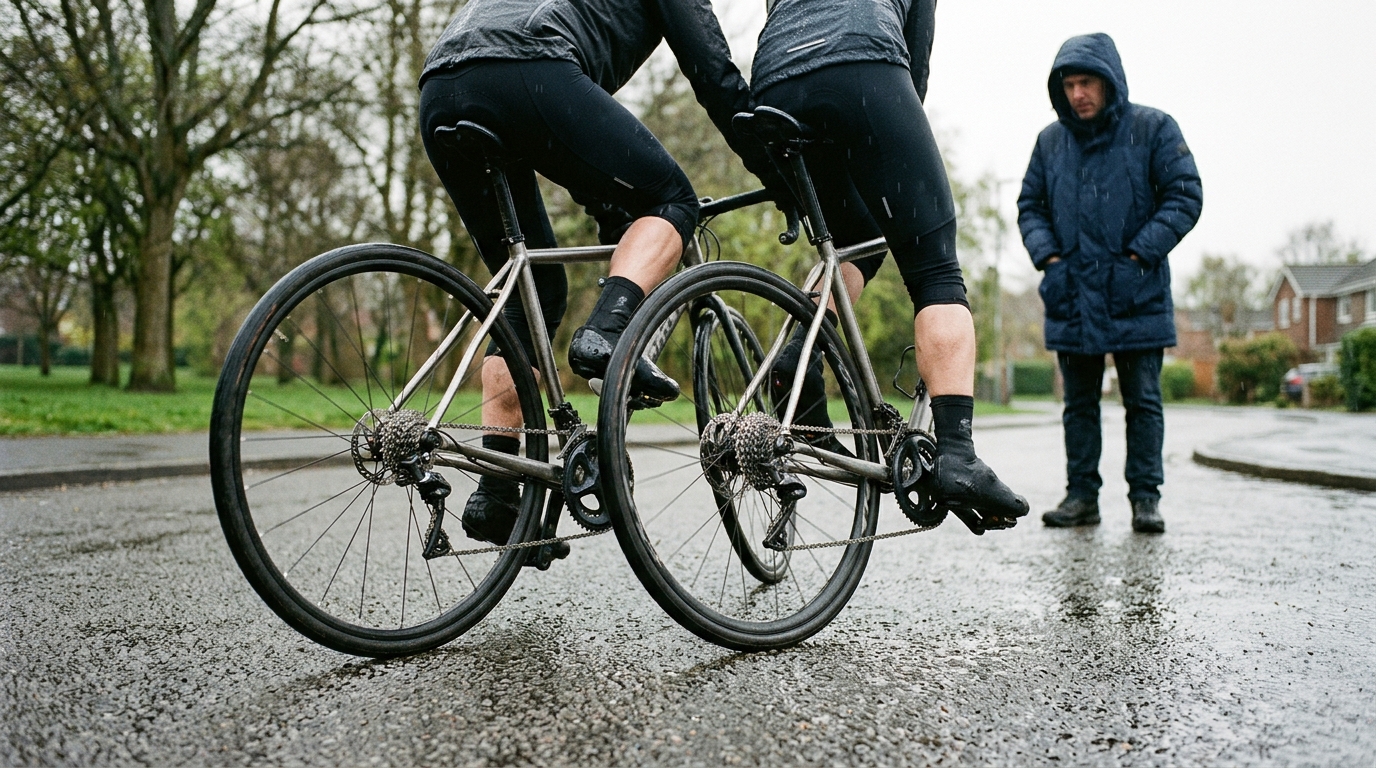
Setup: use an empty car park or closed road with no traffic, obstacles or pedestrians. Ride with one trusted partner at low speed.
Start with a clear gap between handlebars. Ride side by side with relaxed elbows, level shoulders and steady pressure on the pedals. The aim is to remove the instinctive flinch that appears when another rider is close.
Progression:
- Ride parallel with a comfortable gap.
- Gradually reduce the gap while keeping both bikes straight.
- Add gentle speed changes agreed in advance.
- Add a second pair only when both riders can hold a line calmly.
Stop the drill if either rider starts staring down, locking elbows or drifting unpredictably.
Shoulder and elbow contact
Setup: practise only on a closed, traffic-free surface with a trusted partner. This is not for open roads, live group rides, commuting lanes or mixed-ability bunches. Keep the speed low enough that both riders can put a foot down safely if needed.
The purpose is not to push anyone around. It is to learn that minor contact does not require a major reaction. Many dangerous moments become worse because a rider stiffens, grabs the brakes or swerves.
Progression:
- First ride side by side without touching.
- Then allow a light shoulder brush while both riders keep hands on the bars and eyes forward.
- Build to brief, gentle shoulder contact only if both riders remain relaxed.
- Do not practise handlebar contact, leaning contests or forceful bumping.
If one rider is uncomfortable, stop. The skill is calmness, not toughness.
Bottle, glance and signal drills
Setup: use a traffic-free space and ride at low speed before adding complexity.
Practise taking a bottle, checking over your shoulder and pointing out hazards without drifting across the road. These are small skills, but they matter because they happen when attention is divided. If you cannot drink or look back without changing line, that becomes a group risk.
Progression:
- Take a bottle while riding alone in a straight line.
- Add a shoulder check without drifting.
- Add a simple hand signal.
- Practise the same skills while riding beside a trusted partner with plenty of space.
The target is not speed. It is line discipline while your attention is split.
Cornering lines
Setup: choose a quiet, closed or traffic-free corner with clear sightlines and a clean surface. Do not practise bunch-cornering skills on open roads with cars, pedestrians or blind exits.
Practise entering corners with a clear sequence: setup, brake, turn, exit. Keep the line consistent. You are not trying to find the fastest possible turn in isolation. You are trying to build a line that remains usable when riders are around you.
Progression:
- Ride the corner alone at low speed with the same line each time.
- Add braking before the turn while the bike is upright.
- Add a trusted partner riding behind with a safe gap.
- Only then practise side-by-side corner entries, and only if the space is wide and controlled.
A good group cornering line is predictable before it is fast.
Braking control
Setup: use a flat, traffic-free surface with plenty of run-off. Start alone before adding another rider.
Practise reducing speed smoothly without grabbing the levers. Learn how much speed you can scrub by soft-pedalling, changing body position and feathering the brakes. The more ways you have to control speed, the less likely you are to create panic behind you.
Progression:
- Ride alone and practise gradual speed reductions.
- Add a marker where braking begins so the timing is deliberate.
- Practise soft-pedalling and sitting taller before touching the brakes.
- Add a trusted rider behind only after your braking is smooth and predictable.
These drills are not separate from fitness. They are what allow your fitness to be used safely. A high FTP helps you hold position, but handling decides whether you can hold it without wasting energy or creating risk.
Using ride data to review risky moments
Ride data will not tell you everything about cycling bunch safety, but it can show where your risk exposure tends to rise. The file is useful because it removes some of the emotion from the post-ride story.
Use a repeatable workflow rather than scrolling through the file and hoping something stands out.
A post-ride review process
- Mark the risky sections immediately after the ride
Before the details blur, note the places where you felt boxed in, braked suddenly, lost position, followed a poor wheel, or had to sprint after a corner. Use lap markers, route notes, segment names, or a simple written note. The exact system matters less than capturing the moment while you still remember the bunch context.
- Compare the data around those moments
Look at the period before, during and after each marked section. Focus on speed variability, coasting, braking-like drops in speed, repeated power spikes and how long effort stayed elevated afterward. Around corners and pinch points, repeated spikes usually mean you were paying for position or line choice, not just fitness.
- Add the tactical context
For each section, write down where you were in the bunch: near the front, mid-pack, at the back, sheltered, exposed, boxed against the gutter, or following a rider with an inconsistent line. A power spike means something different if you were closing a gap from the back than if you were accelerating smoothly out of the front third.
- Identify the mechanism
Ask what caused the cost. Did you enter the corner too far back? Did the road narrow while you were trapped on the wrong side? Did a wind shift move the sheltered line and leave you exposed? Did fatigue make you scan less, brake later, or drift through the turn?
- Choose one change for the next ride
Do not turn the review into a long list of flaws. Pick one handling or positioning change and test it next time. Move up before the technical section. Leave more space behind an erratic wheel. Brake earlier before a repeated corner. Hold a slightly more sheltered position when the wind changes. One specific change is easier to execute than a vague plan to ride safer.
A few useful review prompts:
- Did power spike after every corner because you entered too far back?
- Did speed fluctuate because you were following an unpredictable wheel?
- Did perceived effort rise when the road narrowed or the wind changed?
- Did you lose position before hazards, then burn energy regaining it afterward?
- Did braking points match the group, or were you always reacting late?
- Did late-ride fatigue show up as poorer line discipline or more abrupt braking?
This is where data-driven athletes can make real progress. Do not use the file only to judge fitness. Use it to identify decision points. If the same type of road repeatedly creates high-cost accelerations, the solution may not be more power. It may be earlier positioning, better corner entry, or choosing a smoother wheel.
For broader intensity review, normalized power and RPE can help connect what the ride demanded with how it felt. The safety value comes from asking why those demands appeared in the first place.
Pre-ride checks for group dynamics and course hazards
A safer fast ride starts before the rollout. The route, riders and weather shape the risk profile long before the first hard section.
Ask practical questions:
- Is this group disciplined or does it surge unpredictably?
- Are there known narrow roads, rough surfaces or awkward turns?
- Where does the ride usually become hard?
- Are there riders who overlap wheels, brake late or change line without warning?
- Is the wind likely to push riders toward the gutter or across the lane?
- Does the group communicate hazards clearly?
This is not about being fearful. It is about riding with a plan. If the course has technical sections, move up before them. If the bunch is full of riders you do not know, leave more margin. If the route includes urban furniture or repeated turns, prioritise visibility over perfect drafting.
Wind deserves specific attention because it changes the geometry of safety. In a headwind, the bunch may sit wider and slower. In a tailwind, speed rises and braking distances feel shorter because everything happens faster. In a crosswind, the sheltered line shifts sideways, which can push riders toward the gutter or across the lane. The risk is not only exposure to wind. It is the fight for the limited protected space.
Equipment checks matter too because small mechanical problems become large group problems. Tyres should be sound, brakes predictable, bottles secure, bar tape intact and drivetrain reliable. A dropped bottle, skipping chain or soft brake lever is not just your issue when riders are close.
There is also an honesty check. If you are fatigued, distracted or overreaching to stay with a group that is too fast, your margin narrows. Fitness is not binary. You may be strong enough to survive the pace but too tired to make clean decisions late in the ride. That is when poor scanning, wheel overlap, delayed braking and loose line discipline start to appear.
The safest riders make the bunch calmer
The rider who sees earlier, moves sooner and handles the bike calmly saves energy and reduces risk for everyone nearby. That matters because safety and performance are linked in a fast group. Better position reduces repeated accelerations. Smoother braking protects the rider behind. Cleaner corner entry stops a technical section from becoming an anaerobic tax every time the road bends.
Fast groups will always carry uncertainty. Riders make mistakes. Roads change. Corners compress. But much of the risk builds from predictable ingredients: bad position, late braking, poor scanning, wheel overlap, fatigue and unfamiliar group dynamics.
The practical goal is not to eliminate every hazard. It is to stop being surprised by the obvious ones. Hold a position that gives you vision. Read bodies as much as wheels. Brake before you are forced to. Practise close handling in controlled environments before you need it. Review your data for the places where tactical errors turned into physical cost.
When those habits improve, the group often feels calmer at the same speed. Not because the ride became easier, but because fewer situations require a late correction.