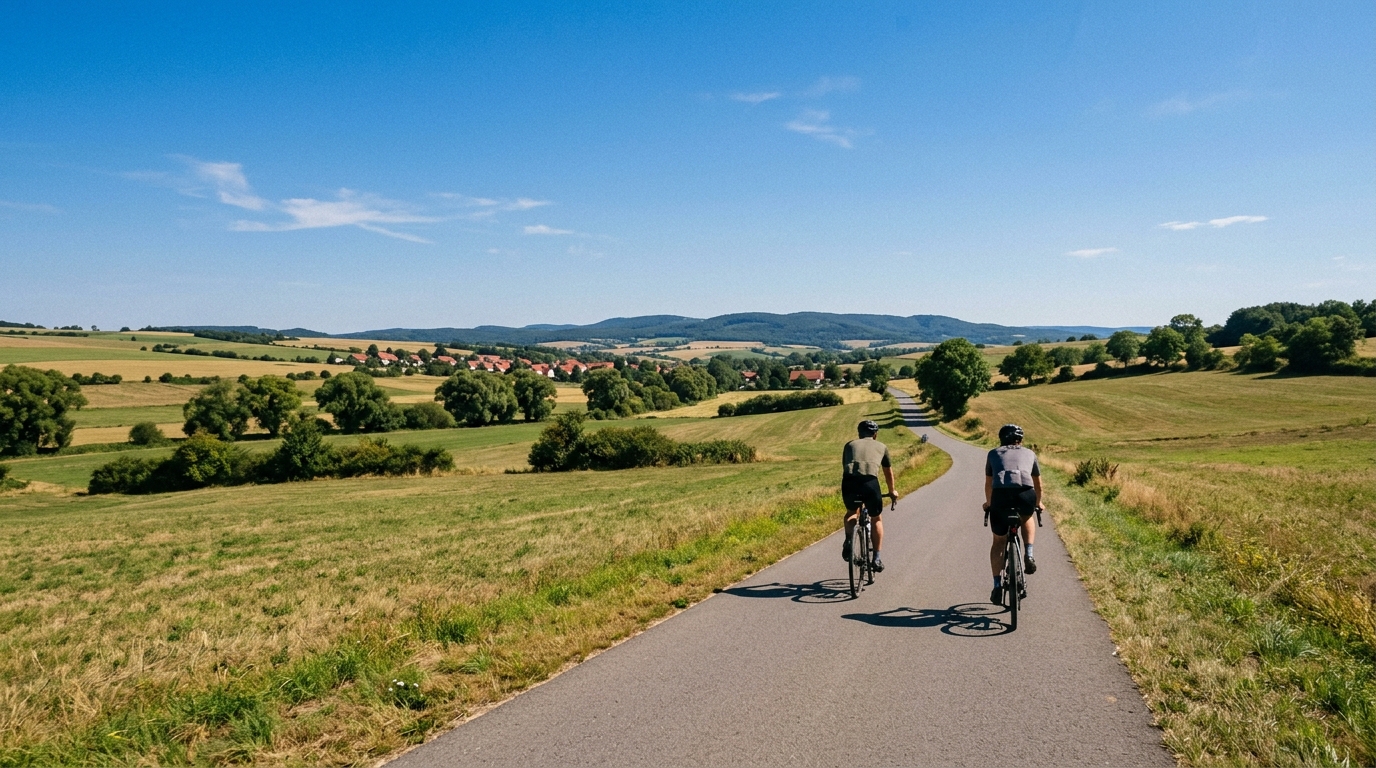
Unstrut-Werra-Radweg
A 117.8 km asphalt point-to-point route with 599 m of climbing, suited to steady endurance pacing rather than climb-focused riding.
- Distancia
- 117.8km
- Desnivel
- 599m
- Superficie
- —
- Forma
- Punto a punto
La ruta
Perfil de elevación
Unstrut-Werra-Radweg cycling route overview
The Unstrut-Werra-Radweg is a 117.8 km point-to-point cycling route in DE, built around a simple but important profile: asphalt surface, 599 m of elevation gain, and no notable climbs listed in the route data.
That combination gives the ride its character. This is not a route defined by a single decisive ascent or a mountain-style pacing problem. The climbing load is real, but it is spread across the distance rather than concentrated into named climbs. For most riders, that shifts the demand from peak climbing power to disciplined endurance pacing. The route is long enough that repeated small efforts can accumulate, especially if the early kilometres are ridden too aggressively.
Terrain and ride feel
With 117.8 km on asphalt, the route should favour efficient rolling speed and consistent rhythm. The absence of listed notable climbs does not mean the ride is flat or passive. The 599 m of gain still has to be paid for, and on a route of this length the cost often comes through fatigue rather than one obvious make-or-break section.
The key is to treat the profile as an endurance ride with modest vertical load. Stay smooth over rises, avoid turning every gradient change into an acceleration, and keep pressure steady rather than spiky. If riding with power, this is the kind of route where holding back above /glossary/ftp matters more than chasing speed whenever the road tilts up.
Practical notes
Because the route is not a loop, logistics matter. Plan the start and finish as separate points, or have a clear return strategy before rolling out. That is not a minor detail on a 117.8 km ride. A point-to-point route rewards preparation and punishes improvisation at the end, when the legs are already carrying the full distance.
The asphalt surface makes a road bike, endurance road bike, or fast all-road setup the natural choice. Tyre selection can lean toward efficiency rather than off-road durability, while still prioritising comfort for the full distance.
Pacing approach
- Start conservatively, because the main difficulty is cumulative distance.
- Keep climbs and rises controlled rather than reactive.
- Fuel early enough that the final portion is not decided by energy availability.
- Use the 599 m of gain as a reminder that this is not a purely flat roll.
Bottom line
The Unstrut-Werra-Radweg cycling route is best understood as a long, asphalt endurance ride with manageable climbing and point-to-point planning demands. Its difficulty is not in a signature climb, but in sustaining an efficient rhythm across 117.8 km without letting small efforts compound into late-ride fatigue.
Rutas relacionadas
3-Länder-Radweg
A 302.2 km asphalt route in Germany with 1512 m of climbing and point-to-point logistics shaped by the Reußenkreuz climb.
7 Peaks Alpine Challenge
A 110.9 km point-to-point assault through the Victorian Alps, stacking 3404 metres of climbing across relentless, wind-swept high-country ascents.
Aberdare Range
A 46 km asphalt point-to-point through Kenya's Central Highlands that trades big climbs for a relentless 1,700 m of rolling grind.
Abra Málaga
A 45-kilometer point-to-point ribbon of asphalt through Peru's Sacred Valley, climbing 1,699 relentless meters into the high Andes.
Afriski Mahlasela Pass
A 112.8 km asphalt ascent through the Maloti Mountains, climbing 3,384 m to the roof of southern Africa via the storied Mahlasela Pass.
Ahr Cycleway
An 82.9 km asphalt point-to-point route with 541 m of gain, the Ahr Cycleway is a steady endurance ride rather than a climb-focused day.