Imagen generada por nuestro modelo.
strength training
Strength Training for Cyclists Without Dead Legs
How to lift, schedule, progress, and adjust strength work so it supports key rides instead of leaving you flat.
Why Strength Training Helps Endurance Cyclists
Strength training for cyclists is not about turning an endurance athlete into a powerlifter. It is about raising the ceiling of force production, improving joint tolerance, and making the same pedaling demand cost less.
On the bike, every pedal stroke is a small force repeated again and again. If your maximum force capacity is low, hard accelerations, steep climbs, low-cadence torque work, and long fatigue-resistant efforts all sit closer to your limit. Off-bike strength gives you more margin. The goal is not to feel muscular in the gym. The goal is to make race-specific work feel more manageable on the road.
The best strength work usually improves three things:
- Force production through the hips, knees, and ankles
- Stability through the pelvis and trunk when fatigue builds
- Load tolerance in the tendons, calves, hamstrings, glutes, and lower back
That last point is underrated. A stronger athlete is often not just faster, but more durable. They can absorb training blocks, hold position late in rides, and handle changes in terrain without every hard session becoming a recovery problem.
The mistake is treating cycling gym workouts like a second sport. When the gym becomes a constant source of soreness, it stops supporting the riding. The right strength training plan should sharpen the bike work, not compete with it.
If you have a meaningful injury history, pain under load, recurring tendon issues, or major mobility limitations, get individualized coaching or clinical input before loading aggressively. Strength work is powerful because it adds stress. That stress needs to fit the athlete in front of it.
The Minimum Effective Dose for Busy Riders
The best plan is the one that creates a clear return without dead legs. For most endurance cyclists, that means a small menu of repeatable lifts, enough load to stimulate adaptation, and enough restraint to keep the bike calendar intact.
A practical starting point:
- Off-season: 2 strength sessions per week
- In-season: 1 strength session per week
- Main lifts per session: 2 to 4
- Working sets per main lift: 2 to 4
- Strength-focused reps per set: 3 to 8
- Effort target: stop 1 to 3 reps short of failure on most work
That is enough for a rider who is already training seriously on the bike. More work can be added later, but only if the riding still looks right.
Cyclists often overestimate how much variety they need and underestimate how much fatigue variety creates. A new lunge variation, machine, or plyometric drill can produce soreness simply because the tissue is not used to it. That soreness may not mean the session was productive. It may mean the workout was poorly dosed.
Think of gym work as a support system. If your week already includes threshold work, long endurance, and race-specific intensity, the gym does not need to add another maximal stressor. It should fill the gaps that riding leaves behind: heavier force, loaded range of motion, unilateral control, posterior-chain strength, and trunk stiffness under fatigue.
Start with less than you think you can tolerate, then earn additions. The test is not how strong you feel in the final set. The test is how well you ride once lifting becomes part of your normal week.
Best Exercises for Cycling Strength and Durability
The best exercises for cycling leg strength are not exotic. They are simple movement patterns that target the muscles and positions cyclists rely on while addressing some of the limitations created by long hours in the saddle.
A simple session can be built from these categories:
- Squat pattern
- Hinge pattern
- Single-leg movement
- Calf or soleus work
- Trunk or upper-back work
You do not need every category in every session. Pick the movements that solve the problem in front of you without burying the next ride.
Squat pattern
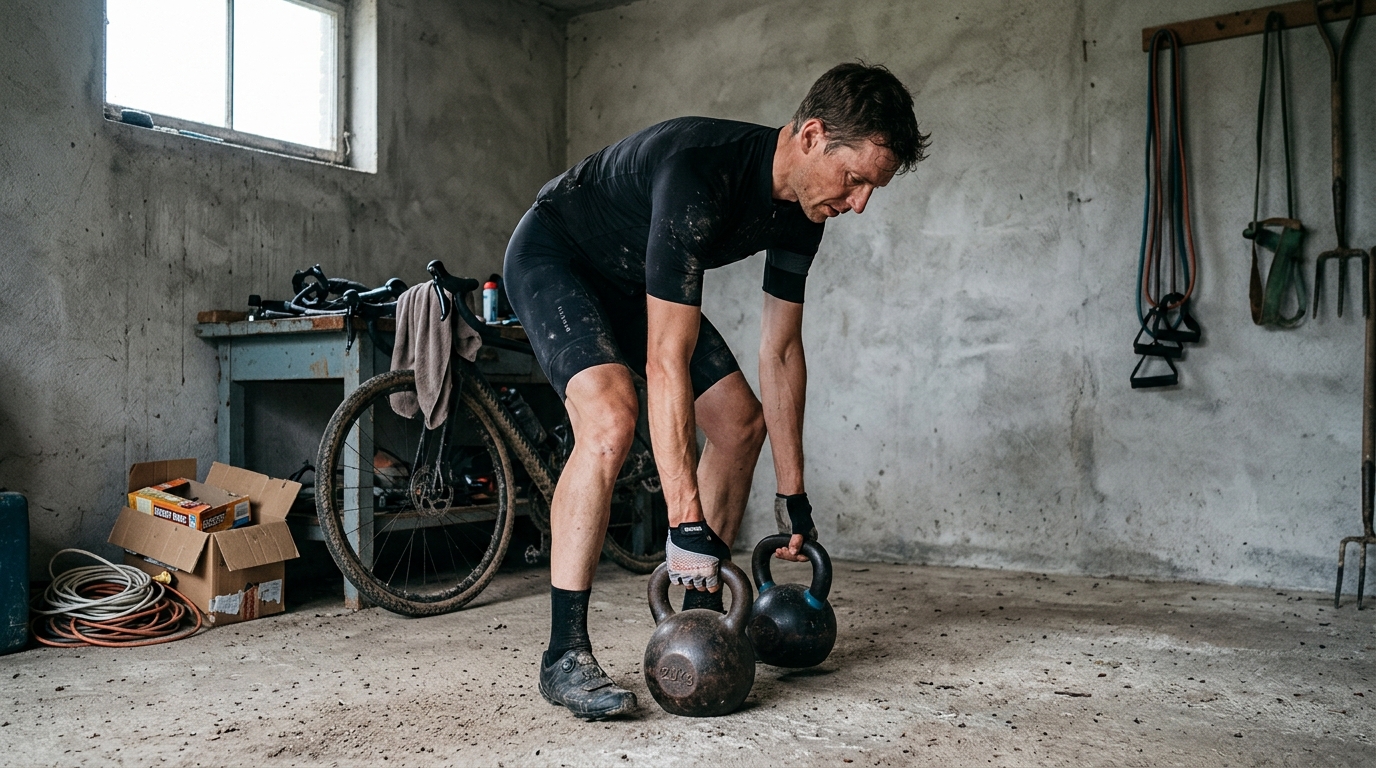
A squat pattern trains coordinated force through the hips, knees, and ankles. This can be a goblet squat, front squat, split squat, or leg press depending on equipment, mobility, and lifting experience.
For cyclists, the key is clean execution. Do not chase depth at the expense of pelvic position or knee tracking. Use a range where you can stay stable and drive evenly through the foot. If the weight forces you to collapse, twist, or bounce through positions you cannot control, it is no longer serving the bike.
Hinge pattern
A hinge pattern targets the glutes, hamstrings, and back of the body. Romanian deadlifts, hip thrusts, trap-bar deadlifts, and cable pull-throughs all fit here.
This is often where cyclists get the biggest durability benefit. Riding is repetitive and forward-oriented. A stronger hinge helps support the pelvis, reduces over-reliance on the quads, and builds posterior-chain capacity that can matter late in hard endurance rides.
Single-leg work
Split squats, step-ups, single-leg Romanian deadlifts, and rear-foot-elevated split squats expose left-right differences that the bike can hide. Because the pedals are fixed and the motion is constrained, a rider can produce decent power while still lacking control through one hip or knee.
Single-leg work does not need to be brutally heavy. It should be stable, smooth, and repeatable. If balance becomes the limiter, simplify the movement or add support. The target is usable strength, not a balance contest.
Calf and soleus strength
The lower leg is often treated as an afterthought, but it handles repeated load every ride. Calf raises, bent-knee calf work, and loaded carries can help build capacity around the ankle and Achilles.
This matters especially for riders who mix cycling with running, climb out of the saddle often, or notice calf tightness after hard or hilly sessions.
Trunk and upper-back work
Core training for cyclists should not be endless crunches. The better work is the kind that helps you resist unwanted movement while the limbs produce force. Carries, dead bugs, side planks, Pallof presses, rows, and controlled anti-rotation work all have a place.
A stable trunk gives the legs a better platform. It also helps hold position when fatigue makes the upper body start leaking energy into every acceleration.
Plyometrics: Who Should Use Them and Who Should Skip Them
Plyometrics can help riders who already tolerate strength training well and want to improve the ability to produce force quickly. That can matter for sprinting, short accelerations, technical racing, and repeated changes of pace. But jumps and hops are not a shortcut. They are a high-demand tool that needs the right context.
Skip plyometrics for now if:
- You are new to lifting
- You are dealing with tendon pain, joint pain, or recurring calf tightness
- You cannot land quietly and consistently
- You are in a heavy race block
- Your key rides are already compromised by gym fatigue
Consider them if:
- You have several weeks of consistent strength work behind you
- You recover well from lower-body lifting
- You can control basic squat, hinge, and single-leg patterns
- Your cycling goals include sprinting, punchy accelerations, or race-style surges
Introduce them with the smallest effective dose. Put them early in the workout, before heavy lifts, when coordination is fresh. Use simple options first, such as low box jumps, small hops, or medicine-ball throws. Keep every rep sharp. Stop when landing gets loud, timing gets sloppy, or speed fades.
For many endurance-focused riders, explosive intent during lighter strength movements is enough. Moving a moderate load with purpose can train fast force production without adding the soreness and tendon load that poorly timed jump work can create.
How to Schedule Gym Work Around Key Rides
Scheduling is where many strength plans fail. The same workout can support or sabotage the week depending on where it lands.
The first principle is to protect the key ride. If the most important bike session is threshold, VO2-style intensity, race simulation, or a demanding group ride, do not place a hard lower-body gym session close enough that soreness or heavy legs reduce the work that matters.
A strong approach is to pair stress with stress. Put gym work on a day that already has harder riding rather than spreading fatigue across the entire week. This keeps easy days easier and gives the body a clearer recovery signal. If you ride hard earlier in the day, a short strength session later can work, provided the gym volume is modest and the next day is not another key demand.
Another option is to lift after an easier endurance ride, but only if the next key ride has enough separation from the gym session. What usually backfires is lifting hard on what was supposed to be a recovery day. That turns recovery into hidden load and leaves the rider flat when power needs to be available.
For riders using /glossary/ftp-based training, the gym should support the sessions that move FTP, repeatability, and durability. If lifting causes repeated missed targets, the plan is not balanced. The gym is not automatically wrong, but the dose, timing, or exercise selection needs adjusting.
Sample week: intervals Tuesday, tempo Thursday, long ride Saturday
If Tuesday intervals are the highest-priority session, keep Monday light or off. Lift after the Tuesday ride, not before it. That pairs the hard neuromuscular and muscular stress on the same day and protects Monday as preparation.
A workable layout:
- Monday: easy spin or rest
- Tuesday: key intervals, then short strength session later
- Wednesday: endurance or recovery ride
- Thursday: tempo ride
- Friday: rest, mobility, or very easy spin
- Saturday: long ride
- Sunday: endurance ride or rest depending on fatigue
In the off-season, the second lift can sit after Thursday tempo if Friday is genuinely easy. Keep that second session shorter or more trunk and upper-back focused if Saturday long ride quality starts to fade.
Sample week: Saturday group ride is the key session
If the Saturday ride is the week-defining workout, avoid heavy lower-body lifting late in the week. Put the main strength session earlier, then let the legs freshen.
A workable layout:
- Monday: strength session, optionally after an easy ride
- Tuesday: endurance or intervals depending on plan
- Wednesday: endurance or recovery ride
- Thursday: tempo or openers if needed
- Friday: rest or very easy spin
- Saturday: key group ride or race simulation
- Sunday: endurance ride or rest
In-season, this may be the whole gym plan: one concise session on Monday, then no heavy lower-body work until after the key ride.
Progression: Sets, Reps, Load and Deload Rules
Progression should feel conservative at first. The body adapts well to strength work, but cyclists run into trouble when they add load, range, volume, and new exercises at the same time.
Change one variable at a time.
Start with movements you can control. Build consistency. Then add load while keeping the same execution. If the lift becomes slow, unstable, or technically messy, the weight is no longer productive for your current purpose.
For cycling gym workouts, most working sets should finish before failure. Training to failure creates fatigue that is expensive relative to the benefit, especially for an athlete who still needs to ride well. Stopping 1 to 3 reps short of failure is not a lack of effort. It is how you keep strength work compatible with endurance training.
Use these decision rules:
- Add load when all sets are completed with stable technique, the final reps are not grinding, soreness resolves before the next key ride, and bike performance stays intact
- Hold load when technique is clean but the session still feels demanding, or when bike training is entering a harder week
- Add a set only after the current sets are well tolerated for more than one exposure
- Cut a set when soreness carries into the next key session, warm-up power feels unusually labored, or lifting makes endurance power feel harder than expected
- Remove or replace a movement if it repeatedly changes your pedal stroke, irritates a joint, causes soreness that outlasts the normal adaptation window, or compromises intervals despite reduced load
- Deload by reducing sets first, then load, before changing every exercise at once
That hierarchy matters. If a movement is good but overdosed, reduce the amount of work. If a movement itself causes problems even at a low dose, replace it.
A practical progression model looks like this:
- Learn the movement and avoid excessive soreness
- Build repeatable range and position
- Add load while preserving the same movement pattern
- Maintain strength with fewer total reps when bike intensity rises
Load should feel purposeful, not desperate. Heavy enough to require focus. Not so heavy that every rep becomes a negotiation. Cyclists do not need to win the gym. They need to extract the adaptation with the least collateral damage.
Recovery is part of progression. If you increase load and the next rides stay strong, the plan is working. If the same increase creates lingering soreness, poor sleep, low motivation, or flat legs, the progression was too aggressive or poorly placed.
How to Track Fatigue, Soreness and Ride Quality
Strength training becomes easier to manage when subjective notes are tied to observable riding markers. The key question is not simply whether your legs are sore. It is whether the soreness changes the training you can execute.
Watch for these signals:
- Repeated failure to hit interval power that is normally achievable
- Endurance power feeling unusually hard for the effort
- Tempo riding requiring a higher perceived effort than usual
- Sprint or acceleration peak clearly reduced compared with your normal range
- Cadence dropping because the legs feel heavy rather than because the terrain demands it
- Seated climbing feeling blocked, awkward, or unusually quad-dominant
- Soreness changing your position, pedal stroke, or willingness to get out of the saddle
- Persistent soreness that lasts into the next key session
- Easy rides requiring more focus than they normally should
Some soreness is acceptable when returning to lifting or introducing a movement. But soreness should trend down as the body adapts. If every gym session produces the same dead-leg response, the plan is not building durability. It is repeatedly exceeding your current tolerance.
Use ride execution as the deciding metric. If endurance rides feel normal, key sessions are completed, and gym loads are moving up over time, the balance is good. If your gym numbers improve while bike work deteriorates, the plan is drifting away from the actual goal.
Subjective notes still matter. After each lift and key ride, write one short line: legs normal, snappy, blocked, sore, or flat. Then pair that note with what happened in the file. Did you hit the intervals? Did endurance power feel routine? Did your sprint disappear? Over time, those patterns show which exercises, loading choices, and weekly placements work for you.
For riders who use tools like /tools/ftp-estimator or structured zones, the same logic applies: strength training should improve the engine's ability to express power, not distort the data by making every key effort underperform.
In-Season vs Off-Season Strength Priorities
The off-season is the best time to build. Bike intensity is usually less race-specific, the cost of short-term soreness is lower, and there is more room to learn movements and progress load. This is where a rider can refine technique, expand range where appropriate, and build the foundation that will be maintained later.
Off-season priorities:
- Lift 2 times per week if recovery allows
- Learn and refine key movement patterns
- Build general lower-body strength
- Address left-right differences
- Improve trunk and hip control
- Add load only when bike sessions remain on track
In-season strength is different. The goal shifts from building to preserving. The gym should become sharper, smaller, and less disruptive. Keep enough load to maintain strength, but remove unnecessary fatigue. That usually means fewer movements, fewer sets, and no surprise exercises near important rides.
In-season priorities:
- Lift 1 time per week in most normal race or intensity blocks
- Maintain strength with minimal soreness
- Keep movement execution crisp
- Avoid new exercises close to important rides
- Reduce lower-body volume when bike intensity is high
- Use mobility and trunk work to support position and durability
The biggest in-season mistake is panic lifting. A rider skips strength for a while, then tries to make up for it with a hard session during a race block. That usually creates dead legs without restoring meaningful strength. Maintenance works because it is consistent and restrained.
Starter Plan and Checklist
A good strength training plan starts with the bike calendar. Identify the rides that matter most, then place lifting where it least interferes. Choose a small set of movements, progress one variable at a time, and judge the plan by what happens on the bike.
Starter session
Use this as a baseline, then adjust based on equipment, experience, and recovery:
- Squat pattern: 2 to 4 sets of 3 to 8 reps
- Hinge pattern: 2 to 4 sets of 3 to 8 reps
- Single-leg movement: 2 to 3 sets of 3 to 8 reps per side
- Calf or soleus work: 2 to 3 controlled sets
- Trunk or upper-back work: 2 to 3 controlled sets
Keep most strength-focused sets 1 to 3 reps short of failure. If you are new to lifting, start at the low end of the set range and prioritize repeatable technique over load.
Weekly process
Run this checklist each week:
- Mark the key rides first
- Place strength after hard rides or far enough away from key sessions
- Start with 2 sessions per week off-season or 1 session per week in-season
- Use 2 to 4 main lifts per session
- Progress load only when bike work stays intact
- Cut sets before abandoning the plan
- Replace any movement that repeatedly compromises pedaling, joints, or key-session execution
- Track soreness, interval completion, endurance RPE, sprint feel, and next-day leg status
- Deload when the gym starts taking more from the bike than it gives back
The outcome you want is not a dramatic gym transformation. It is a rider who can push harder without falling apart mechanically, handle torque without feeling fragile, and arrive at key sessions with legs that are strong rather than dead.
That is the real value of off-bike strength for cyclists. Done well, it raises the ceiling while protecting the work that actually makes you faster on the bike.