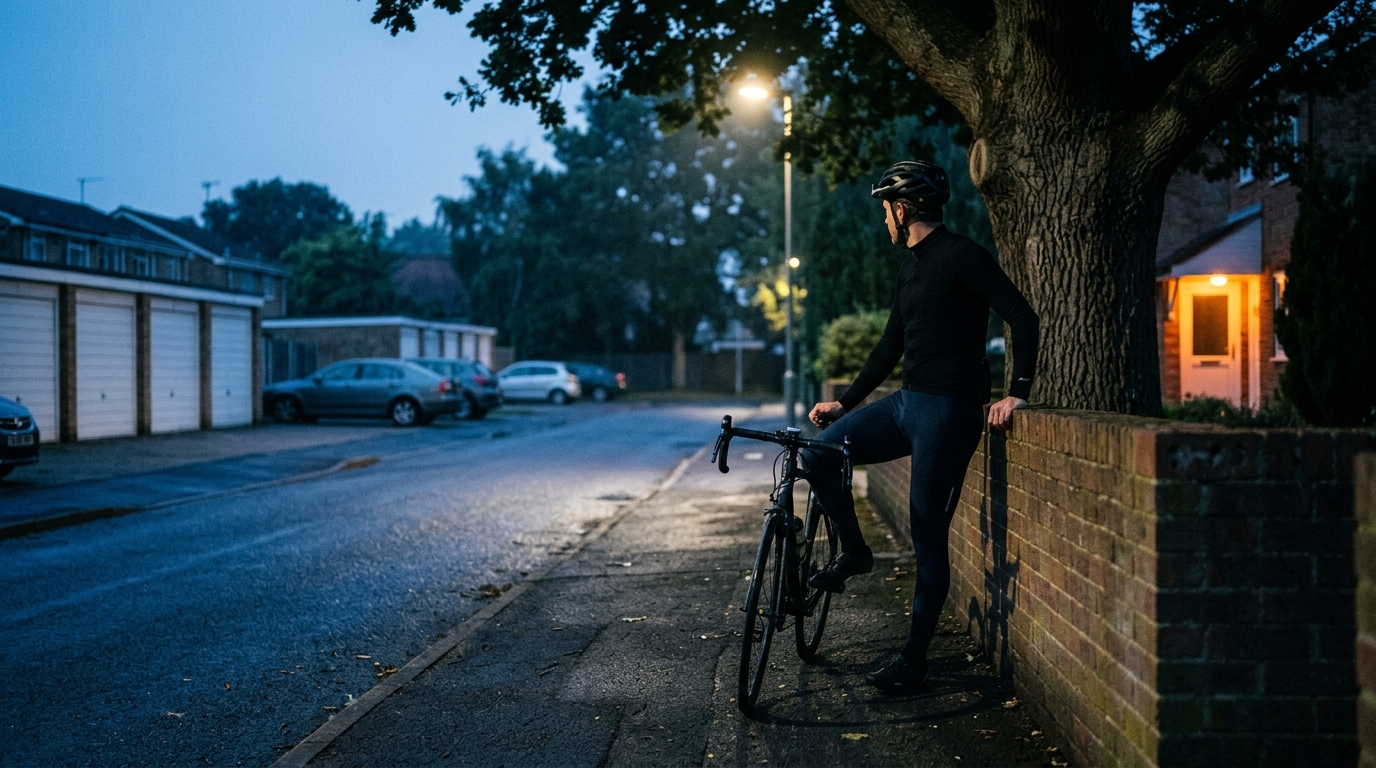
Imagen generada por nuestro modelo.
cyclocross
Cyclocross Training With Power: Starts, Surges and Skills
Use power to train the actual demands of cyclocross: hard starts, repeated surges, corner exits, short recoveries and skills under fatigue.
Why Cyclocross Power Looks So Chaotic
Cyclocross training with power can feel less tidy than road or time trial work because the race does not reward tidy power. A useful cyclocross file is usually ugly: big spikes out of corners, sections of near-zero power while coasting, running, braking or remounting, then another violent acceleration before the system has settled.
That chaos is not a data problem. It is the event.
The key mistake is treating a cyclocross race file like a steady-state effort and judging it by average power alone. Average power gets pulled down by technical sections, braking zones and dismounts, but the physiological cost is driven by what happens between those zeros: repeated accelerations, high-torque efforts from low speed, and the ability to keep producing meaningful power while breathing hard and making technical decisions.
This is why cyclocross power workouts need to train repeatability more than purity. The goal is not to hold the cleanest line on the graph. The goal is to make hard efforts, recover incompletely, handle the bike well, and do it again without your power collapsing or your skills turning sloppy.
The Key Demands: Starts, Surges, Corners and Recoveries
Cyclocross is usually decided less by one long effort than by the accumulation of small separations. A rider exits a corner a bike length ahead. Someone remounts cleaner. Another rider hesitates before a short rise. Those gaps are small at first, but each one forces the rider behind to spend more energy closing it.
Power helps because it shows where those matches are being burned.
Starts
The start is not just a sprint. It is a positioning effort that determines how much traffic, braking and corner congestion you deal with in the opening phase. A strong start buys space. An uncontrolled start can put you into debt before the race has stabilized, which means you spend the next technical section trying to recover instead of choosing lines, defending position or moving forward.
Training starts should therefore include both the launch and the transition into sustainable race pressure. If you only practice the first kick, you train the least complete part of the sequence.
Surges
Cyclocross surges are rarely clean. They often come from low speed, after braking, on uneven ground, or while traction is limited. That changes the power demand. You need the ability to produce force quickly without spinning out, slipping, or over-gearing yourself into a stall.
This is where power and technique overlap. A high number on the head unit means little if it comes with wasted movement, a bad line or a gear choice that forces you to accelerate twice.
Corners
Corners are power events even when you are not pedaling through them. A better corner reduces the size of the acceleration required on exit. A poor corner turns into a repeated sprint workout you did not choose.
That is the real value of cyclocross skills training with power: it shows whether better handling is saving energy. If you ride the same section smoother and need less power to reach the same exit speed, the improvement is not cosmetic. It changes the cost of the race.
Recoveries
Recovery in cyclocross is fragmented. It may come during a downhill, a technical turn, a run-up, or a section where pedaling is limited. These are not comfortable recoveries. They are opportunities to lower the pressure just enough to repeat the next surge.
Your training should reflect that. Long, complete recoveries can be useful for developing maximum output, but cyclocross also requires the ability to go hard again while still carrying fatigue.
How to Set Training Targets When Average Power Lies
Average power is a weak guide for cyclocross race pacing because it does not tell you how the effort was distributed. A race can have a modest average but still feel brutal if the file is full of repeated spikes and short recoveries.
Use power differently.
Anchor the work to FTP, but do not worship it
Your FTP is still useful because it gives context. If your threshold estimate is wrong, your training zones and workout interpretation become distorted. If you need a starting point, use the FTP estimator and then validate it against real rides.
But cyclocross is not a steady FTP test. The relevant question is not only whether you can ride at threshold. It is whether you can repeatedly go above it, recover below it, handle the bike, and avoid fading late.
Track repeatability
For cyclocross, the most useful power question is often: how well did the later efforts compare with the earlier ones?
If the first surge is strong but every later surge fades, the limiter may be repeatability, pacing, fueling, or too much intensity too early. If power is stable but speed drops, the limiter may be technical execution. If power and handling both collapse together, the session is probably exposing a fatigue-resistance gap.
Separate race pacing from workout pacing
Cyclocross race pacing is not about riding evenly. It is about spending energy where it changes the race.
That means a hard start can be justified if it buys position before bottlenecks. A surge out of a corner can be worth it if it prevents a gap from opening. But chasing every wheel, sprinting every straight and over-pedaling into every technical section is usually poor pacing disguised as aggression.
Power gives you accountability. If the file shows repeated maximal accelerations early and a clear fade later, the conclusion is simple: the early effort was too expensive for the position or speed it produced.
Workouts for Repeated Accelerations and Short Recoveries
Good cyclocross power workouts should look like the race demands without becoming random suffering. The structure matters because you are trying to train a specific response, not just create fatigue.
Use these as templates. Adjust the number of repetitions and the total workload to your level, course access and race schedule. The targets are intentionally broad: sharp accelerations, incomplete recoveries, controlled technical execution and a comparison between early and late efforts.
Workout 1: Corner-exit repeats
Use a short loop with a braking point, a turn and an exit straight.
Structure:
- Warm up, then ride a few low-pressure passes through the corner.
- Do 2 to 4 sets of 6 to 8 corner exits.
- For each repetition, enter under control, brake at a consistent marker, turn, then accelerate hard out of the exit for roughly 10 to 20 seconds.
- Recover easily while circling back to the start.
- Take a longer easy spin between sets so the next set stays technically clean.
What to look for in the file:
- Are exit accelerations similar from the first set to the final set?
- Does speed improve at the same or lower power as your line gets cleaner?
- Do late repetitions show a delayed power rise because you are over-braking or choosing the wrong gear?
- Does the best power number actually produce the fastest exit, or did it come from fighting the bike?
The target is not the highest single peak. The target is consistent exit power with clean handling. If power rises but the line gets worse, the race outcome is not improving. If the line improves and you need less power to reach the same exit speed, you have reduced the cost of the course.
Workout 2: Surge-and-settle efforts
This session trains the transition that many riders miss. In races, the problem is rarely launching once. The problem is launching, then continuing to ride hard while the course is still demanding.
Structure:
- Find grass, dirt, a cyclocross loop or a quiet mixed-surface section.
- Do 6 to 10 repetitions.
- Start each repetition with a hard acceleration for roughly 10 to 30 seconds.
- Settle immediately into strong race pressure for 1 to 3 minutes rather than fully backing off.
- Recover easily for 1 to 3 minutes, but keep the recovery incomplete enough that the next effort still carries some load.
What to look for in the file:
- Does the settle phase stay controlled, or does it collapse after the first acceleration?
- Are the final repetitions close enough to the first ones to suggest repeatability?
- Does cadence or torque become erratic late, suggesting gear choice is breaking down under fatigue?
- Are you producing the same power but losing speed on technical sections?
This workout should feel like controlled instability. You are not trying to ride a clean interval graph. You are training the ability to absorb a surge and keep racing.
Workout 3: Broken threshold on a technical loop
This is one of the best bridges between fitness and racing because it teaches you to keep pressure on the pedals without losing the course.
Structure:
- Use a cyclocross-style loop with turns, braking points, short straights and at least one feature that interrupts pedaling.
- Ride 3 to 5 blocks of 4 to 8 minutes.
- Keep the baseline effort hard but controlled.
- Let the course create the spikes: push out of corners, stay smooth through technical sections and avoid turning every straight into a panic sprint.
- Recover easily between blocks until you can start the next one with good handling.
What to look for in the file:
- Compare the first block with the final block. Is the power profile similar, or does the back half turn into low-power survival?
- Do repeated surges become smaller even though perceived effort rises?
- Are there sections where speed drops despite similar power?
- Does technical error increase when the baseline effort is high?
The point is not to dominate the first block. If the early work forces a clear late fade, the file is telling you that the opening intensity exceeded the useful cost of the session.
Workout 4: Start sequence repeats
A cyclocross start has two jobs: create position and avoid unnecessary debt. This workout trains the launch, the acceleration and the ability to keep riding after both.
Structure:
- Set a start line, a first corner or marker, and a short loop afterward.
- Do 4 to 8 start sequences.
- Each sequence begins with a start effort from a controlled position.
- Accelerate hard through the first section, then continue at race pressure for 1 to 3 minutes.
- Include a corner, gear change, remount, or technical feature during the settle phase if possible.
- Recover long enough to repeat the sequence with a clean clip-in and controlled line.
What to look for in the file:
- Did the biggest launch compromise the following minute?
- Was the first corner entered in control, or did the power spike create a braking problem?
- Can you repeat the start without a sharp drop in the settle phase?
- Does a slightly lower peak produce a better full sequence?
The best start is not always the biggest peak. It is the start that gets you into position without forcing you to spend the next section recovering instead of racing.
Workout 5: Low-speed torque accelerations
Cyclocross often asks you to accelerate from awkward speeds. This session builds race-specific force production without turning it into a gym substitute on the bike.
Structure:
- Use firm grass, dirt or a safe low-speed section where traction can be managed.
- Roll slowly into each effort.
- Accelerate forcefully for roughly 8 to 15 seconds.
- Alternate seated and standing starts if both are relevant to your racing.
- Recover easily between repetitions so the next one is forceful and technically sound.
- Stop the set when traction, posture or gear timing gets sloppy.
What to look for in the file:
- Does power rise quickly, or is there a long lag before the effort bites?
- Are later accelerations similar to early ones?
- Are you losing power because the gear is too large, or losing traction because the gear is too small?
- Does standing create more power but less speed because the rear wheel slips?
The goal is to apply power without wheel slip, upper-body tension or a delayed gear change.
Training Starts Without Burning Matches Too Early
A better start workout has three phases.
First, practice the launch. Focus on gear choice, clipping in, body position and the first few pedal strokes. If you are looking down, fighting the gear or swerving under power, fix that before adding more intensity.
Second, practice the acceleration into race speed. This is where power should rise quickly but not become uncontrolled. A start that produces a huge peak but forces you to brake awkwardly, miss a line or lose the wheel afterward is not a useful race asset.
Third, practice settling. After the launch, continue riding at race pressure through a technical section or short loop. This is where the workout becomes cyclocross-specific. You are teaching the body to absorb the start and the brain to make good decisions while under load.
Judge the start by the whole sequence, not the first few seconds. Did you clip in cleanly? Did you hold your line? Did you enter the first corner in control? Could you keep pressure on after the initial acceleration? If not, the power number is telling only part of the story.
Combining Skills Practice With Fatigue
Cyclocross skills training is most valuable when it respects progression. Fresh skills work builds technique. Fatigued skills work tests whether that technique survives the race.
You need both.
Start fresh, then add pressure
Begin technical sessions with clean repetitions: mounts, dismounts, cornering, off-camber riding, braking and line choice. Keep the intensity low enough that you can feel what is happening.
Once the movement is reliable, add power before the feature, after the feature, or both. For example, accelerate into a corner, brake, turn, then accelerate out. Or ride hard before a dismount, carry the bike smoothly, remount, and return to pressure.
The purpose is not to make skills messy. The purpose is to reveal which skills fail first when fatigue arrives.
Use power as a skill-quality check
Power can expose wasted technique. If you need a huge acceleration after every corner, the issue may not be fitness. It may be entry speed, braking timing or line choice. If your power is high but speed is low, you may be fighting the bike rather than driving it.
This is why pairing power with feel and course feedback is so useful. The best cyclocross riders do not simply produce more power. They reduce the number of times they need to produce unnecessary power.
Stop before bad habits take over
There is a point where fatigued skills practice becomes rehearsal of poor technique. If remounts get careless, cornering becomes defensive or braking gets panicked, the session has shifted from productive stress to noise.
End the technical portion while you can still execute. Fitness can be trained in a less technical setting afterward if needed. Poor movement under fatigue is not a badge of toughness. It is a race-day liability.
A Simple Weekly Structure
A cyclocross training plan has to balance intensity, technical practice and recovery. The event tempts riders into doing everything hard: hard group rides, hard skills sessions, hard races, hard starts. That works briefly, then the quality drops.
The better approach is to give each session a job. One day should create the main race-specific intensity. One day should improve skills without turning into another race. Endurance supports recovery between surges. Easy days protect the quality of the hard days.
Non-race week example
- Monday: Recovery ride or full rest. Keep it easy enough that Tuesday can be high quality.
- Tuesday: Race-specific intensity. Use surge-and-settle efforts, broken threshold on a loop, or start sequence repeats.
- Wednesday: Endurance ride. Keep pressure steady and avoid drifting into another interval day.
- Thursday: Skills day. Start fresh with cornering, dismounts, remounts and braking. Add short accelerations only after the movement is clean.
- Friday: Recovery ride or rest. If fatigue is high, choose rest.
- Saturday: Longer endurance or mixed-surface ride. Keep it aerobic enough that it supports the week rather than replacing the Tuesday session.
- Sunday: Optional cyclocross simulation, group skills session or endurance ride. If Tuesday and Thursday were demanding, keep this controlled.
This structure gives intensity, skill and endurance separate roles. The main risk in a non-race week is adding too much unplanned intensity because cyclocross practice feels productive even when quality is falling.
Race week example
- Monday: Recovery ride or full rest after the previous race or hard weekend.
- Tuesday: Skills-focused ride. Keep the intensity mostly low and clean up the technical pieces that cost time.
- Wednesday: Short race-specific intensity. Use a reduced version of start sequences or corner-exit repeats. The goal is sharpness, not fatigue.
- Thursday: Easy endurance or recovery ride. Keep the legs moving without adding load.
- Friday: Openers. Include a few short accelerations and one or two settle efforts, then stop while the response is still sharp.
- Saturday: Race, pre-ride or very short activation depending on the schedule.
- Sunday: Race or endurance ride if there is no race.
In race weeks, the race itself supplies a large dose of intensity. Training should sharpen the accelerations and maintain skill without dulling the response that decides positioning, exits and late-race surges.
Post-Ride Power File Checklist
The file review should be short enough that you actually do it. The goal is not to explain every second. It is to identify repeatable patterns that can shape the next session.
After a cyclocross workout or race, check:
- First-third versus final-third surge power: are the late accelerations close to the early ones, or is repeatability the limiter?
- Speed at similar power: where does speed drop even though power is similar? Those sections often point to line choice, braking timing, traction or fatigue-related handling errors.
- Repeated high-exit corners: which corners require a hard acceleration every lap? Decide whether the solution is more power, a better entry, a different gear or less braking.
- Starts and opening efforts: did the opening effort compromise the next section? Look at the power after the launch, not only the launch itself.
- Power spikes without speed gain: did you produce a big number but fail to move faster? That usually means the power was poorly applied.
- Technical fade: do mistakes appear at the same point in each block or lap? That can show where fatigue starts changing decisions.
This turns the file into a feedback loop. The next workout should target the costliest pattern, not the most dramatic power spike.
The Bottom Line
Cyclocross training with power works best when the data is used to understand the race, not flatten it into a steady-state model. Average power will rarely tell the full story. The important signals are repeatability, the cost of accelerations, how well you settle after starts, and whether your skills hold up when the effort gets hard.
Train the start, but train what comes after it. Train the surge, but connect it to the corner or obstacle that caused it. Train skills fresh, then test them under fatigue. Build a cyclocross training plan that makes the hard parts repeatable and the technical parts cheaper.
That is the real advantage of power in cyclocross. It does not make the race less chaotic. It shows you which parts of the chaos you can control.