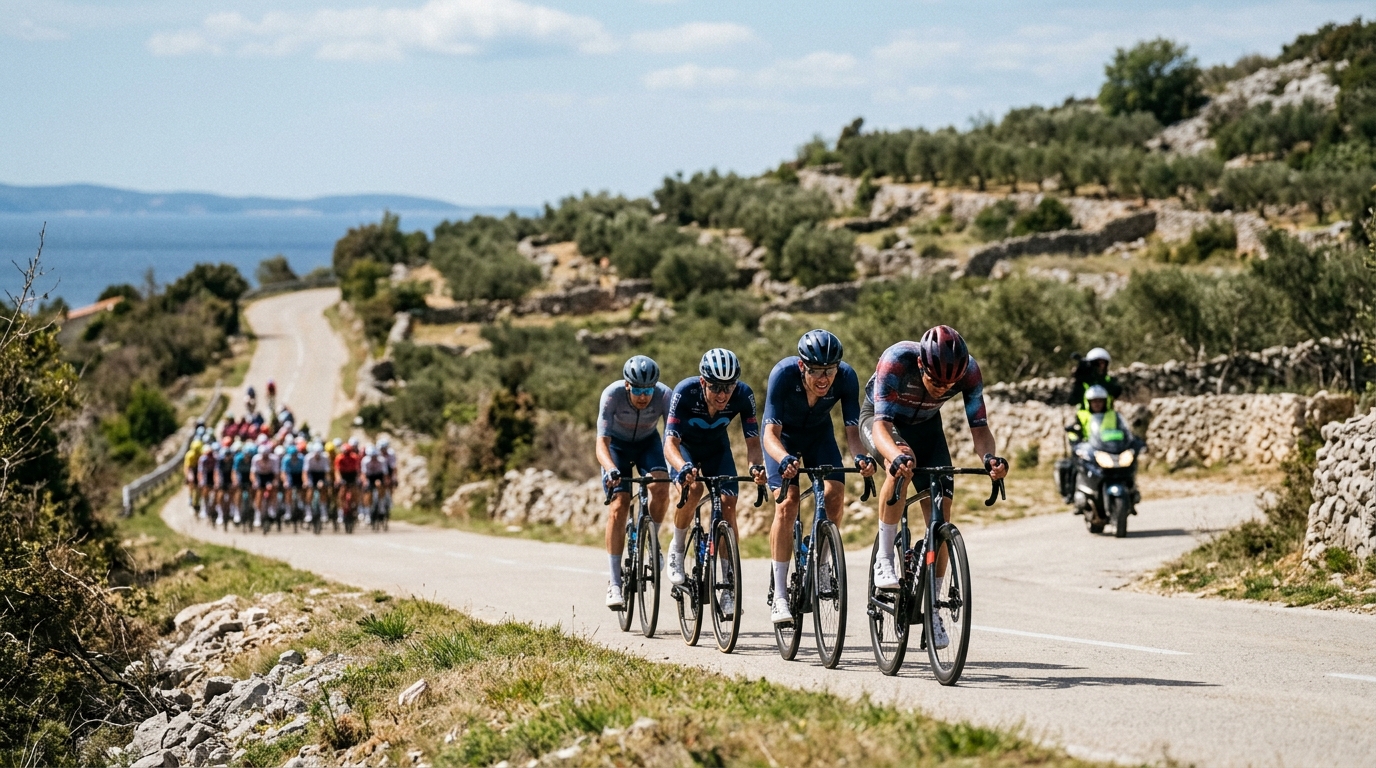
Imagem gerada pelo nosso modelo.
Preview da prova
CRO Race 2026 preview: summit finish gives six-day route its GC hinge
CRO Race 2026 runs from 22 to 27 September over six stages, with Stage 4 to Rijeka standing out as the only mountain stage and summit finish.
The shape of the race
CRO Race 2026 runs from 22 September to 27 September as a six-stage men’s 2.Pro road stage race, covering 940 kilometres in Croatia. On paper, it is not a race built around repeated high-mountain days. It is more about control, positioning, and making the one clear climbing opportunity count.
The route opens with a 167km hilly stage from Split to Seget, then gives the sprinters their first obvious chance on the 114.5km flat stage from Biograd na Moru to Novalja. From there, the race starts to tighten. Stage 3 from Krk to Labin is another hilly day at 174.5km, long enough to soften the race before the main GC test arrives the next day.
The GC hinge: Stage 4 to Rijeka
Stage 4, from Pula to Rijeka, is the obvious queen-stage candidate from the supplied route data. It is the only mountain stage, it is 160km long, and it is the only summit finish of the race. That combination matters because it concentrates the climbing leverage into one day. Teams with GC ambitions cannot assume there will be another equivalent chance later in the week.
The lack of repeated summit finishes changes the tactical balance. A climber who waits too long risks running out of road in the overall race, while a punchier all-rounder can survive one difficult mountain day and then defend through the hillier terrain that follows. The summit finish also reduces the value of pure team control in the final kilometres, because the race should naturally separate once the road tilts up toward the line.
The route data does not list named climbs, so the decisive climbing reference is the Rijeka summit finish itself rather than a specific ascent. That limits how precise any pre-race analysis can be, but it does not change the basic structure: Stage 4 is where the general classification should be most exposed.
Why the hilly days still matter
Stage 1, Stage 3, and Stage 5 are all classified as hilly, and that gives the race more texture than a simple sprint-versus-summit-finish layout. The opening day from Split to Seget can immediately create selection pressure, especially if teams decide the race is too short to give away early time. Stage 3 to Labin, the longest day at 174.5km, comes directly before the mountain stage, which makes it important even if it does not decide the GC outright.
Stage 5 from Karlovac to Sveta Nedelja is also significant because it follows the summit finish. If the GC is close after Rijeka, this is the stage where teams can still use terrain rather than waiting for the final flat day. In a six-stage race, the day after the key mountain stage often rewards riders who recover quickly and punishes those who spent too much to limit losses.
The final day favors control
The race ends with a 159.5km flat stage from Samobor to Zagreb. Based on the profile alone, that makes it more likely to be a day for defending positions than reshaping the overall standings. Any rider who wants to win the race will almost certainly need to have done the serious GC work before the final stage.
There is no recent-edition history included in the supplied data, so there is not enough evidence here to claim a pattern from previous races. The 2026 route can still be read clearly on its own terms: three hilly days, two flat stages, and one mountain summit finish that should define the race.