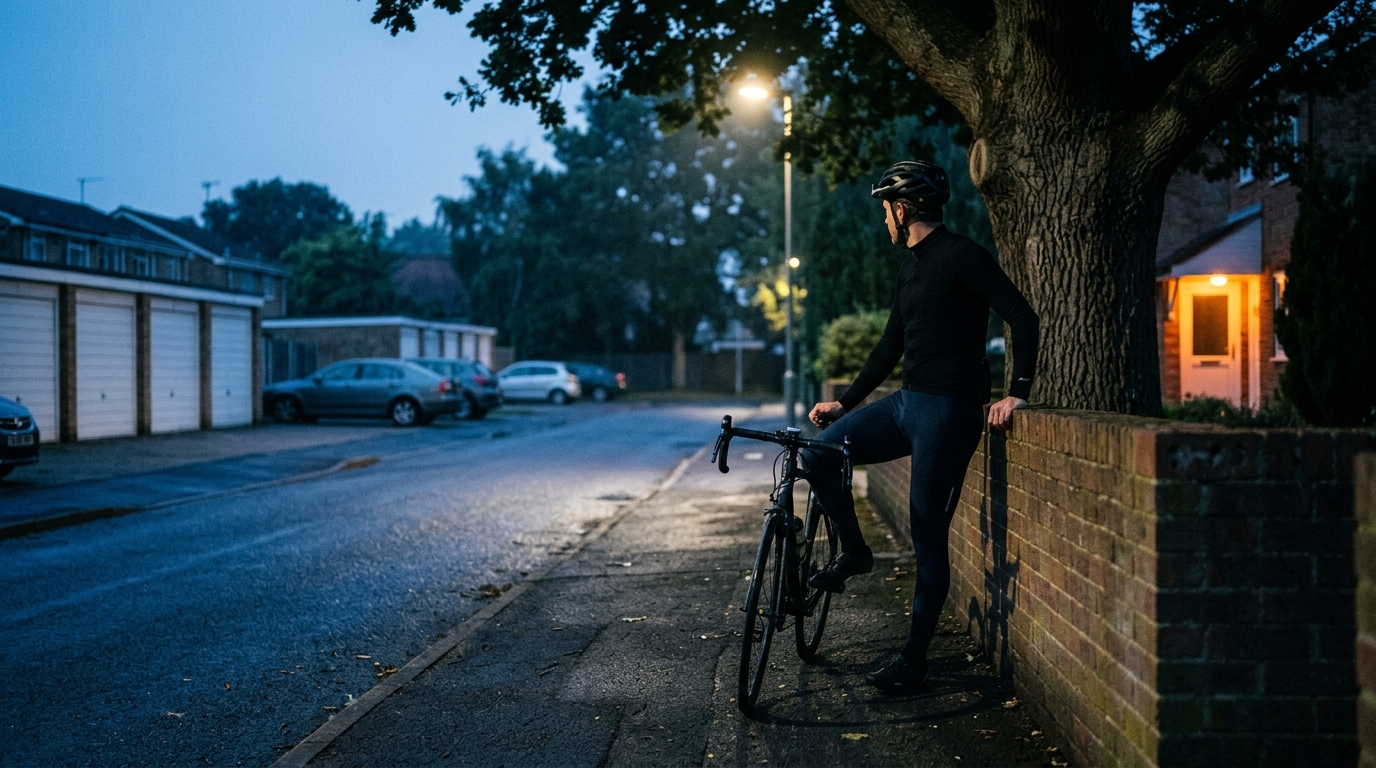
Imagem gerada pelo nosso modelo.
cycling training
Cycling Over-Unders for Threshold and Surge Control
Cycling over unders build threshold control, surge tolerance, and better pacing when hard rides stop being steady.
What cycling over unders train and when they help
Cycling over unders are threshold-focused intervals that alternate between riding slightly above and slightly below a sustainable hard effort. The point is not simply to make the session feel difficult. The value is in forcing the body to process repeated surges while still working close to the intensity where race-winning and race-surviving decisions are often made.
A steady threshold interval teaches control. An over-under interval teaches control under disruption.
That distinction matters. In a race, group ride, or hard fondo, the effort rarely sits at a clean, steady number. A climb steepens, a rider accelerates out of a corner, the bunch strings out, or a move goes just as the road tilts up. If every threshold session is perfectly even, the athlete may have the aerobic power to ride hard but still struggle when the effort becomes stochastic.
This is where cycling over unders fit. They train the ability to surge above the line, recover while still riding hard, and avoid the common mistake of turning every acceleration into a full commitment. In practical terms, they improve three things that matter in real riding:
- Tolerance for repeated changes in pace near threshold
- The ability to settle after a surge without fully backing off
- Decision-making discipline when the legs are under pressure
They are especially useful before races or events where the decisive terrain is rolling, punchy, technical, or tactically aggressive. They are also useful for athletes who can produce a strong steady effort but crack when the pace keeps changing.
How to set power targets from FTP or critical power
The cleanest way to anchor cycling over unders is to use a known threshold reference such as FTP or critical power. The under portion should feel controlled but not easy. The over portion should feel like a meaningful push, not a sprint.
That is the central mistake many riders make: they set the over segment too high. Once the over becomes a maximal effort, the session changes from threshold development to repeated anaerobic rescue work. That may have a place, but it is not the same workout.
A good over-under target should pass this test:
- The first surge feels manageable
- The middle of the set requires focus
- The final over segment is hard but still technically clean
- The under segments are recoveries in relative terms only
- Power, cadence, and breathing do not collapse at the end
As a starting point, the under target usually sits just below threshold and the over target sits just above it. Many riders can begin with under segments around high tempo to threshold feel and over segments around low VO2 or hard threshold feel, then adjust based on execution. The exact number matters less than whether the session produces the intended behavior: repeated pressure without repeated failure.
If your FTP estimate is stale, update it before building a block around threshold work. A poor estimate turns a precise-looking workout into guesswork. Use recent training data, a controlled test, or a tool like the FTP estimator to keep the target grounded in current form.
Perceived exertion is still useful. The under section should feel like a hard pace you could hold with concentration. The over section should feel like you are pressing into discomfort, but not launching a finishing effort. If you need to stand, rock the bike, and fight the bars every time the over begins, the target is probably too ambitious.
Beginner, intermediate and advanced over-under workouts
The right version depends less on identity and more on how well the athlete can regulate effort. A rider with strong power but poor pacing should start conservatively. Over-unders punish ego quickly because a small overshoot early compounds across the whole set.
Use the examples below as starting points, not universal rules. If the session falls apart, reduce the over target first, then shorten the block. If it feels too easy but controlled, extend the work before making the surges more aggressive.
| Level | Starting structure | Segment pattern | Recovery between blocks | Suggested intensity |
|---|---|---|---|---|
| Beginner | Two to three blocks of six to eight minutes | Two minutes under, one minute over | Easy spinning until breathing normalizes | Under just below threshold, over slightly above threshold |
| Intermediate | Two to three blocks of ten to twelve minutes | Two minutes under, two minutes over, or three minutes under, one minute over | Short aerobic recovery, not a full reset | Under close to threshold, over clearly above threshold but controlled |
| Advanced | Three to four blocks of twelve to sixteen minutes | One to two minutes under, one to two minutes over, or sharper surges inside a longer block | Limited recovery that preserves quality | Under very close to threshold, over hard but repeatable |
Beginner version
Start with short over-under blocks where the under portion is longer than the over portion. The goal is rhythm, not survival. The rider should learn how the transition feels: lifting the effort smoothly, holding form, then reducing power without drifting into actual recovery.
A practical beginner session could look like this:
- Warm up progressively until threshold power feels available
- Ride two to three blocks of six to eight minutes
- Alternate two minutes under with one minute over
- Recover easily between blocks until breathing and cadence are back under control
- Keep the under portion around a controlled hard tempo to low-threshold feel
- Keep the over portion only slightly above threshold, not near a maximal surge
Use this when:
- You are new to cycling over unders
- You have mostly done steady threshold work
- You tend to attack surges too hard
- You are returning after a break from structured intensity
Execution cues:
- Keep cadence stable between under and over segments
- Raise power gradually rather than stamping on the pedals
- Treat the under as work, not coasting
- End the set while you still have control
A successful beginner session should feel productive, not dramatic. If you finish wondering whether you could have done a little more, that is usually better than finishing with ruined mechanics and a distorted power file.
Intermediate version
The next step is to make the under portions closer to true threshold and the over portions more assertive. The total block becomes more continuous, and the recovery between blocks becomes less of a full reset.
A practical intermediate session could look like this:
- Ride two to three blocks of ten to twelve minutes
- Alternate two minutes under with two minutes over, or three minutes under with one minute over
- Recover easily between blocks, but keep the recovery short enough that the next block still carries some load
- Set the under effort close to threshold, where concentration is required
- Set the over effort clearly above threshold, but low enough that the final surge still looks controlled
Use this when:
- You can complete steady threshold intervals without fading
- You can transition between efforts without spiking power wildly
- You are preparing for rolling terrain or aggressive group riding
- You want threshold work that transfers better to real race pacing
Execution cues:
- Avoid chasing every short-term power fluctuation
- Watch the average trend across each segment
- Keep breathing under control before the next surge
- Stay seated unless the terrain naturally requires otherwise
This version should expose whether your threshold is durable or fragile. If the under sections gradually become soft-pedaled recoveries, the workout is too hard. If the overs barely change breathing or leg load, the targets are too conservative.
Advanced version
Advanced over-unders become more race-specific. The over segments may be sharper, the under sections may stay very close to threshold, or the blocks may be placed after prior fatigue. The goal is not merely to complete harder intervals. The goal is to simulate the moment where a race demands control after you are already carrying load.
A practical advanced session could look like this:
- Ride three to four blocks of twelve to sixteen minutes
- Alternate one to two minutes under with one to two minutes over
- Keep recovery between blocks limited, but long enough to preserve clean execution
- Hold the under portion very close to threshold rather than letting it become recovery
- Make the over portion hard and race-relevant, but still repeatable across the final block
Use this when:
- You have a strong threshold base
- You can complete intermediate over-unders cleanly
- You are preparing for repeated surges on climbs, in breakaways, or during selective group rides
- You understand the difference between hard training and proving fitness
Execution cues:
- Keep the first block almost restrained
- Let fatigue build through the structure rather than forcing it early
- Maintain posture and cadence when the over begins
- Stop the workout if the effort becomes random attacking instead of controlled alternation
Advanced surge work should still be repeatable. A heroic file that leaves you flat for days is usually less valuable than a hard, clean session that fits into the week.
Where to place over-unders in the training week
Over-unders are quality work. They belong on a day when you are fresh enough to make good decisions, not on a day when you are trying to rescue a tired week.
A useful decision rule is this: place over-unders as the main hard session of the day, and only use them when the next key session still has a realistic chance of being high quality. If the workout makes the rest of the week worse, it was not well placed, even if the file looked impressive.
Practical placement guidelines:
- Put over-unders after an easy day or a low-stress endurance day when the goal is quality execution
- Keep endurance rides truly aerobic before and after if the week is already intensity-heavy
- Avoid stacking them directly beside VO2 max work unless the plan is deliberately focused on a short race-specific overload
- If you race on the weekend, use over-unders earlier in the week only when they sharpen the race demand rather than adding fatigue
- If you have a hard group ride, treat that ride as intensity before deciding whether over-unders still belong in the same week
- Do not place over-unders on recovery days. If the day is meant to absorb training, keep it easy
In a balanced week, over-unders often work best as the threshold-specific session, while endurance rides provide volume and VO2 max work, sprint work, or racing provide the higher-intensity stimulus. The mistake is treating all of those as separate add-ons. The body counts stress, not workout names.
When not to use over-unders
Over-unders are useful because they sit close to the limit. That is also why they are easy to misuse.
Skip or downgrade them when:
- Sleep has been poor and the warm-up already feels forced
- Your threshold trend is declining across recent rides
- Fatigue is unresolved from racing, travel, work stress, or prior training
- Your FTP or critical power estimate is stale enough that the targets are mostly guesswork
- You are in a base phase where the priority is aerobic volume, durability, and consistency
- The week already includes racing, VO2 max work, hard group rides, or multiple high-intensity sessions
- You need a recovery day more than another proof-of-fitness workout
This is not a conservative argument against hard training. It is a placement argument. Over-unders work when you can execute the transitions with control. If fatigue turns every over into a panic effort and every under into survival, the session is no longer training the skill it is supposed to train.
How to progress over-unders without overreaching
Progression should be boring in the best way. Change one variable at a time, then watch how the body responds.
Good progression options include:
- Make the under portion a little firmer
- Make the over portion a little more demanding
- Extend the continuous block
- Add another block
- Reduce the recovery between blocks
- Place the session later in a training week after moderate fatigue
Do not progress all of these at once. That is how a threshold workout becomes an unplanned test.
The key signal is repeatability. If you can complete the session with stable power, steady cadence, and normal recovery afterward, progression is reasonable. If you need unusual motivation, caffeine, perfect conditions, or an extended taper to complete it, the workout may be out of place in regular training.
Over-unders are stressful because they sit in a grey area between aerobic control and repeated surging. They should not appear automatically every week. They work best as a focused quality session inside a broader plan that also includes endurance riding, easier days, and more specific high-intensity work when needed.
Indoor vs outdoor execution: ERG, terrain and cadence
Indoor execution is useful because it removes terrain and traffic from the equation. ERG mode can help athletes learn the feel of the transitions, especially when they are new to the format. The downside is that ERG can hide poor pacing habits. The trainer changes resistance for you, so you may complete the workout without learning how to modulate effort yourself.
If using ERG, pay attention to how you produce the power. Do not let cadence collapse as resistance rises. Do not fight the trainer with abrupt surges. Smoothness matters because the goal is race transfer, not just compliance with a screen.
Resistance mode or slope mode often creates a more realistic session. It forces you to manage power like you would outdoors. You learn how much pressure to add, how quickly to back off, and how to keep the under segment honest.
Outdoor execution is more specific but less tidy. Choose terrain that supports the workout. A steady road with slight changes in gradient is often better than a route filled with junctions, descents, and forced coasting. If the terrain interrupts every under segment, the session loses its purpose.
Cadence should generally stay close to your natural hard-effort rhythm unless you are deliberately targeting a race-specific demand. Grinding the over segments at a very low cadence may make the session feel harder, but harder is not always better. The question is whether it improves the ability you are trying to build.
How to analyze an over-under workout file
Do not judge the file only by whether the interval boxes turned green. A clean over-under session has a pattern.
Look for these signals:
- The over segments rise smoothly rather than spiking wildly
- The under segments remain purposeful and do not become soft recovery
- Cadence stays stable across transitions
- Heart rate and breathing rise progressively but do not panic early
- Power does not fade across the final block unless fatigue was the intended stimulus
- The last segment still looks like cycling, not survival
The most useful question is simple: did the workout train surge control near threshold, or did it become repeated overreaching followed by rescue? Those can look similar in normalized power, but they are not the same training stimulus.
If the file shows huge spikes at the start of every over, followed by fading and under-target valleys, the rider is likely attacking the workout instead of controlling it. In a race, that habit burns matches at exactly the moment composure matters most.
If the file shows nearly no separation between over and under, the session may have become a steady threshold interval. That is not a failure, but it is not the same stimulus. Adjust the targets, terrain, or execution next time.
Common mistakes: too hard, too often, too random
The most common mistake is making the over portion too hard. This usually happens because riders equate difficulty with quality. But the purpose of cycling over unders is not to detonate repeatedly. It is to stay near the limit, cross it briefly, and return to hard control without needing full recovery.
The next mistake is using them too often. Over-unders feel specific and productive, which makes them tempting. But they are demanding enough to interfere with other key work if placed carelessly. If endurance rides become flat, sprint work loses sharpness, or threshold power starts trending down, the issue may not be fitness. It may be too much pressure packed into the week.
The final mistake is randomness. Outdoor over-unders can easily turn into chasing terrain, attacking every rise, and calling it structure afterward. Race-like does not mean chaotic. A good session has intention. The surges are planned, the under portions are protected, and the athlete knows what success looks like before starting.
Used well, cycling over unders are one of the best bridges between lab-clean threshold work and the messy demands of real riding. They build the power to stay close to the limit, the control to handle accelerations, and the discipline to avoid turning every surge into a gamble. That combination is what makes them valuable. Not because they are harder than steady intervals, but because they teach you how to ride hard when the effort refuses to stay steady.