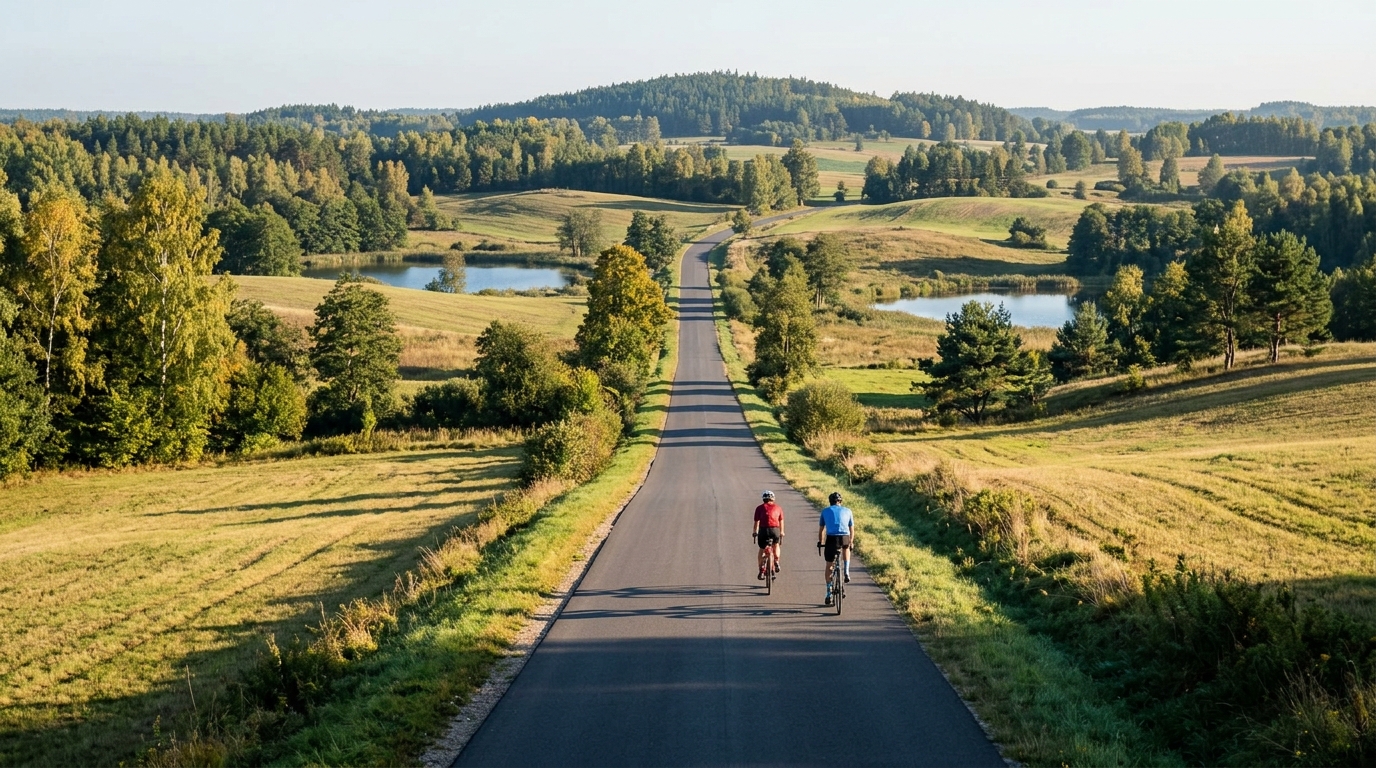
Suwałki Region Cycle Ring
A 322 km asphalt loop in Poland with 900 m of elevation gain, built more around endurance pacing than sustained climbing.
- Afstand
- 322km
- Hoogtemeters
- 900m
- Ondergrond
- —
- Vorm
- Rondje
De route
Hoogteprofiel
Suwałki Region Cycle Ring cycling route
The Suwałki Region Cycle Ring is a 322 km asphalt loop in Poland with 900 m of elevation gain. On paper, that tells you almost everything important about the ride’s character: this is a long-distance endurance route first, not a climbing route.
The low climbing load relative to the total distance means the challenge is likely to come less from any single decisive ascent and more from how steadily you manage the hours. A route can be physically demanding without being mountainous, and this one fits that profile. Over 322 km, pacing errors accumulate. Riding too hard early, skipping food, or letting effort drift above sustainable endurance intensity will matter more than punchy climbing ability.
Terrain and ride feel
The surface is listed as asphalt, which makes the route well suited to a road bike, endurance road bike, or fast all-road setup. With no notable climbs listed, the profile should be approached as rolling or gently varied rather than summit-focused. That does not mean easy. It means the route rewards consistency.
The loop format is also important. A loop changes the psychology and logistics of a long ride because there is no point-to-point transfer to solve at the end. You return to where you started, which simplifies planning, but it also means committing to the full circuit unless you build in shorter bail-out options yourself.
How to pace it
Treat the Suwałki Region Cycle Ring as an aerobic management problem. The right effort is the one you can keep repeating deep into the ride. If you use power, this is a day to stay disciplined below threshold and avoid turning small rises into repeated efforts. If you ride by feel, the useful cue is conversational pressure rather than muscular force.
For riders building toward the full loop, the key preparation is not pure climbing strength. It is fatigue resistance: the ability to keep producing steady power after the easy freshness is gone. If you track training zones, keep the day anchored around endurance intensity relative to /glossary/ftp.
Practical notes
- Distance: 322 km
- Elevation gain: 900 m
- Surface: asphalt
- Format: loop
- Country: Poland
Plan the ride around time on the bike, fueling regularity, and route commitment. The numbers point to a course where the strongest rider is not necessarily the one with the best climbing legs, but the one who can keep the effort boring, controlled, and repeatable from start to finish.
Vergelijkbare routes
3-Länder-Radweg
A 302.2 km asphalt route in Germany with 1512 m of climbing and point-to-point logistics shaped by the Reußenkreuz climb.
7 Peaks Alpine Challenge
A 110.9 km point-to-point assault through the Victorian Alps, stacking 3404 metres of climbing across relentless, wind-swept high-country ascents.
Aberdare Range
A 46 km asphalt point-to-point through Kenya's Central Highlands that trades big climbs for a relentless 1,700 m of rolling grind.
Abra Málaga
A 45-kilometer point-to-point ribbon of asphalt through Peru's Sacred Valley, climbing 1,699 relentless meters into the high Andes.
Afriski Mahlasela Pass
A 112.8 km asphalt ascent through the Maloti Mountains, climbing 3,384 m to the roof of southern Africa via the storied Mahlasela Pass.
Ahr Cycleway
An 82.9 km asphalt point-to-point route with 541 m of gain, the Ahr Cycleway is a steady endurance ride rather than a climb-focused day.