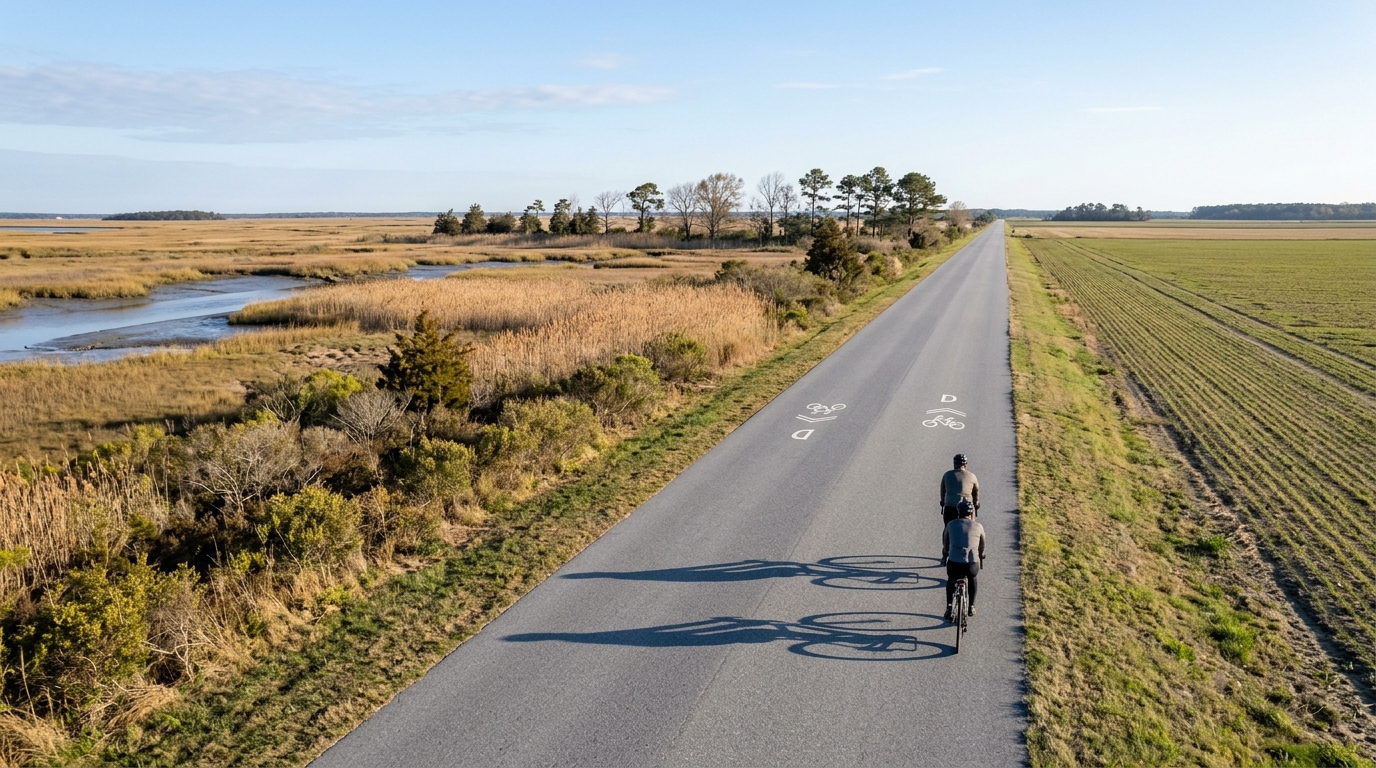
Delaware Bicycle Route 1
A practical look at the Delaware Bicycle Route 1 cycling route: 367.4 km of asphalt, point-to-point riding, and very modest elevation gain.
- Afstand
- 367.4km
- Hoogtemeters
- 351m
- Ondergrond
- —
- Vorm
- Punt-naar-punt
De route
Hoogteprofiel
Delaware Bicycle Route 1 cycling route overview
Delaware Bicycle Route 1 is a long point-to-point asphalt ride in the US, with 367.4 km of distance and 351 m of elevation gain. That combination defines the route more than any single climb or landmark: this is not a ride built around vertical difficulty, but around duration, consistency, and execution.
The key tactical point is simple. With so little total elevation gain relative to the distance, the route is unlikely to reward a punchy, climb-focused approach. The main limiter is time on the bike. Riders who pace well, stay fueled, and avoid unnecessary surges will usually be better served than riders trying to make the route hard early.
Terrain and ride character
The listed surface is asphalt, so the equipment choice can stay road-focused. There is no need to treat this like a mixed-surface or gravel objective based on the available route data. A normal endurance road setup is the logical starting point, with tire choice leaning toward comfort and reliability rather than off-road grip.
The absence of notable climbs matters. It does not mean the route is effortless, but it does mean the difficulty is more cumulative than explosive. Over 367.4 km, small pacing mistakes compound. A steady endurance effort will generally make more sense than riding by short-term speed, especially if conditions or stops interrupt rhythm.
How to pace it
Treat Delaware Bicycle Route 1 as a long aerobic route rather than a climbing challenge. If riding it in one push, the priority is keeping the first part controlled enough that the final hours do not become survival. If splitting it across stages, the low climbing load makes back-to-back consistency more realistic, but the total distance still demands respect.
Useful pacing cues:
- Keep effort smooth early, even if the route feels mechanically easy.
- Avoid repeated accelerations, because distance is the main source of fatigue.
- Fuel from the start, not once the ride begins to feel long.
- Build stops into the plan, since this is a point-to-point route rather than a loop.
Practical notes
Because the route is not a loop, logistics matter more than on a local circuit. Start and finish planning should be handled before the ride, including transport, bailout options, and how much kit to carry. The point-to-point format also means a change in conditions or pacing late in the ride can have bigger consequences, because simply turning back is not the same option it would be on an out-and-back.
The cleanest way to approach this route is to respect its scale without overcomplicating its terrain. Delaware Bicycle Route 1 is long, asphalt-based, and lightly climbing on paper. That points to a ride won by patience: steady power, disciplined fueling, and enough planning to make the distance the challenge rather than the logistics.
Vergelijkbare routes
3-Länder-Radweg
A 302.2 km asphalt route in Germany with 1512 m of climbing and point-to-point logistics shaped by the Reußenkreuz climb.
7 Peaks Alpine Challenge
A 110.9 km point-to-point assault through the Victorian Alps, stacking 3404 metres of climbing across relentless, wind-swept high-country ascents.
Aberdare Range
A 46 km asphalt point-to-point through Kenya's Central Highlands that trades big climbs for a relentless 1,700 m of rolling grind.
Abra Málaga
A 45-kilometer point-to-point ribbon of asphalt through Peru's Sacred Valley, climbing 1,699 relentless meters into the high Andes.
Afriski Mahlasela Pass
A 112.8 km asphalt ascent through the Maloti Mountains, climbing 3,384 m to the roof of southern Africa via the storied Mahlasela Pass.
Ahr Cycleway
An 82.9 km asphalt point-to-point route with 541 m of gain, the Ahr Cycleway is a steady endurance ride rather than a climb-focused day.