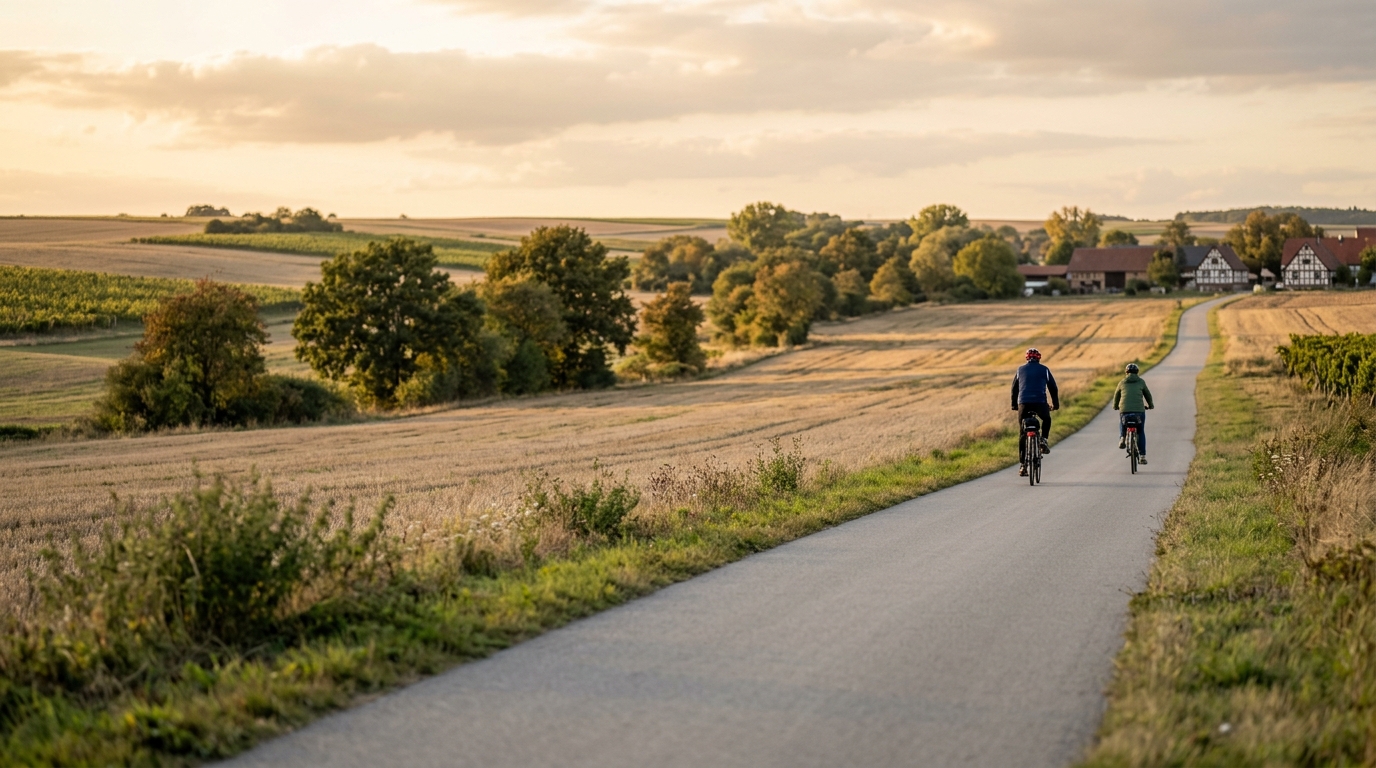
Appelbach-Radweg
A 42.5 km asphalt point-to-point route with 286 m of gain, the Appelbach-Radweg is steady, controlled, and better suited to rhythm than climbing drama.
- Afstand
- 42.5km
- Hoogtemeters
- 286m
- Ondergrond
- —
- Vorm
- Punt-naar-punt
De route
Hoogteprofiel
Appelbach-Radweg cycling route overview
The Appelbach-Radweg cycling route is a 42.5 km asphalt ride with 286 m of elevation gain. On paper, that tells you most of what matters: this is not a route built around a decisive climb, a high-mountain effort, or repeated steep accelerations. It is a point-to-point ride where the main challenge is holding a clean rhythm from start to finish.
That matters because the terrain profile shapes the way you should ride it. With no notable climbs listed, the route is better understood as steady endurance terrain rather than a climbing test. The elevation gain is present, but spread lightly enough that the effort should feel more like controlled pressure than a sequence of major climbing efforts.
Terrain and ride character
The all-asphalt surface makes the Appelbach-Radweg straightforward from an equipment and pacing perspective. You do not need to build the day around surface changes, and the route should suit a normal road setup or a fast all-road bike if that is your preference.
The key is not to overcomplicate the effort. A route of 42.5 km with 286 m of gain rewards consistency. If you ride it too hard early, the cost will not come from one defining climb. It will come from repeated small rises, changes in pace, and the gradual fatigue that accumulates when a rolling route is ridden above its natural tempo.
For riders using power, this is the kind of course where staying below threshold on the early rises is usually smarter than trying to force speed everywhere. If you are calibrating effort, anchor it to sustainable endurance or tempo riding rather than treating every incline as an interval. For reference, /glossary/ftp is useful if you are setting power zones before the ride.
Practical notes
Because the route is not a loop, logistics matter more than they would on a closed circuit. Before riding, decide whether you are arranging transport at the finish, returning by the same route, or linking it into a larger ride. That choice changes the day more than the profile itself.
The lack of notable climbs also changes how you should fuel and pace. There is no obvious point where the route demands a reset, so it is worth eating and drinking on a schedule rather than waiting for a major climb or landmark to remind you. The ride is short enough to stay controlled, but long enough that poor pacing can still turn a smooth route into a fade.
Who it suits
The Appelbach-Radweg is best for riders who want a clean asphalt point-to-point ride without a heavy climbing load. It works well as an endurance spin, a tempo-focused session, or a route to fold into a longer day. Its value is not in spectacle. It is in the simplicity of the numbers: moderate distance, modest gain, predictable surface, and a route shape that rewards disciplined riding.
Vergelijkbare routes
3-Länder-Radweg
A 302.2 km asphalt route in Germany with 1512 m of climbing and point-to-point logistics shaped by the Reußenkreuz climb.
7 Peaks Alpine Challenge
A 110.9 km point-to-point assault through the Victorian Alps, stacking 3404 metres of climbing across relentless, wind-swept high-country ascents.
Aberdare Range
A 46 km asphalt point-to-point through Kenya's Central Highlands that trades big climbs for a relentless 1,700 m of rolling grind.
Abra Málaga
A 45-kilometer point-to-point ribbon of asphalt through Peru's Sacred Valley, climbing 1,699 relentless meters into the high Andes.
Afriski Mahlasela Pass
A 112.8 km asphalt ascent through the Maloti Mountains, climbing 3,384 m to the roof of southern Africa via the storied Mahlasela Pass.
Ahr Cycleway
An 82.9 km asphalt point-to-point route with 541 m of gain, the Ahr Cycleway is a steady endurance ride rather than a climb-focused day.