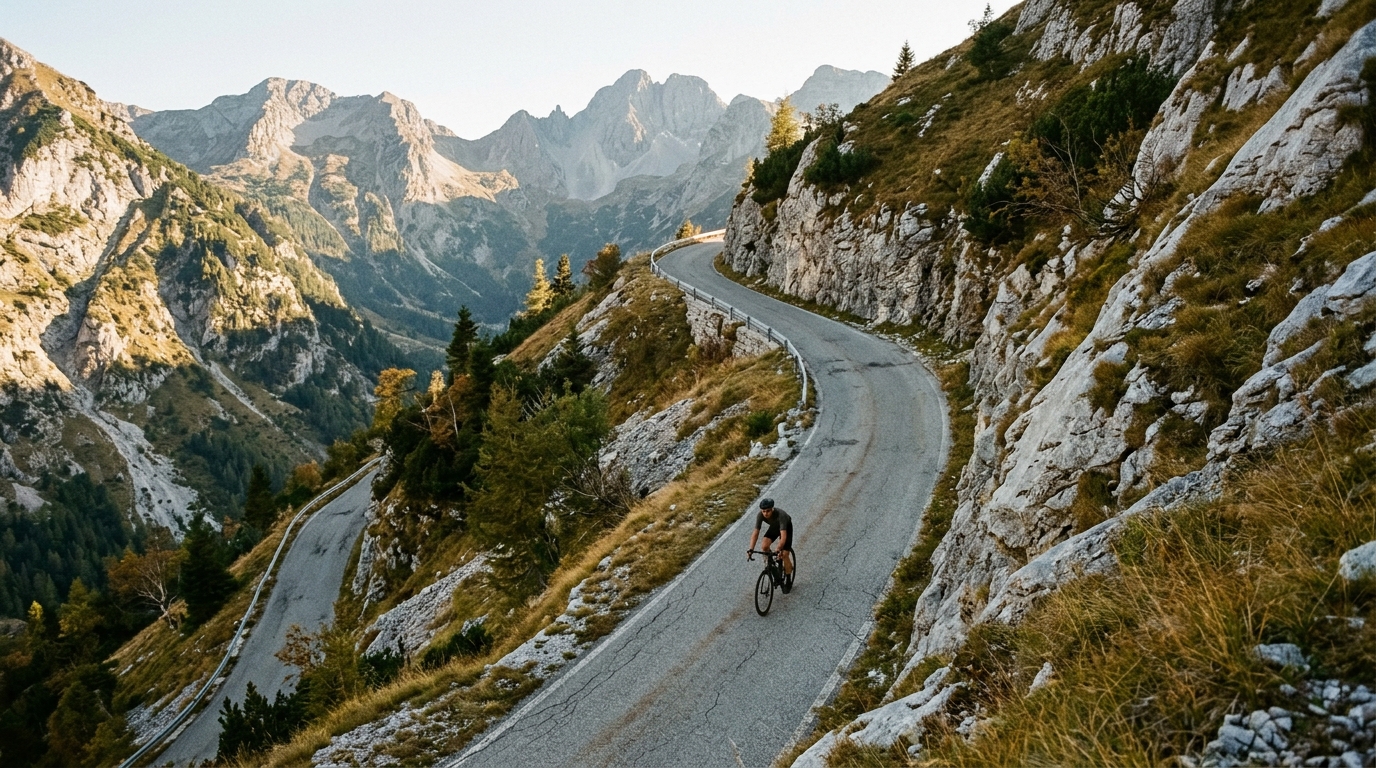
Sella Nevea
A practical Sella Nevea cycling climb profile covering gradient, pacing, and gearing for the 10.2 km category 1 ascent in Italy.
- Lengte
- 10.2km
- Gem.
- 6.3%
- Max
- 15.1%
- Top
- 1,157m
- Hoogtewinst
- 625m
De klim
Hoogteprofiel
Sella Nevea cycling climb profile
Sella Nevea is a category 1 Italian climb that demands a controlled effort rather than a hopeful surge from the bottom. On paper, the climb is 10.2 km at an average gradient of 6.27%, rising from 517 m to 1157 m. That puts it in the awkward middle ground where it is not brutally steep for its full length, but it is long enough that riding it above your sustainable range early will come back hard before the summit.
The key number is the maximum gradient of 15.09%. The average tells you the climb is broadly manageable for a trained rider, but that maximum tells you the road has enough bite to disrupt rhythm. Without relying on segment-by-segment detail, the safest way to read Sella Nevea is as a climb where the baseline load is steady and aerobic, while the steepest ramps can briefly push you well above comfort if you are overgeared or already riding too close to your limit.
How the gradient rides
The total rise from start to summit is 640 m across 10.2 km, so the climb is not defined by flat recovery. It is a sustained uphill problem. The 6.27% average means you can usually settle into a seated cadence and build pressure gradually, but the 15.09% maximum means the climb should not be paced like a uniform trainer interval.
That distinction matters. A steady 6% climb rewards smooth power. A climb with a double-digit maximum rewards patience before the hardest gradients arrive. If you ride the opening kilometres at the top of your /glossary/ftp range, the steepest pitch is likely to force a costly spike. If you leave a margin, that same ramp becomes something you can absorb without turning the final part of the climb into damage control.
Pacing and gearing notes
Treat Sella Nevea as a long tempo-to-threshold ascent with short sections that may require more torque. The best pacing plan is conservative early, stable through the middle, and only more aggressive once the summit effort is clearly under control.
Practical approach:
- Start slightly below the effort you think you can hold for the full 10.2 km.
- Keep cadence protected for the steepest ramps, because the 15.09% maximum can punish a gear that feels fine on the average gradient.
- Avoid repeated standing accelerations unless you are deliberately changing rhythm. On a climb of this length, small spikes accumulate quickly.
- If riding by power, cap the early effort and save the hardest work for the final portion rather than chasing speed on every ramp.
Gearing should be chosen for the maximum gradient, not the average. A setup that only suits 6.27% may feel efficient most of the way, but it leaves little room when the road pitches up. The smarter choice is a low enough gear to stay seated and controlled on the steepest section, then use the steadier gradient to keep momentum rather than forcing it.
What decides a good ride
Sella Nevea is about resisting the misleading comfort of the average gradient. The numbers describe a climb that is sustained, substantial, and capable of sharp resistance. Ride it as a measured aerobic climb with a few hard interruptions, and it becomes manageable. Ride it as if 6.27% is the whole story, and the 15.09% maximum is where the climb starts making decisions for you.