U.S. Bicycle Route 45
A practical guide to U.S. Bicycle Route 45, a 208.8 km point-to-point asphalt ride with minimal climbing.
- Distance
- 208.8km
- Dénivelé
- 116m
- Revêtement
- —
- Forme
- Point à point
L'itinéraire
Profil d'altitude
U.S. Bicycle Route 45 cycling route overview
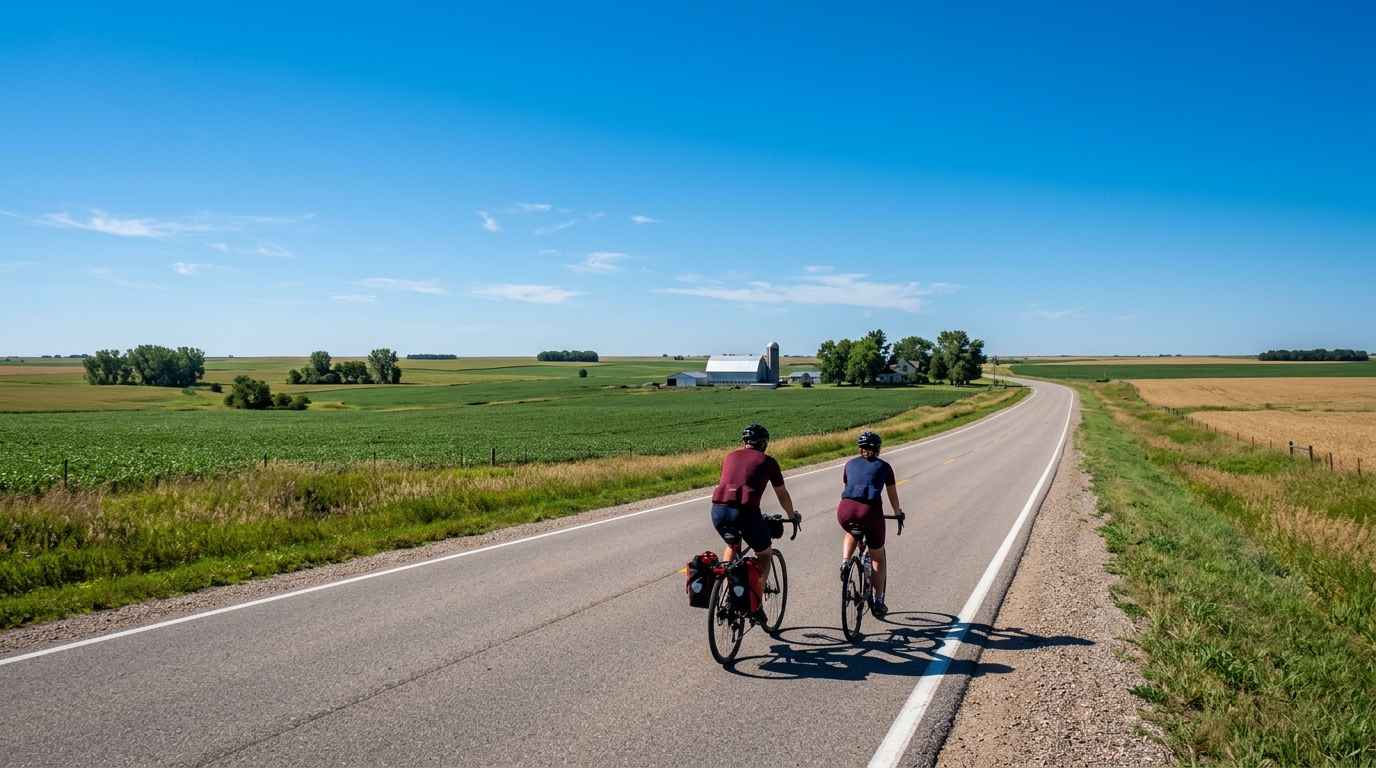
U.S. Bicycle Route 45 is a 208.8 km point-to-point asphalt route in the US, with 116 m of total elevation gain. That combination defines the ride more clearly than any label could: this is not a climbing route, and it is not a punchy loop where repeated elevation changes dictate the rhythm. It is a long, linear endurance effort where the main challenge is sustaining pressure over distance.
The low elevation gain matters because it changes how the ride is likely to be paced. With no listed notable climbs and only 116 m gained across the full route, there are few obvious terrain features to naturally break the day into sections. Riders who normally use climbs as pacing anchors will need to create structure another way - through fueling intervals, planned stops, or power and heart-rate targets.
Terrain and ride character
The asphalt surface points toward a road-focused setup. A standard endurance road bike, all-road bike, or well-fitted touring bike is the natural match, depending on how much gear is being carried. The key is comfort over 208.8 km rather than equipment built around climbing efficiency.
Because the route is point-to-point, logistics are part of the ride rather than an afterthought. A loop returns the rider to the start by design. This does not. Transport, pickup, accommodation, or a return ride need to be planned before rolling out. That point-to-point format also changes the psychology of the day: once committed, progress is measured by forward movement, not by circling back toward familiar roads.
Pacing and effort
The mistake on a route like this is treating the lack of climbing as a reason to ride loosely. Minimal elevation gain usually means fewer forced recoveries. Without notable climbs or descents to reset the legs, small pacing errors can compound quietly over a long distance.
A steadier approach makes more sense. Ride below threshold, keep the effort controlled early, and avoid turning every open stretch into a tempo block. If using power, anchor the day around sustainable endurance riding rather than chasing speed. For riders calibrating effort, /glossary/ftp is the right reference point, but the better principle is simpler: the route is long enough that consistency beats aggression.
Practical notes
- Distance: 208.8 km.
- Surface: asphalt.
- Format: point-to-point, not a loop.
- Elevation gain: 116 m.
- Listed notable climbs: none.
The practical takeaway is straightforward. U.S. Bicycle Route 45 rewards preparation more than climbing strength. Bring enough food, plan resupply or support around the full distance, and think through the finish logistics before starting. The terrain profile suggests a ride where the aerobic system, contact-point comfort, and disciplined fueling matter more than low gearing or climbing surges.
For a rider looking for a long asphalt route with very little elevation gain, U.S. Bicycle Route 45 is best understood as an endurance pacing test. The route will not be decided by a summit. It will be decided by how well the rider manages a long day without much help from the terrain.
Itinéraires similaires
3-Länder-Radweg
A 302.2 km asphalt route in Germany with 1512 m of climbing and point-to-point logistics shaped by the Reußenkreuz climb.
7 Peaks Alpine Challenge
A 110.9 km point-to-point assault through the Victorian Alps, stacking 3404 metres of climbing across relentless, wind-swept high-country ascents.
Aberdare Range
A 46 km asphalt point-to-point through Kenya's Central Highlands that trades big climbs for a relentless 1,700 m of rolling grind.
Abra Málaga
A 45-kilometer point-to-point ribbon of asphalt through Peru's Sacred Valley, climbing 1,699 relentless meters into the high Andes.
Afriski Mahlasela Pass
A 112.8 km asphalt ascent through the Maloti Mountains, climbing 3,384 m to the roof of southern Africa via the storied Mahlasela Pass.
Ahr Cycleway
An 82.9 km asphalt point-to-point route with 541 m of gain, the Ahr Cycleway is a steady endurance ride rather than a climb-focused day.