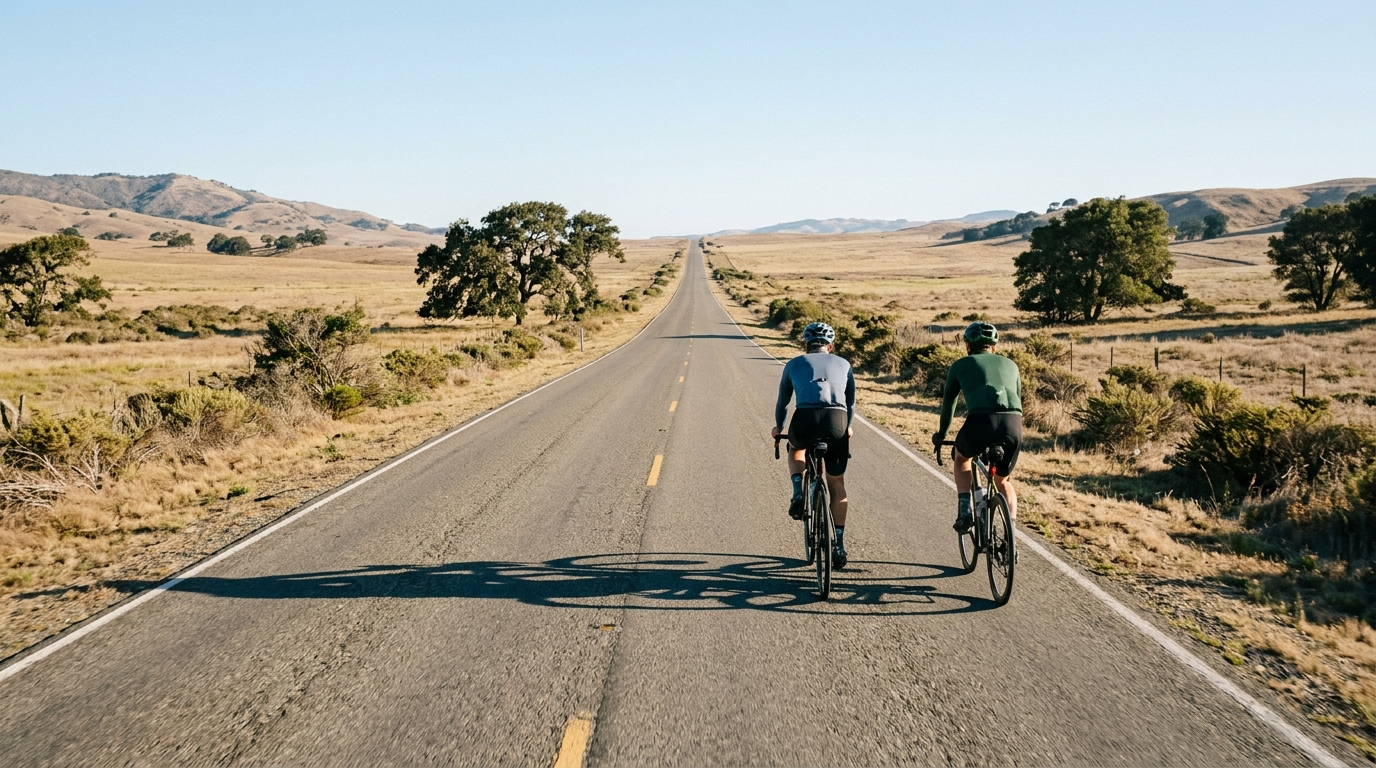
U.S. Bicycle Route 235
A long asphalt point-to-point with modest total climbing, USBR 235 is an endurance route where pacing, fueling, and surface consistency matter more than summit tactics.
- Distance
- 256.5km
- Dénivelé
- 860m
- Revêtement
- —
- Forme
- Point à point
L'itinéraire
Profil d'altitude
U.S. Bicycle Route 235 cycling route overview
U.S. Bicycle Route 235 is a long point-to-point asphalt ride with 256.5 km of distance and 860 m of elevation gain. That combination defines the route more clearly than any single climb could: this is not a climbing route in the classic sense. It is an endurance route where the main challenge is holding a sustainable rhythm for a long time while managing food, fluids, contact points, and concentration.
The absence of listed notable climbs matters. On a route like this, riders are less likely to be forced into repeated threshold efforts by major gradients. Instead, the difficulty is cumulative. Small rises, wind exposure, surface drag, traffic rhythm, and the mental cost of staying efficient for hours can do more damage than the elevation total suggests.
Terrain and ride character
With asphalt as the listed surface, the route should favor road bikes, fast endurance setups, and bikepacking rigs that still roll efficiently. The surface profile points toward steady seated pedaling rather than mixed-surface handling or tire-choice compromises. That said, asphalt does not automatically mean easy. Over 256.5 km, comfort becomes performance.
The 860 m of gain spread across the route suggests a profile that should reward even pacing. The better approach is to stay well below the intensity that feels exciting early, especially if riding the full route in one go. Treat the opening phase as controlled aerobic work, not a test of freshness. If using power, anchor the day around sustainable endurance rather than chasing short surges above /glossary/ftp.
Pacing and practical notes
Because the route is not a loop, logistics matter before fitness gets a chance to show. Plan the start and finish transport, bailout options, and any overnight strategy before committing to the full distance. A point-to-point route removes the convenience of simply turning back to the same base.
For most riders, the key demands will be:
- Sustained fueling from early in the ride
- A position comfortable enough for a long asphalt day
- Tires chosen for efficiency and durability rather than pure speed
- Conservative pacing over the first portion of the route
- Clear navigation, since a long non-loop course offers fewer easy resets
The low-climb profile can be deceptive because it allows steady speed, and steady speed can quietly raise the metabolic cost if the effort drifts too high. Riders who know their training zones should keep the route honest by riding to effort, not ego. If power targets are uncertain, estimating a baseline with /tools/ftp-estimator is more useful than guessing on the road.
Who this route suits
U.S. Bicycle Route 235 suits riders looking for a long asphalt endurance objective rather than a summit-focused challenge. It is a good fit for building durability, testing fueling systems, or preparing for longer point-to-point events where the decisive factor is not one climb, but the ability to keep making efficient decisions deep into the ride.
Itinéraires similaires
3-Länder-Radweg
A 302.2 km asphalt route in Germany with 1512 m of climbing and point-to-point logistics shaped by the Reußenkreuz climb.
7 Peaks Alpine Challenge
A 110.9 km point-to-point assault through the Victorian Alps, stacking 3404 metres of climbing across relentless, wind-swept high-country ascents.
Aberdare Range
A 46 km asphalt point-to-point through Kenya's Central Highlands that trades big climbs for a relentless 1,700 m of rolling grind.
Abra Málaga
A 45-kilometer point-to-point ribbon of asphalt through Peru's Sacred Valley, climbing 1,699 relentless meters into the high Andes.
Afriski Mahlasela Pass
A 112.8 km asphalt ascent through the Maloti Mountains, climbing 3,384 m to the roof of southern Africa via the storied Mahlasela Pass.
Ahr Cycleway
An 82.9 km asphalt point-to-point route with 541 m of gain, the Ahr Cycleway is a steady endurance ride rather than a climb-focused day.