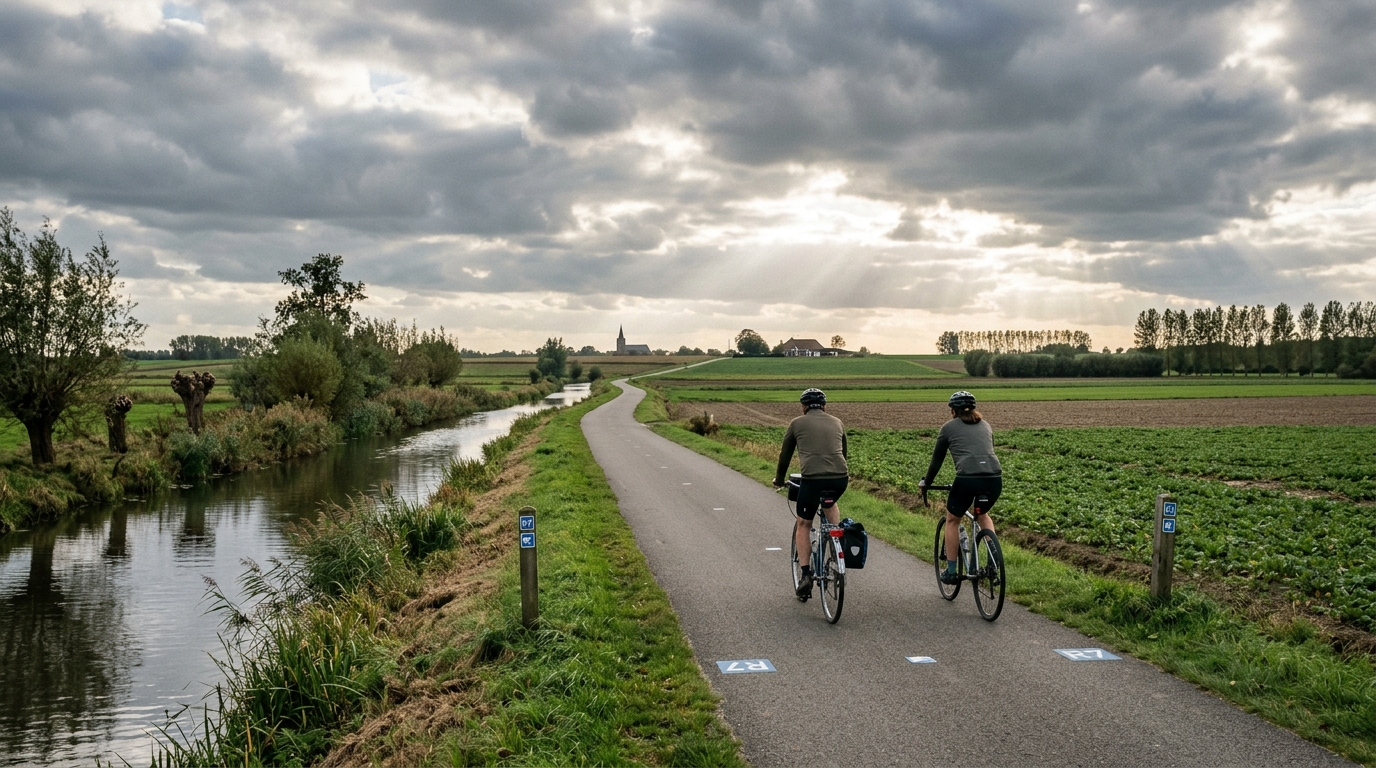
Regional Cycling Route 7
A short asphalt point-to-point route in Belgium, with 10.8 km of riding and 49 m of elevation gain. Best read as an easy connector or controlled endurance segment.
- Distance
- 10.8km
- Dénivelé
- 49m
- Revêtement
- —
- Forme
- Point à point
L'itinéraire
Profil d'altitude
Regional Cycling Route 7 cycling route overview
Regional Cycling Route 7 is a short asphalt cycling route in Belgium, covering 10.8 km with 49 m of elevation gain. The key thing to understand is that this is not a route defined by climbing or repeated changes in terrain. Its profile points to a controlled, low-variability ride where pacing, position, and route logistics matter more than managing major gradients.
Because it is not a loop, the practical question is not just how hard the ride is, but how it fits into the rest of the day. A point-to-point route changes the planning equation. It works well as a connector, the opening or closing section of a longer ride, or a short standalone effort if transport at either end is already solved.
Terrain and ride feel
The surface is asphalt, which makes the route suitable for road bikes, endurance bikes, and general fitness riding. With only 49 m of elevation gain across 10.8 km, the terrain should feel steady rather than selective. There are no notable climbs listed, so the ride is unlikely to be decided by sustained climbing strength.
That changes the way you should approach it. Instead of riding defensively for a climb that never really arrives, settle into a sustainable rhythm early. On a short route like this, even small pacing mistakes are compressed into a limited amount of riding time. If using the route for training, it is better suited to controlled endurance, cadence work, or a short aerobic spin than to a climbing-focused session.
How to ride it
The low elevation gain makes Regional Cycling Route 7 a good option when you want a ride that is easy to dose. Keep the effort smooth rather than surging. On flatter asphalt routes, speed tends to come from consistency, good positioning, and avoiding unnecessary accelerations.
For riders building a longer day, this route can be useful because it adds distance without adding much climbing load. That makes it easier to manage fatigue and keep the ride aligned with the intended training goal, whether that is an easy endurance block or a light recovery-oriented outing. If you are riding by power, use it as a place to stay disciplined around your target rather than chasing speed. For reference points on intensity, see /glossary/ftp.
Practical notes
- Distance: 10.8 km.
- Elevation gain: 49 m.
- Surface: asphalt.
- Format: point-to-point, not a loop.
- Notable climbs: none listed.
- Country: Belgium.
The main takeaway is simple: Regional Cycling Route 7 is a short, asphalt, point-to-point route with minimal climbing demands. Treat it as a practical connector or a controlled ride segment rather than a destination climb or all-day route.
Itinéraires similaires
3-Länder-Radweg
A 302.2 km asphalt route in Germany with 1512 m of climbing and point-to-point logistics shaped by the Reußenkreuz climb.
7 Peaks Alpine Challenge
A 110.9 km point-to-point assault through the Victorian Alps, stacking 3404 metres of climbing across relentless, wind-swept high-country ascents.
Aberdare Range
A 46 km asphalt point-to-point through Kenya's Central Highlands that trades big climbs for a relentless 1,700 m of rolling grind.
Abra Málaga
A 45-kilometer point-to-point ribbon of asphalt through Peru's Sacred Valley, climbing 1,699 relentless meters into the high Andes.
Afriski Mahlasela Pass
A 112.8 km asphalt ascent through the Maloti Mountains, climbing 3,384 m to the roof of southern Africa via the storied Mahlasela Pass.
Ahr Cycleway
An 82.9 km asphalt point-to-point route with 541 m of gain, the Ahr Cycleway is a steady endurance ride rather than a climb-focused day.