Münchner Radschnellweg
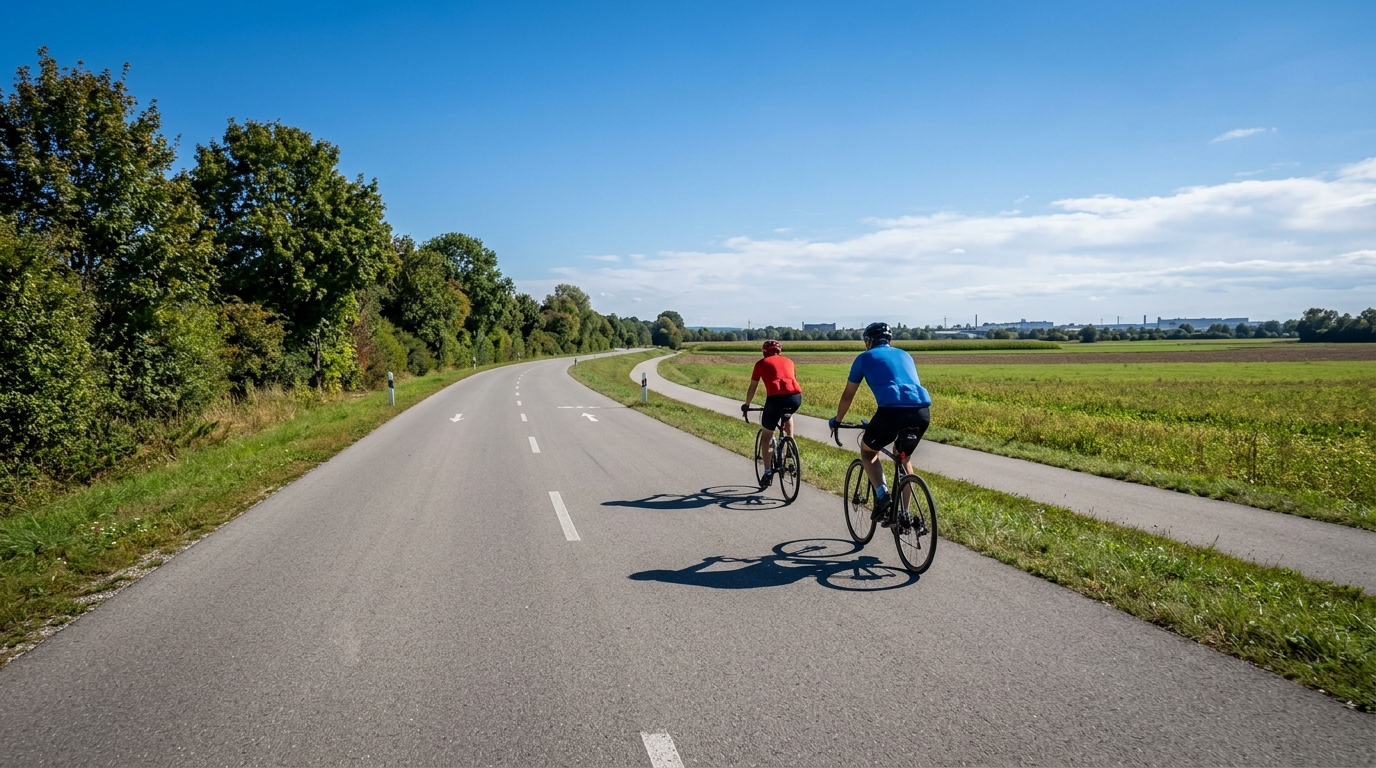
A flat, asphalt, point-to-point route in Germany built around momentum rather than climbing.
- Distance
- 19.9km
- Dénivelé
- 6m
- Revêtement
- —
- Forme
- Point à point
L'itinéraire
Profil d'altitude
Münchner Radschnellweg cycling route overview
The Münchner Radschnellweg cycling route is defined by one thing above all else: efficiency. At 19.9 km with just 6 m of elevation gain, this is not a route that asks much from your climbing legs. It asks for rhythm, smooth pacing, and attention to how well you can hold speed on flat asphalt.
Because it is not a loop, the ride has a different feel from a closed training circuit. You are committing to a point-to-point effort, which changes the practical side of the ride. Think about how you will return, where you want to finish, and whether the route is being used as transport, endurance work, or a controlled steady-state session.
Terrain and ride character
The surface is asphalt, and the elevation profile is effectively flat. That combination makes the route better suited to sustained momentum than repeated changes in effort. There are no notable climbs listed, so the limiter is unlikely to be gradient. Instead, the quality of the ride comes from consistency: staying seated, keeping pressure on the pedals, and avoiding unnecessary surges.
On a route like this, speed can become deceptive. With almost no vertical resistance, it is easy to drift above the effort you intended, especially if the surface is running well. If the goal is endurance, keep it controlled. If the goal is tempo, the profile gives you the right canvas for a clean, uninterrupted feel, provided the route conditions allow it.
This is not the place to measure yourself through climbing performance or a maximal /glossary/ftp-style effort. It is better understood as a route for aerobic durability, commuting efficiency, or steady pacing discipline.
Practical notes
For setup, prioritize rolling efficiency and comfort over low gearing. The listed terrain does not demand a climbing-focused bike or special gearing choice. A road bike, commuter setup, or fast all-road build all make sense as long as the tires suit asphalt.
The main planning point is the non-loop layout. Before riding, decide whether this is a one-way transfer, an out-and-back extension, or part of a larger route. That matters more here than elevation management, because the 6 m of gain across 19.9 km will not shape the day in any meaningful way.
Who it suits
This route suits riders who want a flat asphalt ride in Germany with minimal climbing interruption. It is a strong fit for steady endurance, practical point-to-point riding, or controlled aerobic work where the goal is to keep the effort even rather than chase terrain-driven intensity.
Itinéraires similaires
3-Länder-Radweg
A 302.2 km asphalt route in Germany with 1512 m of climbing and point-to-point logistics shaped by the Reußenkreuz climb.
7 Peaks Alpine Challenge
A 110.9 km point-to-point assault through the Victorian Alps, stacking 3404 metres of climbing across relentless, wind-swept high-country ascents.
Aberdare Range
A 46 km asphalt point-to-point through Kenya's Central Highlands that trades big climbs for a relentless 1,700 m of rolling grind.
Abra Málaga
A 45-kilometer point-to-point ribbon of asphalt through Peru's Sacred Valley, climbing 1,699 relentless meters into the high Andes.
Afriski Mahlasela Pass
A 112.8 km asphalt ascent through the Maloti Mountains, climbing 3,384 m to the roof of southern Africa via the storied Mahlasela Pass.
Ahr Cycleway
An 82.9 km asphalt point-to-point route with 541 m of gain, the Ahr Cycleway is a steady endurance ride rather than a climb-focused day.