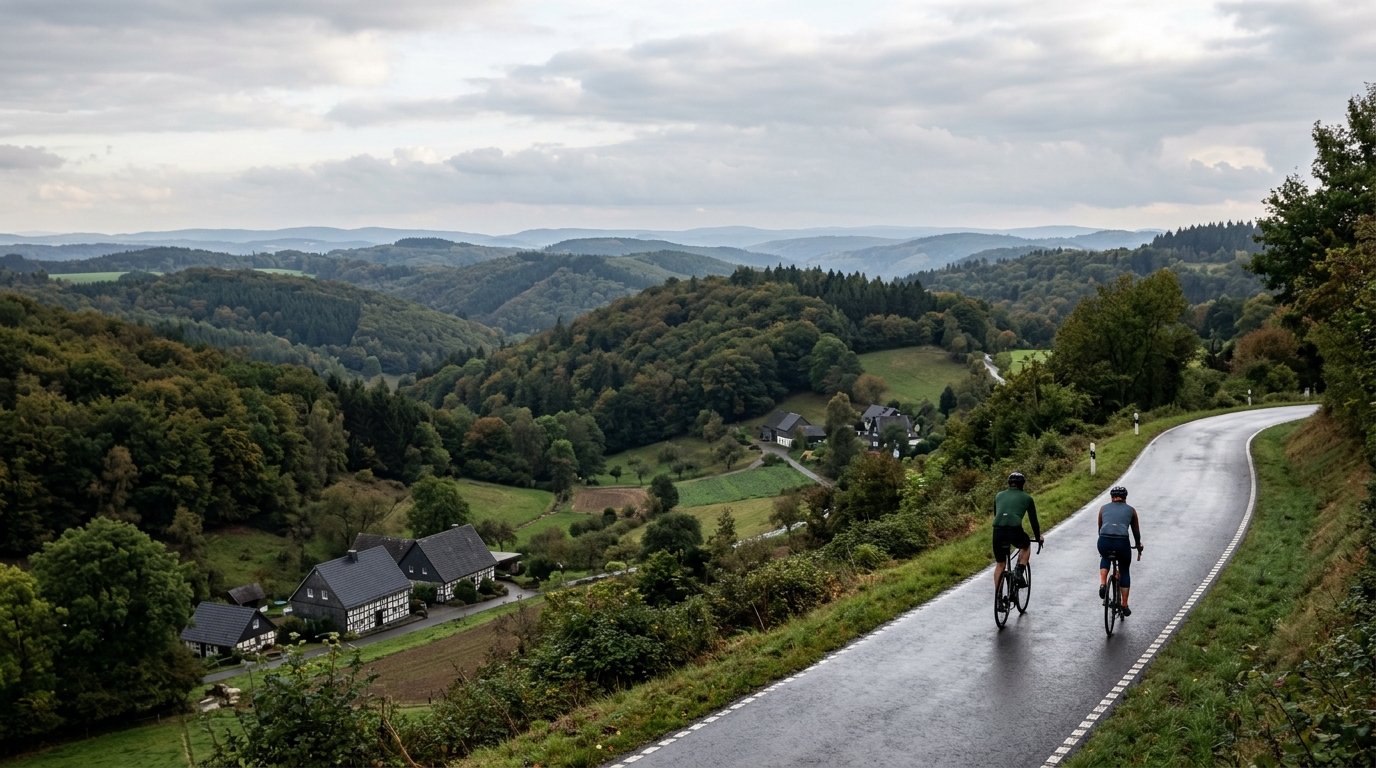
Bergischer Panorama-Radweg
A 123.2 km asphalt point-to-point ride in Germany with 851 m of climbing, built more around steady endurance than decisive climbs.
- Distance
- 123.2km
- Dénivelé
- 851m
- Revêtement
- —
- Forme
- Point à point
L'itinéraire
Profil d'altitude
Bergischer Panorama-Radweg cycling route overview
The Bergischer Panorama-Radweg is a long asphalt point-to-point ride in Germany, measuring 123.2 km with 851 m of elevation gain. On paper, that makes it less about a single decisive climb and more about sustained endurance, rhythm management, and keeping the ride under control from the first hour.
The key number is not just the distance or the climbing in isolation, but the way they sit together. A 123.2 km route is long enough that pacing, fueling, and position on the bike matter. The 851 m of elevation gain adds enough resistance to make the day accumulate, but the absence of any listed notable climbs suggests the difficulty is likely spread across the route rather than concentrated into one headline ascent.
Terrain and ride character
Expect an asphalt ride that rewards smooth, patient riding. With no notable climbs listed, the route should be approached as a rolling endurance effort rather than a climb-focused challenge. That changes the tactics. Instead of saving everything for one major ascent, the better strategy is to avoid repeated surges, keep pressure on the pedals steady, and let the route come to you.
The distance gives the Bergischer Panorama-Radweg its real weight. A rider who treats the first half like a fast training loop can easily find the final portion becoming much harder than the profile suggests. The climbing total is manageable, but over 123.2 km, small rises, accelerations, and stop-start sections can still add up. This is a good route for practicing durable pacing around endurance intensity, especially if you are working on long steady rides rather than maximal climbing efforts. For pacing reference, the concept of /glossary/ftp is useful, but this is not a route that should be ridden like a threshold test.
Practical notes
Because the route is not a loop, logistics matter. Plan the start and finish as two separate points, not as a ride where you naturally return to the car or hotel. That affects transport, clothing, charging, and nutrition. It also means wind direction and late-ride fatigue can have a bigger psychological impact, since there is no simple halfway turn.
For most riders, the best approach is conservative early pacing, regular fueling, and avoiding big efforts on short rises. The asphalt surface keeps equipment choice straightforward: a road bike or fast all-road setup makes sense, with gearing selected for repeated moderate climbing rather than one extreme gradient.
Who it suits
The Bergischer Panorama-Radweg is best viewed as a long endurance route with enough elevation gain to keep it honest. It suits riders who want a substantial day out on asphalt without building the ride around a named climb. If you ride it well, the challenge is not surviving one brutal section. It is staying efficient for the full 123.2 km, keeping the 851 m of climbing from turning into a late-ride tax.
Itinéraires similaires
3-Länder-Radweg
A 302.2 km asphalt route in Germany with 1512 m of climbing and point-to-point logistics shaped by the Reußenkreuz climb.
7 Peaks Alpine Challenge
A 110.9 km point-to-point assault through the Victorian Alps, stacking 3404 metres of climbing across relentless, wind-swept high-country ascents.
Aberdare Range
A 46 km asphalt point-to-point through Kenya's Central Highlands that trades big climbs for a relentless 1,700 m of rolling grind.
Abra Málaga
A 45-kilometer point-to-point ribbon of asphalt through Peru's Sacred Valley, climbing 1,699 relentless meters into the high Andes.
Afriski Mahlasela Pass
A 112.8 km asphalt ascent through the Maloti Mountains, climbing 3,384 m to the roof of southern Africa via the storied Mahlasela Pass.
Ahr Cycleway
An 82.9 km asphalt point-to-point route with 541 m of gain, the Ahr Cycleway is a steady endurance ride rather than a climb-focused day.