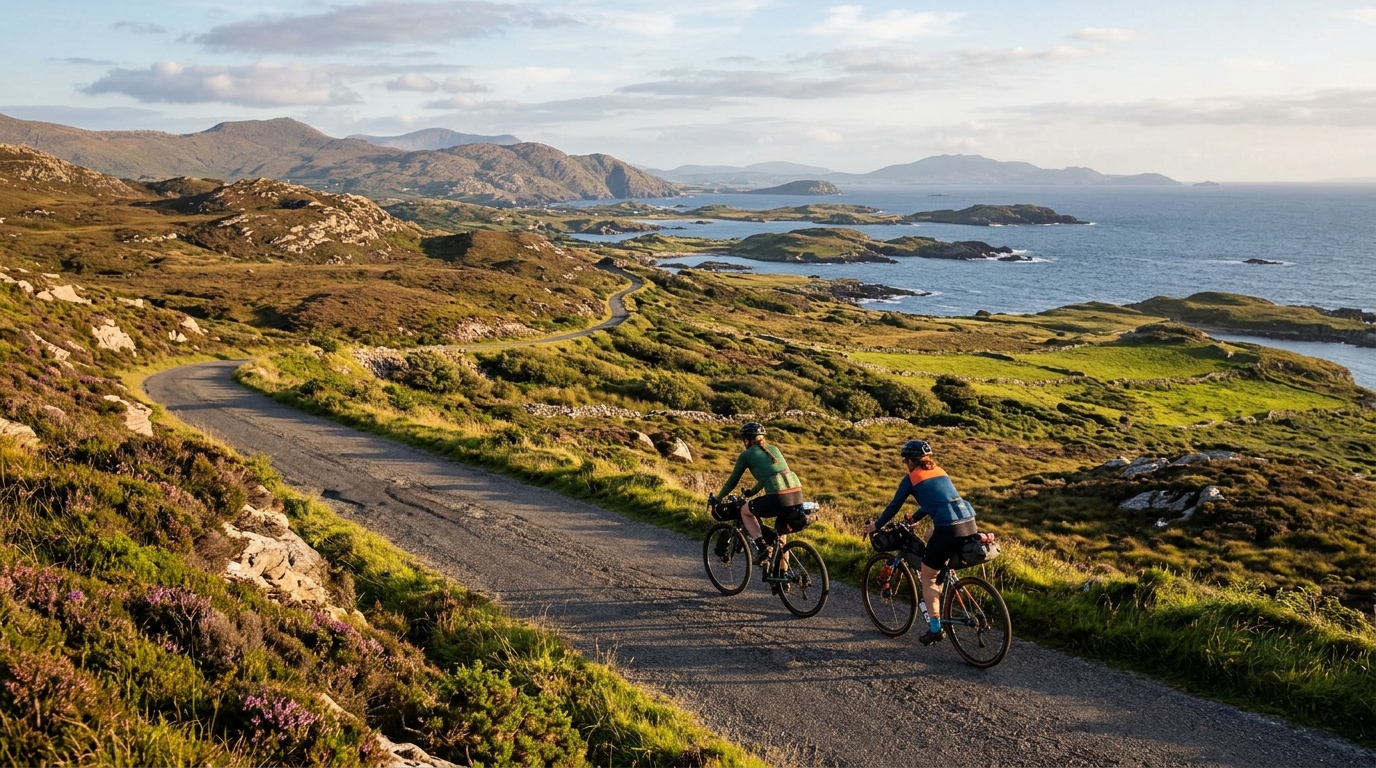
Beara Way
A practical route guide to the Beara Way cycling route: 262.6 km of asphalt in Ireland with 4,205 m of climbing and no looped finish.
- Distance
- 262.6km
- Dénivelé
- 4,205m
- Revêtement
- —
- Forme
- Point à point
L'itinéraire
Profil d'altitude
Beara Way cycling route overview
The Beara Way cycling route is a long asphalt ride in Ireland, covering 262.6 km with 4,205 m of elevation gain. The headline is not just the distance. It is the combination of distance and accumulated climbing that defines the ride.
This is not listed as a loop, which matters for planning. A non-loop route changes the day before you turn a pedal: transport, accommodation, bag logistics, and bailout options all need more thought than they would on a circular ride that returns to the same point.
Terrain and ride character
With 4,205 m of climbing across 262.6 km, the Beara Way sits firmly in endurance territory. The climbing load is substantial, but the context suggests the challenge is more cumulative than defined by a single named ascent. There are no notable climbs listed in the route data, so the sensible assumption is not to wait for one decisive climb, but to manage effort over repeated rises, transitions, and rolling terrain.
That changes the pacing model. On a route like this, the costly mistakes usually come early: riding every ramp as if it is isolated, pushing above sustainable power too often, and failing to fuel before fatigue is obvious. The better approach is to cap intensity on the climbs, keep pressure steady on flatter sections, and treat the first half as preparation for the second rather than as a place to bank time.
For riders using power, this is a route where /glossary/ftp matters less as a bragging number and more as a ceiling. The aim should be to avoid repeated surges above threshold unless the route plan demands it. The total elevation gain means muscular fatigue will accumulate even if no individual climb looks decisive on paper.
Surface and equipment
The listed surface is asphalt, so a road bike is the natural choice. That does not make the ride easy. Over 262.6 km, comfort and efficiency become part of the performance equation. A position that feels fast for two hours can become expensive late in a route with this much climbing.
Practical setup priorities:
- Use gearing that lets you climb without grinding when fatigue builds
- Choose tyres for comfort and reliability rather than chasing the narrowest possible setup
- Carry enough food to avoid depending entirely on stops
- Plan charging or battery management if navigating the full route
Practical notes
Because the Beara Way is not a loop, the finish logistics are as important as the route itself. Do not treat this as a simple out-and-back day unless you have deliberately built that into the plan. Arrange transport, confirm where the ride ends, and decide in advance whether this is a single long effort or a route to split across stages.
The ride rewards discipline. The distance is long enough that small pacing and fueling errors compound, and the elevation gain is high enough that those errors will show up on the climbs first. Ride the early kilometres under control, keep the effort repeatable, and let consistency do the work.
Itinéraires similaires
3-Länder-Radweg
A 302.2 km asphalt route in Germany with 1512 m of climbing and point-to-point logistics shaped by the Reußenkreuz climb.
7 Peaks Alpine Challenge
A 110.9 km point-to-point assault through the Victorian Alps, stacking 3404 metres of climbing across relentless, wind-swept high-country ascents.
Aberdare Range
A 46 km asphalt point-to-point through Kenya's Central Highlands that trades big climbs for a relentless 1,700 m of rolling grind.
Abra Málaga
A 45-kilometer point-to-point ribbon of asphalt through Peru's Sacred Valley, climbing 1,699 relentless meters into the high Andes.
Afriski Mahlasela Pass
A 112.8 km asphalt ascent through the Maloti Mountains, climbing 3,384 m to the roof of southern Africa via the storied Mahlasela Pass.
Ahr Cycleway
An 82.9 km asphalt point-to-point route with 541 m of gain, the Ahr Cycleway is a steady endurance ride rather than a climb-focused day.