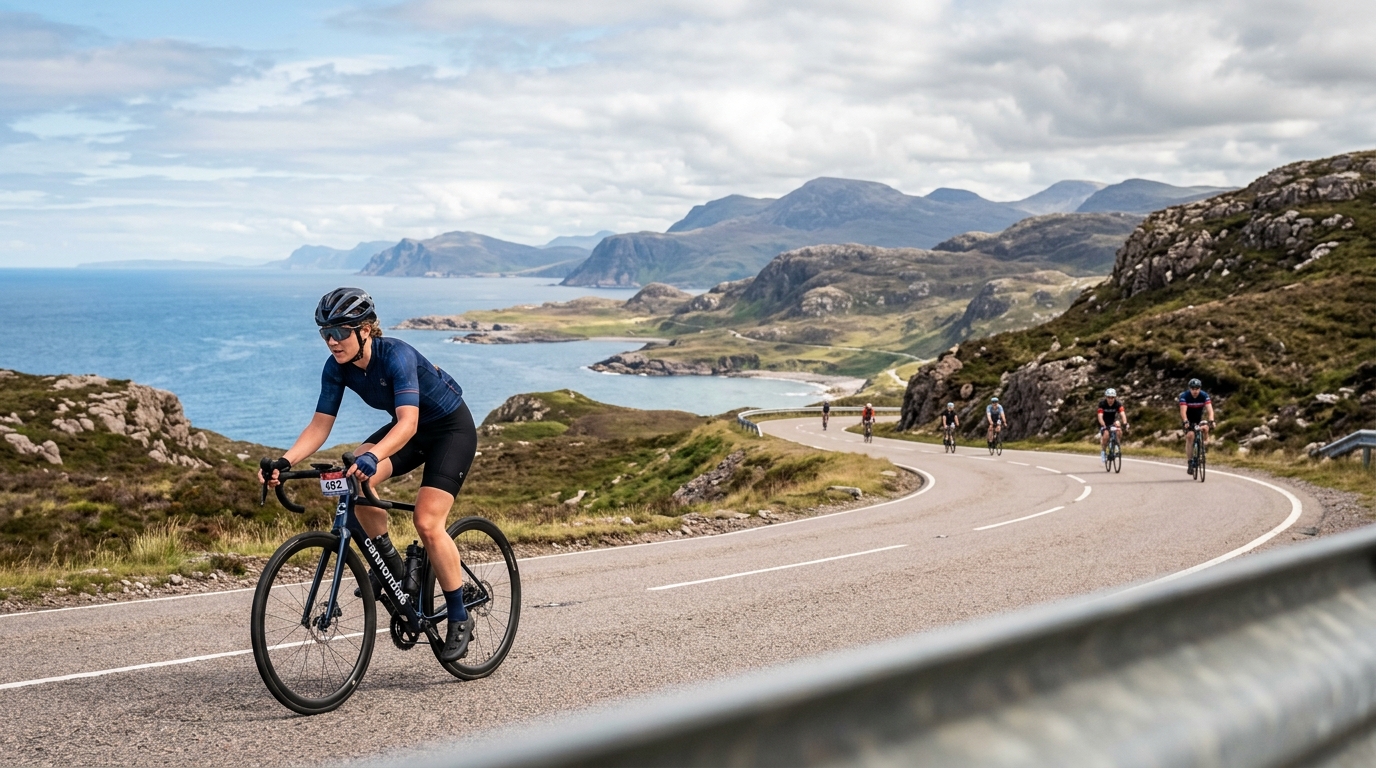
Image generated by our model.
Your First Gran Fondo: A Complete Training Guide
What Is a Gran Fondo?
A gran fondo is a mass-participation cycling event — not a race in the traditional sense, but a timed long-distance ride open to all abilities. Distances vary widely by event, but most sit in the range of a challenging day in the saddle: enough climbing and mileage to demand genuine preparation. Some events chip-time the full course; others time only a designated segment. Either way, finishing well requires structured training, not just accumulated miles.
If you've been riding casually and want a goal that forces genuine fitness gains, a gran fondo is the right target. It's demanding enough to require a real gran fondo training plan, manageable enough to complete without a professional coaching background.
Choosing Your Event
Pick your event before you build your plan — the course profile dictates everything.
- Flat or rolling: Demands sustained power output and efficient pacing. Aerodynamics matter more.
- Mountainous: Demands climbing fitness, descending confidence, and energy management over long ascents.
- Distance: Longer events require more base volume in training. Don't underestimate duration over distance — a hilly shorter route can cost more time and energy than a flat longer one.
Look for your target event's elevation profile and estimated finishing time for the median rider. That finishing time, not the distance alone, should anchor your preparation.
Registration tip: Popular gran fondos fill months in advance. Lock in your entry before you start training — commitment is itself a training tool.
How Much Time Do You Need to Prepare?
For a rider with a moderate base — meaning consistent riding several times per week — allow a minimum of 12 weeks of structured preparation. Riders coming from low or inconsistent fitness should target 16–20 weeks.
The training plan splits into three phases:
- Base phase — aerobic foundation, volume over intensity
- Build phase — event-specific intensity, longer rides, threshold work
- Taper phase — reduced volume, maintained sharpness, recovery
If your event involves significant climbing, the build phase needs dedicated climbing intervals and long rides that simulate the sustained effort of extended ascents.
Building Your Base
Base training is non-negotiable for a gran fondo. Without aerobic capacity, intensity work has no foundation to build on.
Weekly Volume Targets
Base phase riding should be predominantly easy — genuinely easy, meaning you can hold a conversation without strain. This is Zone 2 on a five-zone model. Resist the urge to ride every session hard.
- Aim for three to five rides per week
- Include one long ride per week that progressively extends in duration
- Keep long ride intensity low; the goal is time in the saddle, not speed
- Add one moderate-effort ride per week as volume grows
Progressive Overload
Increase your long ride duration each week, then pull back every third or fourth week for recovery. A common structure:
- Week 1: Long ride at baseline duration
- Week 2: Add time to the long ride
- Week 3: Add more time
- Week 4: Recovery — reduce volume by roughly a third
Repeat this cycle, starting each new block slightly above where the previous one ended.
Know Your FTP Before You Train
Every intensity target in a structured gran fondo training plan references your Functional Threshold Power (FTP) — the highest average power you can sustain for approximately an hour. Without knowing your FTP, you're training by feel, which produces inconsistent results.
If you don't have a recent FTP figure, use the Neverchill FTP estimator or perform a standard 20-minute test. Retest every four to six weeks during your build phase; fitness gains should be reflected in updated zones.
Training Zones at a Glance
| Zone | Name | Intensity |
|---|---|---|
| Z1 | Active Recovery | Very easy |
| Z2 | Endurance | Conversational |
| Z3 | Tempo | Comfortably hard |
| Z4 | Threshold | Hard, sustainable briefly |
| Z5 | VO2 Max | Very hard, short efforts |
Base phase: mostly Z2, some Z3.
Build phase: Z2 foundation with Z3–Z4 intervals.
Taper: reduced volume, one or two short Z4 efforts to stay sharp.
The Build Phase: Adding Intensity
Once your aerobic base is solid — usually after six to eight weeks — introduce structured intensity.
Key Workouts for Gran Fondo Preparation
Tempo intervals
Sustained efforts at Z3 for 20–40 minutes. Develops the ability to hold a strong but not punishing pace over long sections of the course.
Threshold intervals
Shorter efforts at Z4 — typically 2×20 minutes or 3×15 minutes with recovery between. Raises your sustainable ceiling so race pace feels more manageable.
Climbing repeats
If your event has significant elevation, find a climb you can repeat. Ride it at race effort — not all-out, but genuinely hard — multiple times in a session. This builds both physical adaptation and pacing judgment on ascents.
Back-to-back long rides
Ride long on Saturday, then ride again at moderate duration on Sunday — before full recovery. This simulates cumulative fatigue and trains the body to perform on tired legs. Extremely useful for events with substantial distance.
What to Avoid
- Going hard on every ride. Recovery is where adaptation happens.
- Skipping the long ride. It's the most important session of the week for gran fondo prep.
- Riding Z3 constantly. This "moderate trap" accumulates fatigue without the specific benefits of either base work or true intensity.
Pacing Strategy for Race Day
Most first-time gran fondo riders go out too fast. The mass start, the crowd energy, and the adrenaline all push toward an opening hour that's significantly above sustainable pace. You pay for this in the final quarter of the ride.
The Rule
Start conservatively. If you feel like you're going too easy in the first hour, you're probably pacing correctly.
- Flat and rolling sections: Target a power output you can hold for the entire ride — typically Z3 or the lower end of Z4 depending on distance. Use a power meter or heart rate monitor to keep yourself honest.
- Climbs: Do not spike your power at the base of a climb. Settle into a sustainable rhythm and hold it to the top. Blowing up on a climb mid-event is very hard to recover from.
- Descents: Recover actively — eat, drink, soft-pedal if appropriate, but stay alert and in control.
Segment Racing
Many gran fondos include timed segments where you can legitimately push hard. If this applies to your event, identify those segments in advance and plan to ride them at higher intensity — but only if you've managed your energy through the rest of the course.
Nutrition: Fueling Before, During, and After
Nutrition is where gran fondo rides are won or lost at the amateur level. Running out of glycogen — bonking — can turn a strong ride into a survival march.
During Training
Practice your race-day nutrition strategy on every long ride. Never try something new on event day.
- Begin eating early — within the first 30–45 minutes, before you feel hungry
- Aim for consistent carbohydrate intake across the ride; the longer the event, the more critical this becomes
- Train your gut to handle food and drink at pace — this is a real physiological adaptation
Race-Day Nutrition Guidelines
- Pre-ride: A carbohydrate-rich meal two to three hours before start time. Something familiar, nothing that risks GI distress.
- On the bike: Carry more than you think you need. Gels, chews, bars, or real food depending on your preferences and what you've practiced.
- Hydration: Drink before you're thirsty. Factor in heat, humidity, and ride duration when planning how much to carry or rely on feed stations.
- Feed stations: Reconnoiter the event's feed station locations on the course map ahead of time. Know when you'll reach them and plan your pockets accordingly.
Gear and Equipment
A gran fondo doesn't require the latest equipment, but a few things make a significant difference.
Non-Negotiables
- Bike fit: If your position is wrong, a long ride will expose it painfully. Get a professional fit before your training block, not the week before the event.
- Tires: Appropriate tires for the surface and conditions. Check event guidelines — some mountain fondos use mixed surfaces.
- Gearing: If your event involves substantial climbing, make sure you have a gear you can turn comfortably at low cadence on steep terrain. Being under-geared is a miserable, avoidable problem.
Useful Additions
- A cycling computer with power or at minimum heart rate, so you can pace accurately
- Spare tubes, a pump or CO2 inflator, a basic multi-tool — mechanicals happen
- Weather-appropriate layers; mountain events especially can turn cold on descents even in summer
The Taper Phase
The two weeks before your event, reduce training volume while maintaining a small amount of intensity. The goal is to arrive at the start line recovered, not deconditioned.
- Drop total weekly volume by roughly 40–50% in the final two weeks
- Keep one short threshold session in the week before the event to stay sharp
- Resist the urge to cram extra training in. Fitness built in the final week before an event doesn't manifest — only fatigue does.
- Prioritize sleep. It's the most powerful recovery tool available.
Race Week Checklist
- Confirm registration and start logistics (wave time, parking, bag drop)
- Check the weather forecast and prepare kit accordingly
- Charge all devices: computer, lights, Di2 or electronic shifting if applicable
- Prepare nutrition and pack it the night before
- Check tire pressure the morning of the event
- Eat a proper breakfast with sufficient lead time before your start
- Warm up if the event allows — especially important for riders who perform better after a gradual build-in
After the Fondo
Take recovery seriously in the days following the event. A hard gran fondo creates systemic fatigue that goes beyond leg soreness. Allow genuine easy days — or complete rest — before returning to structured training.
Then, review your data. Look at your power or heart rate file, your pacing across the event, where you faded or held strong. That information tells you exactly where your next training block should focus.
Many riders finish their first gran fondo and immediately register for another. That's a good sign — but build recovery into your plan before the next training block begins.