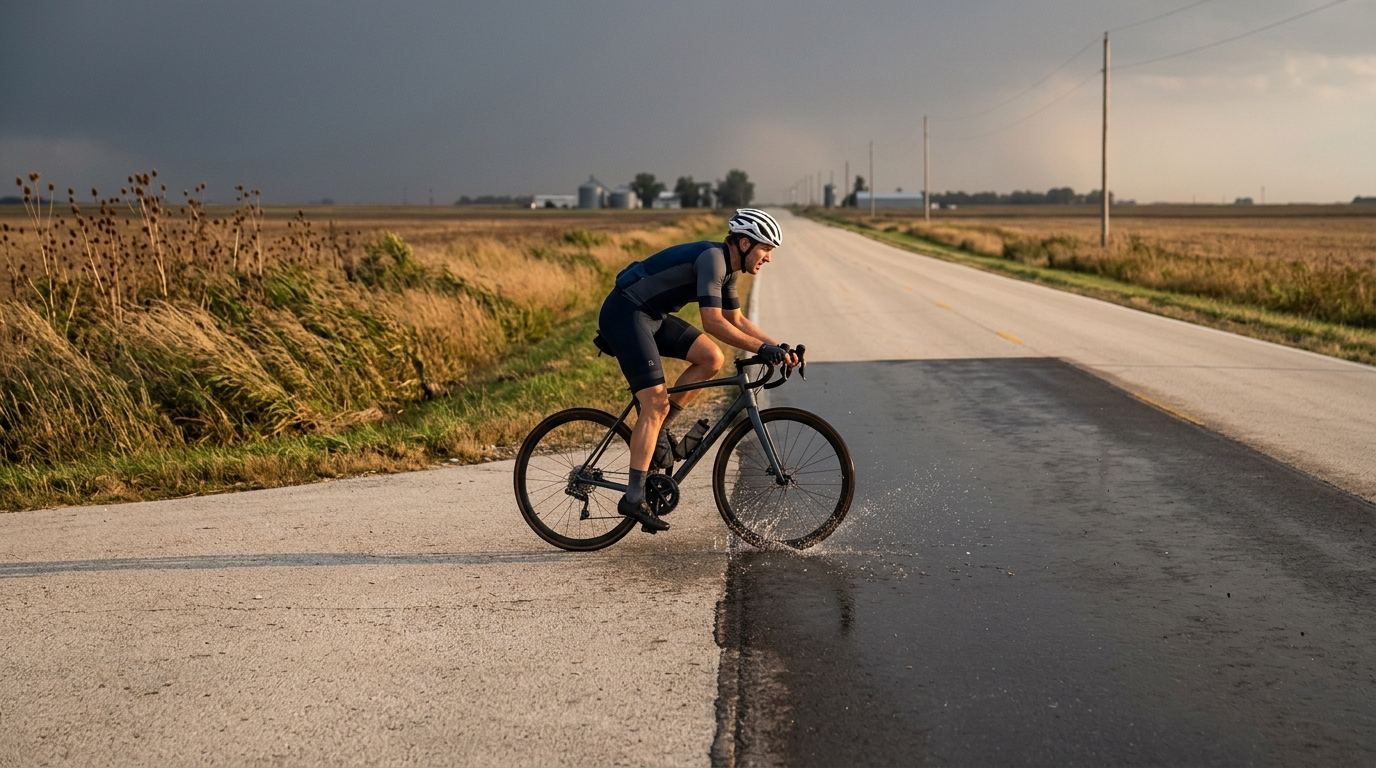
Image generated by our model.
training
Cycling Average Speed: What It Really Says About Fitness
Cycling average speed is useful only when you control the variables. Here is how to read speed without confusing conditions for fitness.
Why cycling average speed is useful, but easy to misread
Cycling average speed is one of the most visible numbers in the sport. It is easy to understand, easy to compare, and emotionally powerful because it feels like the clearest answer to a simple question: am I getting faster?
The problem is that average speed data is not a pure fitness metric. It is the output of fitness interacting with terrain, wind, surface, traffic, drafting, pacing, equipment, and route design. Treating it as a direct measure of aerobic capacity is where riders get misled.
That does not make speed useless. It makes it conditional. Used properly, it is a practical field measure because it tells you how your riding performs in the real world, not just how much power you can produce in controlled conditions. For endurance athletes, that matters. The goal is not to win a lab test. The goal is to move faster over the roads, climbs, and events you actually ride.
The key is separating signal from noise. Speed can tell you something meaningful, but only when you know what shaped it.
The variables that distort speed
Average speed is brutally sensitive to resistance. Small changes in conditions can create large changes in the number on your head unit, even when your fitness has not changed.
Wind
Wind is the biggest trap. A route that feels flat and repeatable can produce very different speeds depending on direction and exposure. A tailwind can make moderate riding look like breakthrough fitness. A headwind can make a strong day look average.
The important detail is that wind does not cancel out cleanly just because a route is an out-and-back. A headwind section often costs more time than a tailwind section gives back because aerodynamic resistance rises sharply as air speed increases. That is why a windy loop can punish average speed even if the route seems balanced on paper.
Practical takeaway: if wind is clearly shaping the ride, do not use total ride speed as a fitness verdict. Use power, heart rate, perceived exertion, or a protected segment instead.
Gradient
Climbing changes the relationship between speed and effort. On steeper or more sustained uphill terrain, speed becomes more closely tied to power relative to body mass. On flatter terrain, aerodynamics and position become more important.
This is why a rider can look fast on rolling roads but struggle on long climbs, or climb well but fail to turn that strength into speed on exposed flats. Both riders may be fit. They are just expressing fitness through different resistance profiles.
Practical takeaway: compare like with like. Do not judge a climbing block using flat-route average speed, and do not judge flat speed using a route with repeated elevation changes.
Surface
Road surface quietly steals speed. Rough pavement, chip seal, wet roads, loose corners, and poor bike paths all increase rolling resistance or force you to ride more cautiously. The effort may be the same, but the speed will not be.
This matters because many riders compare a clean summer road ride with a winter route full of debris, wet corners, and heavier kit, then assume their fitness has fallen. Sometimes it has. Often the route has simply become slower.
Practical takeaway: log surface quality mentally when reviewing speed. If the ride felt mechanically slow rather than physiologically hard, average speed is probably not the best metric for that day.
Traffic and interruptions
Average speed is also shaped by how often you stop, coast, brake, or restart. Urban rides are especially noisy because traffic lights and junctions break up effort. Even if moving average removes stopped time, it cannot fully account for lost rhythm and repeated accelerations.
A ride with constant interruptions can produce lower speed and higher fatigue at the same time. That is not a contradiction. Accelerating repeatedly creates a different physiological cost than holding steady pressure on open roads.
Practical takeaway: separate training rides from transport-style rides in your analysis. They are not measuring the same thing.
Same average speed, very different ride
This is where speed can become misleading even when the headline number is identical.
Take two rides on broadly similar terrain. In the first, you ride solo, spend long stretches into a block headwind, hold steady pressure, and finish with elevated heart rate and high perceived exertion. In the second, you sit in a fast group, avoid the wind for most of the ride, show lower power and lower heart rate, and only work hard during short surges.
The average speed can be the same. The fitness signal is not.
The solo ride may indicate better aerobic durability because you produced the work yourself against higher resistance. The group ride may indicate good positioning, pack efficiency, and the ability to handle changes in pace. Those are useful qualities, but they answer a different question.
The same logic works in reverse. A slower ride at higher power and higher heart rate on a windy day may be a stronger training performance than a faster ride with a tailwind and a low physiological cost. Speed tells you the outcome. Power, heart rate, wind, drafting, and perceived exertion tell you how that outcome was produced.
Speed vs power: when each metric tells the better story
The cycling speed vs power relationship is simple in concept but messy in practice. Power measures what you produce. Speed measures what that production becomes after the environment takes its share.
Power is better when you want to know the work your body is doing. It is the cleaner metric for structured training, intervals, fatigue tracking, pacing climbs, and judging whether a session was executed correctly. If you are building workouts around functional threshold power, power is the anchor because it lets you compare effort across different routes and conditions.
Speed is better when you want to know how effectively your system converts effort into forward motion. That system includes your fitness, position, pacing, equipment choices, cornering, descending, and tactical awareness. In that sense, speed is not less useful than power. It just answers a different question.
A useful way to separate them:
- Power asks: what did the engine produce?
- Speed asks: what did the whole rider-bike system deliver?
For data-driven athletes, the best analysis uses both. If power is rising but speed is flat on similar routes, something else may be limiting performance: position, pacing, fatigue, surface, or conditions. If speed is rising while power is stable, that can still be a real gain. You may be riding more aerodynamically, pacing better, cornering with less braking, or spending less time surging above sustainable effort.
That distinction matters. How to get faster at cycling is not always the same as how to produce more power. Power is a major part of speed, but it is not the whole story.
How drafting and group rides change your speed data
Group rides are where average speed becomes most seductive and most misleading.
Drafting reduces the cost of riding at a given speed. That means your group ride average can be much higher than your solo average without indicating a matching jump in fitness. If you spent large parts of the ride sheltered in the wheels, the speed belongs partly to the group dynamic, not just to your legs.
This does not make the ride meaningless. Group speed can reveal useful skills: positioning, smoothness, efficiency, pack awareness, and the ability to handle surges. Those are real performance qualities. But they are not the same as solo aerobic fitness.
The mistake is comparing a fast group ride to a solo ride and treating the difference as a fitness benchmark. A better approach is to categorize rides by context:
- Solo endurance rides
- Solo hard rides
- Structured workouts
- Small group rides
- Fast group rides
- Event or race efforts
Each category has its own normal speed range. Your goal is not to force them into one ranking. It is to compare each ride against the right peer group.
For group rides, look beyond average speed. Ask where you contributed. Did you pull on the front? Did you close gaps? Did you recover in the wheels after hard turns? Did you finish strong or survive? The same average speed can mean very different things depending on your role.
A repeat-route protocol that actually works
If you want cycling average speed to become a useful fitness metric, control the comparison as much as possible. The simplest method is a repeat-route benchmark.
Choose one solo benchmark route that reflects the type of fitness you care about. If your target events are rolling and exposed, use rolling and exposed roads. If your goal is climbing, use a route where climbing decides the ride. If your goal is fast endurance riding, use a route with minimal interruptions and steady terrain.
Then repeat it every four to six weeks. That spacing is frequent enough to show whether training is moving the needle, but not so frequent that every windy day or fatigue dip becomes a false verdict.
Use the same protocol each time:
- Ride it solo
- Use the same bike, tyres, clothing style, and carrying setup where possible
- Start from a similar state of freshness, or clearly mark the ride as fatigued
- Keep the pacing intent consistent
- Avoid obviously extreme wind if the goal is comparison
- Record wind direction and whether the route felt exposed or sheltered
- Record perceived exertion, not just the file data
- Record power if you have it, or heart rate if you do not
- Note traffic, surface issues, wet roads, unusual stops, or mechanical problems
The post-ride note can be short: solo, northerly wind, steady effort, normal bike, fresh legs, clean route. That is enough to make the file useful later.
The point is not to make every ride sterile. It is to create one controlled reference point. When that route gets faster at similar power, similar heart rate, or similar perceived exertion, the improvement is more credible. When it gets slower despite higher effort and worse wind, the data tells you not to panic.
When segments are better than the whole route
Segments can be even cleaner than full-route average speed because they isolate the part of the ride that matters. A sustained climb, uninterrupted stretch of flat road, or repeated rolling section gives you a more stable comparison than an entire ride full of junctions and variable terrain.
The best segments are long enough to reflect the energy system you want to track and simple enough that tactics do not dominate the result. A technical descent is a skill test. A stop-start urban stretch is a traffic test. A clean sustained effort is more likely to show fitness and pacing.
Neverchill riders can also pair segment analysis with threshold context using the FTP estimator when formal testing is not available. The goal is not to turn every ride into a lab. It is to build enough structure that your data starts answering better questions.
Using speed trends to spot real fitness gains
A single fast ride is interesting. A trend is useful.
Real fitness gains show up as repeatable changes across similar conditions. You are looking for patterns like these:
- The same route feels easier at the same speed
- The same route is faster at the same perceived effort
- Heart rate is more controlled at a familiar pace
- Power is lower for a familiar speed on similar terrain
- You can hold speed deeper into the ride without fading
- Your hard segment efforts improve without needing perfect conditions
The strongest sign is when multiple metrics agree. If your average speed improves on a repeat route, your power is stable or higher, your perceived exertion is controlled, and conditions were normal, that is a credible improvement. If speed improves but the ride had a clear tailwind or a strong group, the conclusion should be more cautious.
This is where cycling fitness metrics should support each other rather than compete. Power, speed, heart rate, cadence, perceived exertion, and route notes all tell part of the story. None is perfect alone. Together, they make the picture harder to misread.
A useful review habit is to write a short note after key rides. Not a diary entry, just enough context: windy, sheltered, heavy legs, clean route, fast group, lots of coasting, strong finish. Months later, those notes explain why the data looks the way it does.
Common mistakes when setting speed-based cycling goals
Speed goals can be motivating, but they often fail because they are framed too loosely. A target average speed without route, conditions, and context is not a training goal. It is a wish attached to a number.
The most common mistakes are predictable.
Comparing solo rides with group rides
This is the easiest way to overestimate or underestimate progress. Group speed reflects drafting, rotation, and collective momentum. Solo speed reflects your own ability to push through resistance. Track them separately.
Using every ride as a test
Not every ride should prove fitness. Endurance rides, recovery spins, commutes, and technical routes have different purposes. If average speed becomes the score for every ride, riders often push too hard on easy days and flatten the quality of hard days.
Ignoring route design
A route with repeated braking, poor surfaces, awkward junctions, or technical descents is not ideal for speed comparison. Choose cleaner terrain for benchmarking.
Chasing average speed instead of pacing
Average speed can tempt riders into surging early, especially with a tailwind or on fast terrain. The result is often a ride that looks good at first and fades later. Better pacing usually means steadier pressure, fewer unnecessary accelerations, and a stronger final section.
Treating speed as the only definition of fitness
Fitness is the ability to produce and repeat work for the demands of your goal. Speed is one expression of that fitness. It is not the whole thing. A rider targeting long climbs, gravel events, criteriums, or endurance fondos will need different combinations of power, durability, efficiency, and skill.
A simple decision framework
Use average speed when the comparison is fair. Ignore it when the conditions dominate. Replace it with a better metric when the ride had a different purpose.
Trust average speed when
- The route is familiar and repeatable
- The ride was solo, or the group context was similar
- Wind, surface, traffic, and setup were broadly normal
- Freshness was similar to previous benchmark rides
- Power, heart rate, or perceived exertion support the same conclusion
Ignore average speed when
- Wind clearly shaped the ride
- Drafting changed the cost of the speed
- Traffic, stops, or technical sections broke up the effort
- The ride was recovery, commuting, skills-focused, or social
- Equipment, clothing, tyres, or surface changed enough to affect resistance
Use a different metric instead
- Use power for structured intervals, pacing, and workload
- Use heart rate for aerobic response and fatigue context
- Use perceived exertion when conditions are messy or sensors are absent
- Use segment times for clean, repeatable efforts
- Use notes when the file needs explanation later
A better way to use average speed
Cycling average speed is most useful when you stop treating it as a universal ranking and start treating it as a contextual performance signal.
Use power when you need to measure the engine. Use speed when you need to measure the outcome. Use repeat routes and segments when you want fair comparisons. Separate solo from group data. Write down the conditions that shaped the ride. Look for trends, not isolated best days.
If the question is how to get faster at cycling, the answer is not simply to chase a higher average speed every ride. It is to build the fitness, efficiency, pacing, and decision-making that make higher speed repeatable under the conditions that matter to you.
That is when average speed becomes valuable. Not as a blunt judgment of fitness, but as a practical measure of whether your training is turning into real-world performance.