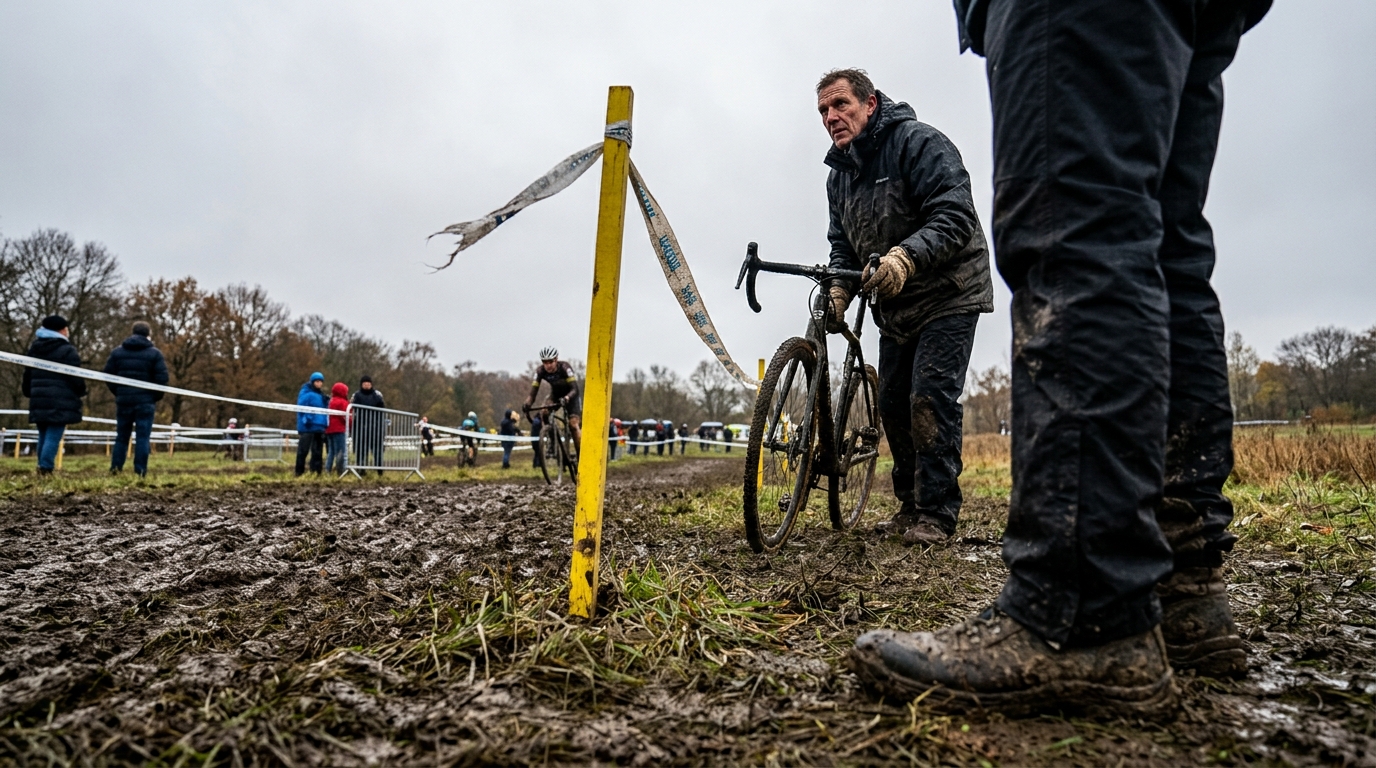
Image generated by our model.
race rules
Cycling Race Rules: Avoid Costly DQs and Relegations
Fitness can put you in position to win. Knowing the rules keeps the result. Here is how to avoid common sprint, course, feed, pit and protest mistakes.
Why Race Rules Matter Even When You Are Fit Enough
Fitness gets you into the selection. Race craft gets you to the final. But cycling race rules decide whether the result actually counts.
That is not a minor distinction. In amateur racing, the difference between a podium and a disqualification is often not raw power. It is a rider changing line in a sprint, missing a course marker, taking help from the wrong person, entering a pit incorrectly, or assuming that what was tolerated at one event will be tolerated at the next.
This is where strong riders get caught out. They treat the rulebook as admin instead of performance preparation. The problem is that rules shape tactics. If you do not know where you can feed, how the sprint lane will be judged, or what happens if you leave the marked course, you are making decisions under fatigue with incomplete information.
That is a bad place to improvise.
The goal is not to race timidly. The goal is to remove avoidable risk so your legs, positioning and decision-making decide the day. If you have done the work to lift your /glossary/ftp, build repeatability and arrive with form, losing the result to a preventable penalty is one of the lowest-return mistakes in the sport.
Start With the Rule Sources That Actually Govern Your Race
Cycling rules are not one universal document that applies the same way everywhere. Your national federation, local association, event technical guide and commissaire instructions can all matter. Sprint conduct, outside assistance, pit procedures, centerline restrictions and protest rules can differ materially by jurisdiction, discipline and event.
That means the useful question is not, 'What is the rule in bike racing?' The useful question is, 'What is the rule at this race, under this federation, as interpreted by these officials?'
Use this hierarchy before race day:
- Check your national federation rulebook for the discipline
- Check your local association rules if they add or modify procedures
- Read the event technical guide for race-specific instructions
- Listen to the commissaire or official briefing on-site
- Ask an official before the start if something is unclear
Do not outsource this to a teammate's memory from last season. A feed rule, pit process or protest deadline that was fine at one event may not protect you at the next.
Night-Before and On-Site Rules Checklist
Use this as a practical pre-race checklist, not a legal document. The point is to identify the decisions you do not want to make for the first time while cross-eyed in the last lap.
Night before
- Read the technical guide from start procedure through protest process
- Find the feed zone and confirm whether feeding is allowed in your race
- Find the litter zone and decide where wrappers and bottles will go
- If racing cyclocross, study pit entry, pit exit and helper locations
- Check centerline, lane, closed-road or restricted-area instructions
- Identify the protest location and protest deadline
- Note who handles disputes: chief commissaire, race director, results official or another named person
On site
- Confirm any rule changes at registration or the rider briefing
- Look at the feed zone, litter zone, pit and finish approach in person if possible
- Ask an official, not another rider, if a rule is unclear
- Tell feeders or helpers exactly where they are allowed to stand
- Make sure teammates understand any lead-out, pit or support constraints
- Save enough time after the finish to check results before the protest window closes
This is the low-friction work that prevents high-cost mistakes.
The Rules That Most Often Decide Amateur Race Results
The details vary by country, federation, discipline and event, but the same categories create problems again and again:
- Sprint deviations and dangerous riding
- Contact that affects another rider
- Course deviations, missed turns or riding outside barriers
- Taking feeds or mechanical help outside approved areas
- Littering
- Using equipment or support that is not allowed
- Ignoring marshal, official or commissaire instructions
- Failing to follow protest or appeal procedures correctly
The pattern is simple. Most penalties do not come from riders deliberately cheating. They come from riders making a fast decision in a messy situation, then discovering that intent is not the only thing that matters. Officials judge actions, consequences and the published rules.
That is especially true in sprints and technical courses. A rider may feel they were protecting position, following the natural bend of the road, or avoiding a hazard. If that move closes another rider into a barrier, forces them to brake, or changes the outcome, the official may see it differently.
The practical takeaway is that rules knowledge is part of race execution. You do not need to memorize every clause. You do need to know the failure points that are likely to appear in your event.
Sprint Lines, Deviations and Contact: What Is Actually Illegal
Cycling sprint rules are often misunderstood because riders talk about them in overly simple terms. The common shorthand is that you must hold your line. That is directionally useful, but incomplete.
What officials are usually concerned with is whether a rider made a movement that endangered another rider, obstructed them, or materially affected their sprint. A perfectly straight sprint can still be dangerous if a rider initiates contact unnecessarily. A sprint that follows the natural bend of the road may still be legal if the rider is not impeding anyone. The context matters.
The highest-risk move is the lateral jump after launching. This often happens when a rider starts behind another wheel, opens the sprint, then drifts toward the barriers or toward the fastest lane. Under fatigue, it can feel like acceleration pulled the bike across the road. To the rider behind, it looks like the door was closed.
The safer way to sprint is to make the tactical decision before the acceleration:
- Choose the side of the road you are willing to finish on
- Check whether you have overlap before moving
- Launch into space, not into a lane you hope will open
- If you are boxed, wait or brake rather than forcing contact
- Once opened up, keep the bike predictable
This is where sprint positioning matters as much as peak power. A clean sprint starts before the final acceleration. If you wait until the road is closing down, your choices become narrower and riskier.
Race-day scenario: sprint deviation
You launch from the right side of the road and feel faster riders coming up along the barriers. The road bends slightly, and your instinct is to drift toward the cleaner pavement near the edge.
The safer decision is to keep the bike predictable, even if the line is not perfect. If you move laterally and force the rider beside you to brake or stop sprinting, the official may see a deviation that affected the result. Your intent to follow the road or find speed may not matter as much as the consequence for the rider you impeded.
Contact is not automatically illegal. Racing is crowded, shoulders brush, and bars can come close. But there is a line between incidental contact and using the body or bike to move another rider. If the contact changes another rider's path or forces them to stop sprinting, you have created a problem even if you stayed upright.
This is why the best sprinters are rarely just powerful. They are predictable. Predictability allows riders around them to commit. Unpredictability forces others to brake, and braking inside a bunch sprint is exactly what officials are trying to prevent.
For lead-outs, the same logic applies. A rider finishing a pull cannot swing across the road without regard for what is coming. If your teammate is launching, your job is not finished until you have exited safely and without blocking the sprint. A lead-out that disrupts rivals can be penalized even if the protected rider did nothing obviously wrong.
For criteriums, the margin gets even smaller because repeated corners compress the field and make late movement more consequential. If you are building toward faster local racing, pair the rule knowledge here with criterium tactics, because the legal line and the tactically smart line are often the same thing.
Course Deviations, Barriers and Missed Turns: When It Becomes a DQ
Course mistakes are some of the most frustrating cycling disqualification rules because the rider often gains the advantage accidentally. That does not guarantee leniency.
A course is not just a suggestion. Tape, cones, barriers, flags, stakes, marshals and signs define the competition area. If you leave it and rejoin with an advantage, skip a section, avoid an obstacle, or bypass traffic, you have changed the race.
This comes up in road races when riders miss a turn, cross a centerline restriction, or use a closed lane. It comes up in criteriums when riders pass inside cones, cut a corner, or rejoin after a crash without following instructions. It comes up constantly in cyclocross, where cyclocross course rules make the tape and barriers part of the race design.
A common principle is that if you leave the marked course, you should rejoin where you left unless an official directs you otherwise. Treat that as a starting point, not a guaranteed safe harbor. Different disciplines and federations can handle course errors differently, and some situations cannot be repaired simply by giving back time.
If you cannot safely rejoin where you left, stop gaining advantage immediately and report what happened as soon as possible. Do not assume that losing time protects you. If you miss a turn and ride a different route, the official still has to decide whether you completed the prescribed course. In some cases, time loss may not solve the issue because the result is no longer comparable to riders who rode the correct route.
Race-day scenario: missed course marker
You are in a small group late in a road race. The rider ahead follows a vehicle through an intersection, and you realize a moment later that the course turned before that point. You are now off course with another rider on your wheel.
The worst response is to keep riding and hope the route reconnects. That can turn a small mistake into an unfixable course deviation. The cleaner response is to stop gaining advantage, return safely to the point where you left if possible, and notify an official or marshal as soon as you can. If an official gives a specific instruction, follow that instruction rather than relying on a generic rule of thumb.
Cyclocross deserves special attention because the course boundary is tactical. Riders are constantly choosing lines near tape, stakes and barriers. If tape is sagging or broken, that does not automatically mean the course has expanded. The safest assumption is that the intended line remains the intended line unless an official or marshal clearly changes it.
In a technical race, pre-riding is not just about cyclocross tire pressure and corner speed. It is about identifying where a mistake would become a rule problem:
- Ambiguous turns after fast sections
- Tape crossings near off-camber corners
- Pit entrances and exits
- Barriers that create forced dismounts
- Sections where riders may be tempted to cut inside course markings
A missed apex costs speed. A missed course marker can cost the result.
Feeds, Pits, Littering and Outside Assistance Rules
Outside assistance rules exist because support changes the race. A rider with unrestricted help from friends, teammates or spectators has an advantage over a rider who has to solve problems alone.
The exact restrictions depend on federation, discipline and event, but the practical categories are consistent.
Feeds are usually controlled by location, method and sometimes race conditions. If feeding is allowed, use the designated area and make the hand-up clean. Do not take a bottle from a random spectator unless the event rules allow it. Do not drift across the bunch to grab a feed without considering the riders behind you. A legal feed can still become dangerous riding if the execution is poor.
Good race-day nutrition only works if the delivery method is legal. The plan is not just what you eat and drink. It is where you collect it, who gives it to you, and what you do with the packaging.
Race-day scenario: illegal feed
You miss your planned bottle in the feed zone. A friend is standing after the zone and holds out a spare bottle. You are thirsty, the pace has eased, and it feels harmless because the feed was intended for you anyway.
The rule risk is that the location and person may matter more than your need for the bottle. If the technical guide restricts feeds to a defined zone, taking that bottle outside the zone can become illegal assistance. The better choice is to skip it, adjust your effort and take the next legal opportunity. A missed bottle is a performance problem. An illegal bottle can become a result problem.
Mechanical help has the same issue. In road racing, neutral service, team support or self-repair may be treated differently depending on the event. In cyclocross, the pit is a defined space with its own rules. Entering or exiting it incorrectly can be more consequential than the mechanical problem itself.
Pits are not shortcuts. The pit lane is part of the course system. If you enter, service, change equipment, or exit in a way that skips racing distance or interferes with other riders, you have created a rule issue. Before a cyclocross race, look at the pit from both race directions if the course uses it that way, identify the legal entry and exit, and understand where helpers are allowed to stand.
Race-day scenario: cyclocross pit error
You flat before the pit and panic because the group behind is closing. Instead of entering through the marked pit lane, you duck under tape near your helper, grab the spare bike, and exit ahead of where the pit rejoins the course.
Even if you lost time with the flat, that sequence can create multiple issues: improper pit entry, an illegal exchange location, and a pit exit that changes the distance raced. The better response is slower but cleaner. Enter through the legal pit entrance, make the exchange in the permitted area, exit where the course requires, then chase. In cyclocross, a messy pit can cost more than the mechanical.
Littering is another easy penalty to avoid. Gel wrappers, bottles and packaging should go where the rules allow. If the event provides a litter zone, use it. If it does not, keep the wrapper in your pocket or kit. The weight cost is irrelevant compared with the penalty risk and the basic responsibility of racing on someone else's roads, trails or venue.
Outside assistance can also be subtle. A push after a crash, an unauthorized wheel, pacing behind a vehicle, or receiving tactical help in a restricted way can all become problems. The clean rule of thumb is this: if the support is not clearly allowed, assume it is not allowed until you verify it with the relevant rule source or an official.
How to Read the Technical Guide Before Race Day
The technical guide is not just paperwork. It is the race plan written from the organizer's point of view. Read it like a competitor, not like someone checking a box.
Start with the rules that affect decisions under fatigue:
- Start procedure and staging
- Course map and laps
- Neutral sections or controlled zones
- Feed zones and litter zones
- Pit rules, if applicable
- Centerline, lane or road restrictions
- Equipment restrictions
- Cut-off rules
- Protest process
- Penalty schedule, if provided
Then translate those rules into actions. If the guide says feeds are in a specific area, decide who is feeding you, what side they will stand on, and what you will do if the hand-up fails. If the course has a restricted lane, identify where the temptation to cross it will be highest. If the finish has barriers, look at the final approach and decide where you can sprint without needing a late lane change.
This is where technical skills and rules knowledge overlap. The rider who can corner, move through a field and handle contact still needs to know which lines are legal. Skill expands your options, but the rulebook defines which options count.
The technical guide also tells you what not to waste mental energy on. If you know the pit process, you do not panic after a mechanical. If you know the protest process, you do not argue at the finish line when you should be gathering information. If you know the course restrictions, you can race aggressively without constantly wondering where the limit is.
This is especially important for riders moving between disciplines. Road instincts do not always map cleanly to cyclocross. Criterium habits do not always fit a road race with centerline enforcement. Gravel and fondo experience can be useful, but sanctioned racing often has a tighter interpretation of assistance, course boundaries and equipment.
What to Do After a Penalty, Protest or Result Dispute
If you receive a penalty or believe the result is wrong, your first job is to stay useful. Emotional arguments rarely improve your position, and they can make it harder for officials to separate facts from frustration.
Handle it in order.
First, find the posted result, penalty notice or official decision. Make sure you understand what is being alleged. A relegation for sprint deviation, a time penalty for course error and a disqualification for outside assistance are different problems with different evidence.
Second, gather specific information. Who was involved? Where did it happen? Were there officials, marshals, video, timing data or witnesses? General statements like 'everyone saw it' do not help as much as a clear account from someone with a useful viewing angle.
Third, follow the published protest process. Most events require disputes to go through a specific person, place and procedure. If there is a deadline, respect it. Do not assume that a social media post, team group chat or argument near the podium counts as a protest.
Fourth, separate two questions: did the incident happen, and what should the consequence be? You may disagree with the penalty severity while acknowledging the action. Or you may believe the official identified the wrong rider. Clarity matters.
Race-day scenario: protest
You finish a criterium and see yourself listed behind a rider you believe was already out of contention after a course error. Riders around you are angry, and the easy move is to argue near the podium or post a clip online.
That is usually wasted energy. The better sequence is to check the posted results, find the protest location listed in the technical guide, confirm the deadline, gather the clearest available evidence, and speak to the designated official. If you miss the process, you may be right on the facts and still lose the chance to have the result reviewed.
Finally, use the dispute as feedback. If you were relegated for a sprint movement, watch the video if available and ask whether your line was predictable from the perspective of the rider behind. If you were penalized for a course issue, ask whether you had actually studied the problem area. If you were warned for assistance, tighten your pre-race plan.
The best outcome is keeping the result. The next-best outcome is never making the same mistake again.
Final Race-Day Rules Checklist
Before you pin numbers and roll to staging, make sure you can answer these questions:
- What rulebook and local rules govern the race?
- Did the technical guide add any race-specific restrictions?
- Where are the feed zone and litter zone?
- Who is feeding you, and are they standing in a legal place?
- If racing cyclocross, where are the legal pit entry and exit?
- Are there centerline, lane or restricted-area rules?
- What does the finish approach look like, and where can you sprint without a late deviation?
- What should you do if you miss a turn or leave the course?
- Where are results posted?
- Where do protests go, who handles them, and what is the deadline?
- Who will you ask if something is unclear before the start?
If you cannot answer one of those, fix it before the race begins. The cost is a few minutes. The upside is protecting the result you are trying to earn.
The Practical Rule: Race Hard, Remove Ambiguity
Good racing lives close to the limit. You cannot contest sprints, fight for position or ride technical courses while leaving a comfort buffer everywhere. But there is a difference between assertive racing and ambiguous racing.
Ambiguity is what gets riders in trouble. A late drift in a sprint. A half-legal line through course tape. A bottle from someone outside the feed zone. A pit exit that saves ground. A protest made after the process has moved on.
The solution is not to race passively. It is to make the legal version of the move the default version of the move.
Hold a predictable sprint line. Treat rejoining where you left the course as a common principle, while following any official instruction that overrides it. Take assistance only where it is allowed. Read the technical guide before your warm-up, not after the result is posted. When something goes wrong, communicate through the official process.
That is not just rule compliance. It is performance hygiene. The rider who understands the constraints can make cleaner decisions under pressure, spend less attention on uncertainty, and keep the result their fitness earned.